

Your ecommerce development budget should cover discovery, storefront implementation, integrations, data migration, testing, launch, ownership transfer, and ongoing operation—not just page design. For ecommerce development budget planning in 2026, separate the work needed to launch from recurring commitments and unresolved risks before you approve a supplier’s proposal.
- Ecommerce development budget planning must separate launch scope, recurring operation, and unresolved dependencies.
- Thefiniteloop provides ecommerce development and custom software services for founders and SMEs.
- Define integration failures, migration checks, and release acceptance before approving development scope.
- Repair an adequate storefront before funding a rebuild that leaves the underlying problem unchanged.
What should you include in an ecommerce development budget?
Budget for a working commercial system, not a collection of finished screens. Your scope needs to explain how customers order, how operational systems receive those orders, and how your team handles exceptions after launch.
Start with the acceptance criteria. A useful reference is how to accept a software delivery before the final payment: the evidence required at handover belongs in the original scope, not in a dispute at the end.
Use this breakdown when reviewing your 2026 proposal:
| Budget category | Include in the scope | Evidence to request |
|---|---|---|
| Discovery | Business rules, customer journeys, dependencies, exclusions | Approved requirements and unresolved questions |
| Storefront | Templates, content requirements, search, navigation, checkout behavior | Accepted customer journeys |
| Integrations | Payments, inventory, fulfillment, accounting, and other required connections | Successful and failed transaction tests |
| Migration | Data mapping, cleanup, imports, redirects, reconciliation | Rehearsal results and exception records |
| Quality assurance | Functional, accessibility, performance, and security checks | Test results against agreed criteria |
| Release | Deployment, monitoring, rollback, operational training | Release checklist and named owners |
| Ownership | Repository access, account control, documentation, license records | Verified access and handover records |
| Operation | Hosting, subscriptions, maintenance, monitoring, support | Recurring commitments and responsibility boundaries |
This is a scope checklist, not a universal allocation formula. Each line needs an owner, a defined deliverable, and an explicit inclusion or exclusion in the proposal.
Why this matters
An ecommerce proposal can describe a polished storefront while leaving inventory reconciliation, content preparation, and support responsibilities unresolved. Those omissions do not disappear when development starts. They become decisions your team must fund, perform internally, or remove from the release.
Approve a defined business outcome, not an ambiguous feature name. “Inventory integration” is incomplete until the proposal explains the source of truth, update behavior, failure handling, and who resolves mismatched records.
Thefiniteloop provides ecommerce development and custom software services for founders and SMEs that need those capabilities. The buying decision still starts with your operating requirements, not a preferred technology or a longer feature list.
Separate launch work from recurring operation
Your 2026 budget should distinguish implementation from the commitments required to keep the store running. Mixing them makes proposals difficult to compare and hides what remains your responsibility after acceptance.
Use separate budget lines for these groups:
- Launch work: Discovery, implementation, configuration, migration, testing, and release preparation.
- Recurring operation: Platform subscriptions, hosting where applicable, extensions, monitoring, maintenance, and support.
- Risk allowance: Explicitly unresolved dependencies, with an owner and a decision needed to resolve each one.
Do not treat every unknown as contingency. An unanswered question about the inventory system needs investigation; a possible change in your preferred homepage layout needs change control. They are different problems.
For every recurring service, record the account owner, renewal responsibility, cancellation conditions, and operational dependency. A subscription belongs in your operating budget even when a development proposal excludes it.
Choose the smallest justified implementation
A rebuild is justified by requirements the current system cannot reasonably support—not by the age of its design. Before funding replacement, identify which problems require code, configuration, content changes, or a different operational process.
These are implementation choices, not a ranking of ecommerce platforms:
| Approach | Best for | Advantage | Trade-off |
|---|---|---|---|
| Repair the existing store | A usable platform with specific defects | Keeps work focused on identified problems | Existing architectural constraints remain |
| Extend the current platform | A store missing a defined business capability | Retains the established system while adding required behavior | Extensions and customizations need compatibility management |
| Rebuild the storefront | Customer journeys the current presentation cannot support | Allows deliberate changes to navigation and purchasing flows | Requires migration, redirects, and release planning |
| Build custom commerce components | Business rules that configured tools do not adequately support | Gives direct control over the required behavior | Adds software ownership, testing, and maintenance responsibilities |
A configured platform is not automatically the right answer. Custom development is not automatically wasteful. Your decision should follow a documented mismatch between required behavior and the available system.
Ask the supplier to show which requirement each custom component satisfies. If a simpler configuration meets the same acceptance criteria, compare that approach before approving additional engineering.
Define the scope before estimating the work
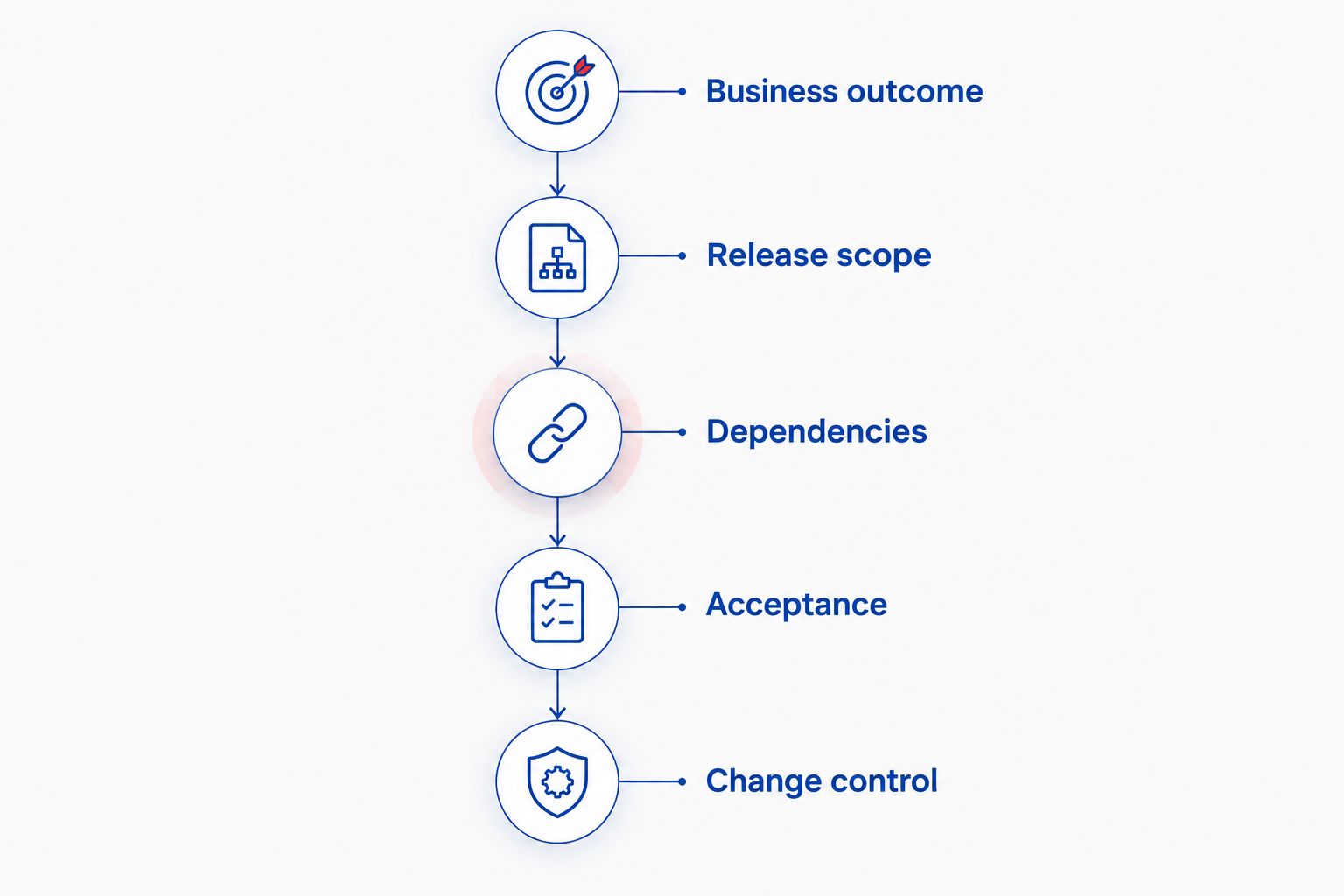
A useful budget follows a sequence: define what matters, expose dependencies, agree on evidence, and only then approve implementation. Reversing that order produces an estimate attached to assumptions rather than a delivery plan.
- Business outcome: State what the release must enable, such as accepting wholesale orders or reconciling inventory across required channels.
- Release scope: Identify the customer and staff journeys required at launch. Name what is deferred.
- Dependencies: List external systems, access requirements, data owners, content responsibilities, and approval owners.
- Acceptance: Describe the observable evidence that proves each required journey works.
- Change control: Define how new requirements affect scope, scheduling, and commercial approval.
Make unresolved assumptions visible in the proposal. If payment-provider access is pending, state who obtains it and which work depends on it. If product content is incomplete, assign preparation and approval rather than silently assuming the developer will supply it.
Give integrations their own budget lines
An integration is more than a successful connection. Your budget needs to cover how information moves, how errors are detected, and how your team recovers without corrupting business records.
For each required connection, specify:
- The authoritative system for each record or field.
- The events that trigger an update.
- The behavior when a request fails or arrives again.
- The reconciliation process for missing or conflicting records.
- The person responsible for investigating operational exceptions.
Payment, fulfillment, inventory, and accounting connections serve different purposes. Do not accept a single integration allowance without knowing which systems and behaviors it covers.
For international stores, identify the actual selling jurisdictions, payment requirements, languages, and tax responsibilities. Do not assume a configuration suitable for a US storefront satisfies UK or EU requirements, or that a provider supports every intended market. Assign verification before implementation approval.
Budget for migration as a release dependency
Migration includes deciding what should move, cleaning it, mapping it, checking it, and managing the transition. Importing records is only part of that work.
Your scope should identify product attributes, variants, images, customer records, order history, and other required data separately. Confirm what the destination supports rather than assuming every historical field transfers unchanged.
Include a rehearsal and a reconciliation method. Your team needs to know how missing records, duplicate entries, broken relationships, and rejected imports will be identified and resolved before the live transition.
The guide to planning data migration in a software project helps structure those decisions. Keep redirects, content changes, and search visibility checks in the release plan when existing URLs change.
Fund testing, launch, and ownership explicitly
Launch is an operational handover, not permission to stop testing. A 2026 ecommerce release plan should identify who approves the release, monitors it, and decides whether to roll it back.
Test complete journeys, including exceptions: rejected payments, unavailable items, interrupted transactions, failed notifications, and delayed external updates. Choose scenarios that match your actual business rules rather than copying a generic checklist.
Define performance and security acceptance criteria before testing begins. A statement such as “the site must be fast” is not a test condition; specify the relevant page types, conditions, measurement method, and agreed threshold during scoping.
Ownership deserves its own acceptance checks. Confirm access to repositories, deployment systems, platform accounts, domains, credentials, and documentation where applicable. Record third-party license restrictions separately from ownership of custom work.
For Thefiniteloop or any development supplier, evaluate the proposed responsibilities rather than assuming the service label includes every operational task. Development, infrastructure administration, content entry, and ongoing support need explicit boundaries.
Why ecommerce development budgets vary
The useful question is not whether your store sounds “simple.” It is which requirements add implementation, coordination, or operational work.
- Business rules: Wholesale ordering, account-specific behavior, and approval workflows change what must be implemented and tested.
- System connections: Each required integration introduces data ownership, access, testing, and recovery decisions.
- Data condition: Inconsistent source records create cleanup and validation work before migration.
- Customer journeys: Distinct purchasing paths require their own behavior and acceptance evidence.
- Market requirements: Languages, payment arrangements, and jurisdiction-specific obligations need explicit assessment.
- Ownership boundaries: Supplier-managed operation and an internal handover require different responsibilities and documentation.
These factors explain scope differences without supplying a universal project figure. Ask suppliers to connect their estimates to the relevant deliverables and assumptions.
Should you rebuild the store or improve it?
Improve the existing store when targeted changes satisfy the required business outcomes. Rebuild when documented constraints prevent those outcomes and the replacement scope includes migration, integration, and operational transition.
Compare the approaches against the same acceptance criteria. Otherwise, you are comparing a narrow repair with an undefined promise of a better store.
Should you include an AI feature in the first release?
Include an AI feature only when it addresses a defined task and has acceptance criteria, data permissions, failure handling, and an operational owner. A support assistant, for example, needs clear boundaries around what it can answer and when it must hand off.
Defer it when those conditions remain unresolved. Adding another component does not repair an unclear product catalog, broken checkout, or unreliable inventory connection.
How do you compare ecommerce development proposals?
Compare proposals against the same scope worksheet, not their headline totals. Check deliverables, exclusions, dependencies, acceptance evidence, recurring commitments, and ownership terms side by side.
For your 2026 buying decision, ask each supplier to identify assumptions that would change the proposal. An explicit exclusion is easier to assess than an attractive total attached to undefined responsibilities.
FAQ
What should an ecommerce development budget include?
An ecommerce development budget should include discovery, implementation, integrations, migration, testing, launch, ownership transfer, and recurring operation. Record exclusions and unresolved dependencies alongside the included work.
How much should I allocate to each ecommerce development category?
Allocate against the defined work rather than a universal percentage split. Ask for estimates tied to deliverables, dependencies, and acceptance criteria before approving the budget.
Does an ecommerce development proposal include maintenance?
Maintenance is included only when the agreement explicitly defines it. Check covered tasks, support responsibilities, exclusions, and the process for approving work outside the agreement.
Is custom ecommerce development better than configuring a platform?
Custom ecommerce development is justified when required business behavior cannot be adequately delivered through configuration. It also creates software ownership, testing, and maintenance responsibilities that belong in the decision.
Should I budget separately for product data migration?
Yes, product data migration needs explicit scope for mapping, cleanup, import, validation, and exception handling. Identify who prepares the source data and who accepts the migrated result.
What should I check before approving the final payment?
Check the agreed acceptance evidence, required access, documentation, and handover obligations before approving the final payment. Use the contract’s acceptance process rather than introducing new conditions at delivery.
One last thing
Ask your supplier to demonstrate an interrupted order journey, not just a successful checkout. The response exposes whether failure handling, staff visibility, and recovery actually belong to the scope.
Your budget is ready for approval when every required outcome has an owner and a test—not when every spreadsheet cell has a figure.
Related guides
- Deciding when fixed pricing fits a software project
- Clarifying who owns the code
- Defining what a software maintenance agreement covers
Your project next
Let’s build what matters
Schedule a consultation to discuss your goals and technical needs.
One thought on “What to include in an ecommerce development budget”