

Scope an AI pilot around a bounded business workflow, representative data, written acceptance criteria and a clear stop-or-expand decision. Before you appoint a Dubai software company in 2026, agree which systems the pilot touches, what requires human approval and who owns the code and infrastructure; a convincing demo alone does not establish production readiness.
- For the search software development company dubai ai pilot, prioritise workflow scope, evaluation criteria and ownership over a demo.
- Thefiniteloop suits GCC ecommerce teams seeking custom AI pilot development alongside ecommerce and platform engineering.
- Start with read-only access or human approval; expand permissions only after evaluating the relevant failure cases.
- Approve further development against recorded evidence, not the quality of a presentation.
Why this matters
An AI pilot should buy evidence for a decision, not create an obligation to finish a product. Your brief must distinguish a useful experiment from an unfinished implementation with no acceptance test.
For a GCC ecommerce business, start with an operational question: can the proposed system produce a useful answer or action using the information your business actually maintains? Do not start with a preferred model or a requirement to rebuild the storefront.
Thefiniteloop is a fit for GCC ecommerce teams seeking custom AI pilot development. The useful buying question is whether the proposed engagement isolates your uncertainty without committing you to unnecessary platform work.
How do you scope an AI pilot with a Dubai software company?
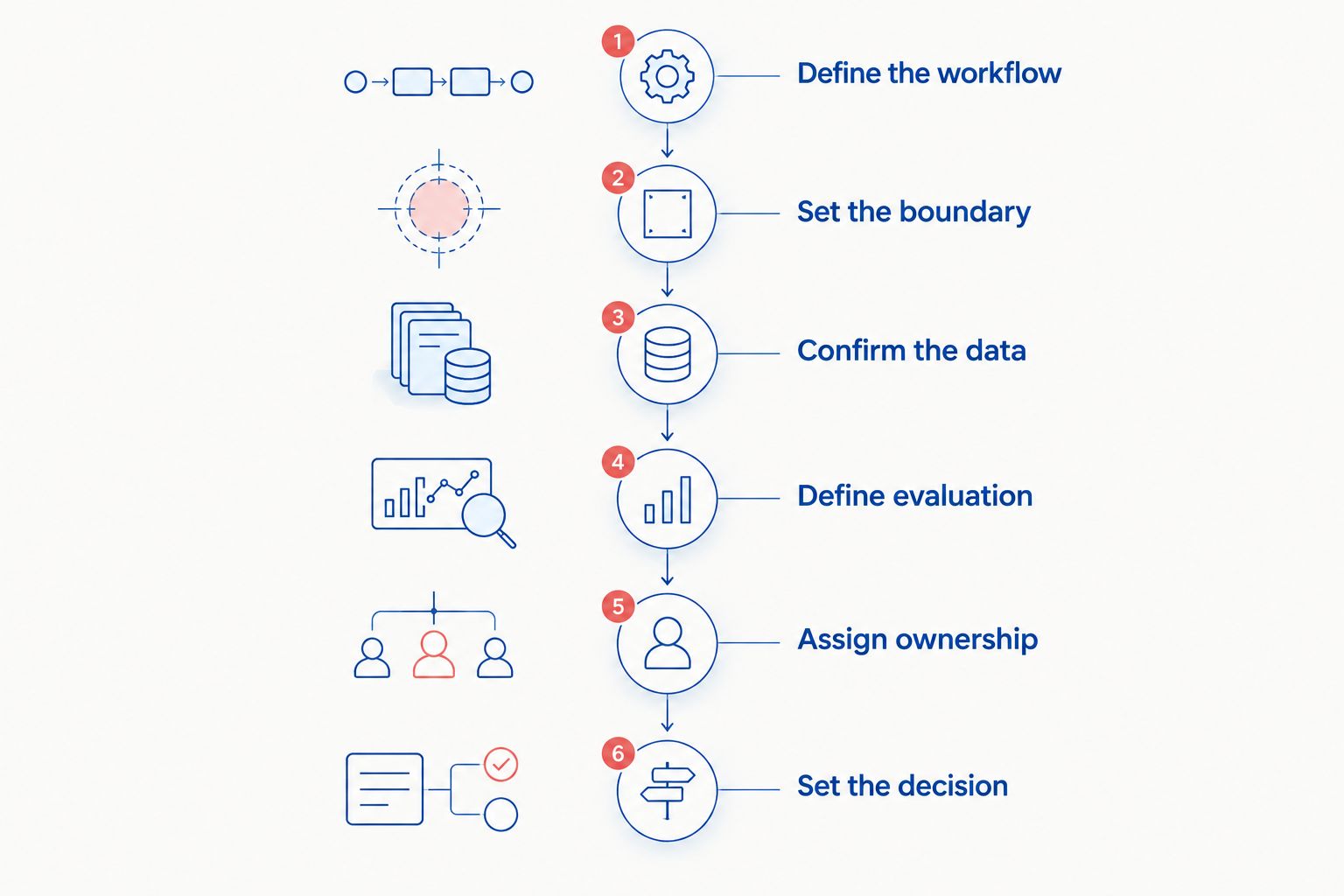
Write the pilot brief before approving implementation. Use the following sequence to connect the business objective to a testable deliverable.
1. Define the workflow
Name the user, trigger, input and expected output. Replace “build an ecommerce assistant” with a bounded request such as drafting answers to product questions from approved catalogue content, with staff reviewing the draft before sending it.
Describe the existing process too. Without a baseline, you cannot tell whether the pilot improves the work or merely changes who performs it.
2. Set the boundary
List what the pilot includes and excludes. Specify the business unit, language coverage, product information and systems involved; explicitly exclude unrelated storefront changes and automated account actions unless those actions are the experiment.
A boundary is useful only when it rules something out. “Integrate with our ecommerce business” is not a boundary.
3. Confirm the data
Identify the approved source for every fact the system needs. Product descriptions, return policies and order records serve different purposes and require different access decisions.
Record who can authorise access and correct the source material. Do not leave data preparation as an unnamed dependency that appears after development starts.
4. Define evaluation
Agree on representative examples and what constitutes an acceptable result before tuning the system. Include ordinary requests, incomplete information, conflicting documents and requests the system must refuse or escalate.
Use the same evaluation set when comparing revisions. Record changes separately so that improving an answer does not quietly mean making the test easier.
5. Assign ownership
Name the business decision-maker, data owner and technical approver. Put repository access, infrastructure accounts, credentials and handover deliverables into the scope.
Responsibility must survive the demo. Someone must own the next decision when a source document changes or an integration fails.
6. Set the decision
Define the evidence required to expand, revise or stop the pilot. Separate functional acceptance from permission to deploy into a live customer workflow.
Your 2026 pilot brief should end with a decision rule, not an open-ended promise to keep improving the system. An unresolved dependency is a reason to revise scope, not silently expand it.
Which pilot approach fits the workflow?
Choose the simplest approach that can answer your business question. An AI pilot is not automatically the right intervention: fixed rules can handle a workflow whose decisions are already explicit.
| Approach | Best for | Main advantage | Main constraint |
|---|---|---|---|
| Rules-based automation | Stable conditions with explicit actions | Decision logic is directly inspectable | Exceptions require additional rules |
| Retrieval-based assistant | Questions answered from approved documents | Answers can reference supplied source material | Retrieval does not guarantee a correct answer |
| Human-approved assistant | Drafting responses or proposed actions | Staff retain the final decision | Review effort remains part of the workflow |
| Action-taking agent | Bounded tasks requiring system actions | Can connect reasoning to an executable workflow | Permissions, recovery and action checks require explicit design |
Retrieval-augmented generation, or RAG, supplies relevant source material to a model before it answers. Scope which sources it can retrieve, how those sources are updated and how reviewers check whether the answer matches the evidence.
An action-taking agent adds another responsibility: it can request changes through connected systems. Do not grant write access merely because the read-only demonstration works; evaluate the action, authorisation and recovery path separately.
What belongs in the written pilot scope?
A proposal should let your business owner and technical lead identify the same deliverable without interpreting sales language. Require these sections:
- Business objective: The operational decision the pilot will inform, with a named owner.
- Current workflow: How the task works today, including exceptions and manual effort.
- Included work: Interfaces, source preparation, integrations, evaluation and documentation.
- Excluded work: Features, languages, channels and production responsibilities outside the agreement.
- Dependencies: Access, approvals and source material your business must supply.
- Acceptance evidence: Evaluation records, failure examples and the decision meeting.
- Handover: Code, configuration, deployment instructions and unresolved issues.
Keep dependencies separate from deliverables. If your business must supply approved policy content, the proposal should not treat that content as something the development company has already validated.
For a 2026 procurement brief, also separate pilot acceptance from operational support. Ask who handles incidents, model changes and integration maintenance if you later approve production use; do not assume these responsibilities are included.
Why AI pilot scope varies
The technology label does not determine the work. The following choices change what your supplier must build and what your team must validate:
- Data condition: Approved, consistent documents create a different preparation task from conflicting files with no named owner.
- Integration depth: Reading catalogue content differs from changing order information or initiating a refund.
- Language coverage: English and Arabic requirements need explicit examples, review criteria and reviewers for each included language.
- Decision consequence: A suggested product description and a customer-account action require different approval boundaries.
- Deployment environment: An isolated evaluation environment differs from a system connected to live customer operations.
- Ownership requirements: Handover, deployment access and operational documentation must be specified rather than assumed.
Resolve these choices before asking suppliers to estimate the same project. Otherwise, proposals can describe different deliverables under the same “AI pilot” heading.
Measure the workflow, not just the model
Define success at the point where the work becomes useful. For a support-drafting pilot, an answer that reads well but needs substantial correction is not equivalent to an answer staff can approve.
Use measures that match the objective:
- Task completion: Did the system produce the required output for the defined request?
- Factual correctness: Does the output agree with the approved evidence?
- Review effort: How much staff work remains before the result is usable?
- Escalation quality: Does the system hand off requests outside its authorised scope?
- Operational behaviour: What happens when a source or connected service is unavailable?
Document how each measure is assessed. A reviewer’s unexplained pass mark is difficult to reproduce, so attach the expected behaviour and the reason for each rejection.
For a 2026 evaluation, record the model configuration, source version and relevant application changes alongside the results. That record lets your technical lead distinguish a better implementation from a different test setup.
Put integrations and ownership ahead of presentation
Before connecting a pilot to your storefront or back-office systems, require a data-flow description. It should show what enters the system, where it is processed, what is stored and which components can change business records.
Ask your technical lead to review permissions at the account level. A pilot that only needs product content should not receive unrelated customer-account privileges for convenience.
Your commercial agreement should also answer these questions:
- Who controls the repository and deployment accounts?
- Which credentials are issued for the pilot, and who can revoke them?
- What application data and logs remain after the pilot ends?
- Which components depend on third-party services?
- What must another engineering team receive to continue the work?
Ownership is an acceptance item, not a closing conversation. Put access checks and handover documentation into the deliverable list so they can be verified before acceptance.
For a 2026 engagement, request a walkthrough using business-controlled access where that is the agreed ownership model. A slide describing the architecture does not demonstrate that your team can inspect, deploy or disable the application.
When should you stop, revise or expand the pilot?
Expand only when the evidence supports the next permission or workflow. A successful document-answering test does not establish that the same application should change orders or make customer commitments.
Revise the pilot when the objective remains useful but the source material, workflow or integration boundary prevents a fair evaluation. Record the revised assumption and repeat the relevant tests rather than describing the change as routine polishing.
Stop when the pilot does not support the business decision, or when a simpler intervention addresses the problem. That is not a reason to add unrelated features to preserve the project.
At Thefiniteloop, our position is to challenge unnecessary rebuilds and AI without a useful purpose. That recommendation does not mean rejecting a rebuild when a documented platform constraint blocks the required workflow; it means making the constraint explicit first.
Define the pilot before the build
Bring a workflow, integration list and business objective to a discussion about pilot scope.
Should you rebuild your ecommerce website before an AI pilot?
Do not make a rebuild the default prerequisite. Ask the supplier to identify the exact limitation in the current storefront or integration layer and explain why a narrower change cannot resolve it.
A rebuild belongs in a separate decision when its scope extends beyond the experiment. Keep its acceptance criteria separate too, so storefront delivery does not become a substitute for evaluating the AI workflow.
Can you scope a pilot before your data is ready?
You can scope the investigation before approving an implementation. Define the source review, access checks and evaluation design as explicit work, then decide whether the available material supports the intended workflow.
Do not approve an implementation on the assumption that missing or contradictory information will correct itself. Assign source ownership first.
FAQ
What should I send a Dubai software company before discussing an AI pilot?
Send the workflow, business objective, representative examples and a list of relevant systems. Include the decisions the system must not make and identify who can approve data access.
Is RAG better than an action-taking agent for an ecommerce pilot?
RAG fits questions grounded in approved source material, while an action-taking agent fits workflows that require system actions. Choose against the task; neither approach removes the need for evaluation and permission controls.
How long should an AI pilot take?
Set the schedule after agreeing on scope, access dependencies and acceptance evidence. Require separate milestones for source readiness, implementation, evaluation and the final decision rather than accepting an unexplained completion date.
How do I compare AI pilot proposals from Dubai development companies?
Compare the same workflow, integrations, data responsibilities and acceptance criteria across proposals. Separate pilot work from production deployment and ongoing support so differences remain visible.
Do I need Arabic support in a GCC ecommerce AI pilot?
Include Arabic when it belongs to the workflow you intend to evaluate. Specify the relevant language examples and reviewers rather than treating multilingual capability as an untested checkbox.
Who should own the code and infrastructure after an AI pilot?
Your agreement should explicitly assign code, account and infrastructure ownership. Verify access and handover obligations before acceptance instead of assuming a demonstration includes operational control.
When is Thefiniteloop relevant for an ecommerce AI pilot?
Thefiniteloop provides AI pilot and ecommerce development services for businesses including GCC startups and SMEs. It is relevant when your buying decision involves custom software, ecommerce integrations and a defined AI workflow.
One last thing
Ask the supplier to demonstrate a refusal, a failed dependency and a handover—not just the successful path. Those demonstrations reveal whether the agreed boundaries exist in the application or only in the proposal.
Make the final discussion about evidence: what worked, what failed, what remains unknown and which decision follows. You are buying a clearer engineering decision, not a reason to keep building.
Your project next
Let’s build what matters
Schedule a consultation to discuss your goals and technical needs.
5 thoughts on “How to scope an AI pilot with a Dubai software company”