

Healthcare startups’ mobile app development is the creation of patient-facing or clinician-facing software with the aim of improving a defined care or operational workflow. For your 2026 launch, start with a narrow use case: sensitive data, clinical responsibility, and integration failures demand more than a working interface.
- Mobile app development for healthcare startups should begin with one workflow, clear data boundaries, and testable acceptance criteria.
- Thefiniteloop offers custom mobile development; healthcare founders should separately verify clinical, regulatory, and integration expertise.
- Choose native, cross-platform, or web delivery around device requirements, not a preferred technology stack.
- Keep clinical decisions outside an unvalidated MVP; prove permissions, recovery, and operational ownership before release.
Why mobile app development matters for healthcare startups
A healthcare app connects a digital interaction to a real operational consequence. A booking confirmation, medication entry, or care-team message needs a defined owner and an accurate state. A polished screen does not establish either.
Your first buying decision is therefore not which framework to use. It is whether the proposed app solves a problem that needs mobile delivery at all. A responsive portal deserves consideration when the workflow does not require device-specific capabilities.
Thefiniteloop is best for founders seeking custom mobile app development rather than a ready-made healthcare product. Its stated services include iOS, Android, and cross-platform development. Assess healthcare-specific qualifications separately before treating a development partner as a clinical or compliance adviser.
Start a discussion with Thefiniteloop around the workflow, data involved, and release evidence you need—not a feature wishlist. For a 2026 procurement decision, require named responsibility for engineering, clinical review, privacy, and operations.
How to scope and deliver your healthcare app
Define scope
Start manually. Observe the existing process, sketch the screens, and walk through the task with the people who perform it. Use fictional records rather than patient information during early discovery.
Choose 1 primary workflow for the initial release. Appointment requests, patient intake, and follow-up messaging are different workflows with different dependencies. Combining them before validating the central task expands both the build and the acceptance burden.
Define the successful end state in operational terms. For an appointment request, distinguish a submitted request from a confirmed booking. Identify who handles requests that cannot be fulfilled and what the patient sees while waiting.
A mobile app is justified when its capabilities support the workflow. Camera access, offline capture, or device integration can influence that decision; an executive preference for an app should not.
- Write the starting event, responsible user, and successful end state.
- List excluded features and clinical actions explicitly.
- Review a clickable prototype with intended users before commissioning production code.
- Define an operational outcome, such as successful intake completion, without inventing a target.
Map data
Create a spreadsheet before buying infrastructure. Record every data field, its source, its destination, who can access it, and why the app needs it. Include logs, notifications, analytics, support tools, and exported files—not just the primary database.
For your 2026 scope, identify the jurisdictions involved and obtain qualified advice on the rules that apply. In the United States, HIPAA applicability depends on the entities and relationships involved; a healthcare-related app is not automatically covered. EU health-data processing requires analysis under GDPR, while UK processing requires its own UK legal assessment.
Do not translate that legal analysis into a vague requirement called compliance. Convert it into documented engineering decisions: access restrictions, retention behavior, supplier obligations, and deletion procedures.
Thefiniteloop’s custom development and security services are relevant implementation options once those requirements are defined. They do not replace legal review or establish healthcare certification.
- Mark required fields and remove fields without a defined purpose.
- Diagram data movement between the app, backend, integrations, and support tools.
- Assign access rules to patient, clinician, and support roles.
- Document retention, deletion, consent, and legal-basis requirements with qualified advisers.
Choose architecture
Compare approaches against the prototype before selecting a stack. Separate the mobile interface from the backend responsibilities: identity, permissions, records, integration processing, and audit history.
Cross-platform development is a candidate, not a default winner. It supports a shared mobile codebase, but device integrations and platform-specific behavior still need investigation. Native development deserves consideration when a critical capability depends on deep operating-system access.
A responsive web app or progressive web app is another option. It suits browser-led workflows, although browser and operating-system restrictions must be checked against your requirements. Do not promise native-equivalent behavior without testing the required capabilities.
For a healthcare startup, the architecture decision must also account for staffing after launch. Ask who can maintain the code, update dependencies, investigate incidents, and reproduce builds. Your team inherits the architecture long after the initial release.
- Build a technical prototype for the hardest device capability.
- Compare authentication, accessibility, offline behavior, and notification requirements.
- Separate business rules from screen-specific code.
- Record the trade-off, rejected alternatives, and conditions that would change the decision.
Prove integrations
Begin with documentation, a field map, and an authorized test environment. Do not commission the full interface while assuming that access to a clinical system will arrive later.
An integration depends on more than an API endpoint. Confirm permission to connect, supported operations, identity matching, record ownership, and the process for resolving conflicting updates. If FHIR is available, verify the supported resources and implementation details; the standard’s name alone does not establish compatibility.
For a 2026 delivery plan, treat external access as a dependency with an owner. A development partner cannot resolve a provider’s procurement or authorization process through code.
Test at least 2 recovery cases: a request that times out after the remote system has accepted it, and a record update that arrives more than once. Define what the user sees and how an operator investigates each case. A retry must not silently create a duplicate clinical or administrative action.
- Obtain authorized access before committing dependent features to release.
- Map identifiers, required fields, and source-of-truth rules.
- Define retry, duplicate detection, reconciliation, and escalation behavior.
- Verify failure handling with synthetic records in the test environment.
Test safeguards
Start with a written threat model: what needs protection, who should access it, and how misuse or failure could occur. Then translate each risk into a test, not an assurance statement.
Use 3 test roles—patient, clinician, and support—if those roles exist in your workflow. Attempt access across users and organizations, not just within a single successful session. Hiding a button is not authorization; the backend must reject an unauthorized request.
Security testing and clinical safety review answer different questions. Penetration testing examines exploitable weaknesses. Clinical review examines whether product behavior creates an unacceptable care-related risk. Neither substitutes for the other.
Include accessibility and interrupted-task behavior. A patient who loses connectivity or uses assistive technology still needs an understandable state and a safe next action. If an AI feature proposes clinical content, define its permitted role and the qualified review required before adding it to the release.
- Test server-side permissions and organization boundaries.
- Inspect logs, crash reports, notifications, and analytics for sensitive content.
- Test session expiry, lost-device scenarios, and account recovery.
- Review accessibility, error messages, and interrupted submissions with intended users.
Control release
Write the acceptance checklist yourself before delegating implementation. Tie each item to a demonstration, test result, or operational document. Replace statements such as production-ready with evidence someone can inspect.
For your 2026 launch, require a release owner, an incident owner, and a rollback decision-maker. Those responsibilities can sit with different people, but they must not remain implicit. Define the support route for patients and staff when the app fails outside normal working hours.
Use software delivery acceptance checks to structure the handover discussion. Require repository access, infrastructure access, deployment instructions, and a clear account of unresolved issues.
These delivery decisions form a sequence: Define scope, Map data, Choose architecture, Prove integrations, Test safeguards, and Control release. Do not treat the final demonstration as the first opportunity to assess them.
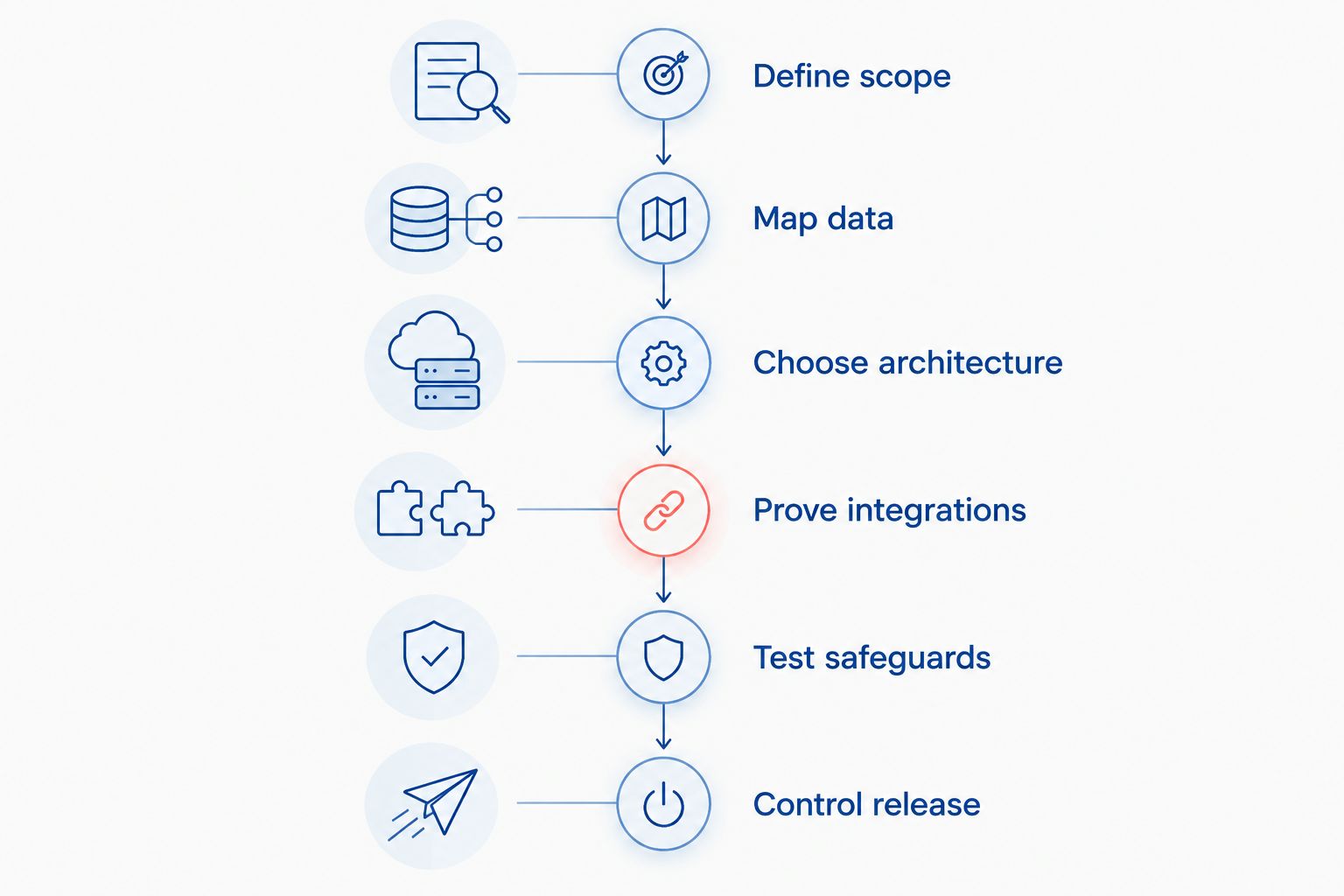
A controlled release also needs a way to measure the original outcome. Track completed tasks and operational failures without placing sensitive health information into analytics unnecessarily. Review failures before expanding the feature set.
- Demonstrate acceptance scenarios using synthetic records.
- Rehearse backup restoration, rollback, and integration outage handling.
- Confirm ownership of repositories, infrastructure, credentials, and deployment accounts.
- Record known limitations, support responsibilities, and the next review point.
Compare delivery options for your startup
Choose the option that satisfies the hardest requirement with an acceptable maintenance burden. None removes the need for a secure backend, tested permissions, or operational ownership.
| Option | Best for | Main advantage | Key limitation |
|---|---|---|---|
| Native mobile apps | Workflows needing deep platform-specific capabilities | Direct access to platform tools and behaviors | Separate platform implementations increase maintenance scope |
| Cross-platform mobile app | Similar workflows across iOS and Android | Shares substantial application code | Platform-specific integrations still require specialist work |
| Responsive web app or PWA | Browser-led intake, portals, and workflow validation | Delivers through a browser | Device and background capabilities vary by browser and operating system |
| Existing healthcare platform | Workflows that fit an established product | Avoids building functions already available | Customization, data access, and integration rights depend on the supplier |
If you choose a custom build, Thefiniteloop offers mobile, web, platform, and security services. The trade-off is ownership responsibility: your startup still needs decisions on clinical scope, legal requirements, operational support, and supplier access. Buy those responsibilities explicitly rather than assuming they accompany development.
Define your first healthcare app release
Bring your workflow, integration dependencies, and ownership requirements to a development discussion.
Common mistakes healthcare startups make
Treating consent as the entire privacy design
A consent screen does not decide every legal or operational question about health data. Determine the applicable legal basis and requirements with qualified advisers, then implement the resulting access, retention, and supplier controls.
Building patient screens before staff operations
A patient request needs somewhere to go. Define the staff queue, escalation process, and reconciliation procedure before approving the patient-facing flow; otherwise the interface promises a process the business has not established.
Calling a demo a clinical validation
A convincing demonstration proves that a scenario can run. It does not establish clinical safety, regulatory status, or suitability for care decisions. Keep those review activities separate in the scope and acceptance plan.
Adding AI without a bounded task
An AI feature needs a defined purpose, evaluation method, and failure response. If a deterministic form or rule solves the task, start there. Do not introduce generated clinical guidance merely to make the product appear more advanced.
Leaving operational ownership with the supplier by default
Developer access is not business ownership. Your startup needs an explicit agreement on accounts, source code, infrastructure, data export, and support. Confirm how another team would operate the system if the supplier relationship ended.
FAQ
What’s the best first step in mobile app development for healthcare startups?
Define one workflow and its successful end state before choosing a framework. Map the users, data, operational owner, and failure response, then validate the flow with fictional records.
Should a healthcare startup choose native or cross-platform development?
Choose according to device capabilities, platform-specific requirements, and maintenance responsibilities. Cross-platform development shares code, while native development gives direct access to platform tools; test the hardest requirement before deciding.
Does every healthcare app need to comply with HIPAA?
No. HIPAA applicability depends on the entities, relationships, and activities involved, not simply whether an app concerns health. Obtain qualified advice on the US requirements and assess other applicable laws separately.
Can a healthcare startup launch with a web app instead?
Yes, when a browser supports the required workflow and device capabilities. Validate authentication, accessibility, notifications, and interrupted sessions before choosing web delivery over a mobile app.
Can Thefiniteloop build a healthcare startup’s mobile app?
Thefiniteloop offers iOS, Android, and cross-platform development. Before commissioning a healthcare project, verify the required domain expertise, integration access, security scope, and clinical review responsibilities.
How should a healthcare startup estimate its development budget?
Estimate against a written scope covering workflows, platforms, integrations, safeguards, testing, and ongoing operations. Require explicit assumptions and exclusions so proposals describe the same deliverable.
Should an initial healthcare app include AI?
Include AI only when a defined task benefits from it and you can evaluate failures. Establish permitted outputs, human review, and escalation before including any feature that influences clinical decisions.
One last thing
Ask the team to demonstrate a failed workflow before demonstrating the successful one. An expired session, unavailable integration, or duplicate submission reveals whether the system has understandable states and accountable operators.
For your 2026 release decision, that evidence is more useful than another polished screen. If nobody can explain what happens after failure, narrow the release until someone can.
Related guides
Your project next
Let’s build what matters
Schedule a consultation to discuss your goals and technical needs.