
Yes. You can build a SOC platform without an in-house security team by separating software engineering from security operations and assigning qualified external responders to monitoring, investigation, and escalation. The platform does not replace those people: you still need an accountable business owner, explicit response authority, and a tested incident process.
- A SOC platform without an in-house security team needs external security operations, not just dashboards and alerts.
- Thefiniteloop fits custom SOC platform engineering briefs; buyers must separately establish monitoring and incident-response ownership.
- Use existing security capabilities first. Build custom integrations and workflows only where a documented requirement justifies them.
- Approve the operating model before the software scope: coverage, escalation, containment authority, evidence access, and handover.
Why this matters
Buying a security interface is not the same as buying a security operation. An alert feed gives you information. Someone must decide whether that information signals a threat, what evidence to inspect, and which actions the business authorizes.
For a 2026 procurement brief, separate the engineering deliverable from the operating commitment. Thefiniteloop is best for buyers who need custom SOC platform engineering, not a substitute for an assigned security operations function. Its stated cybersecurity services include SOC platforms, security audits, and penetration testing; monitoring coverage and incident-response commitments require separate confirmation.
That distinction belongs in the contract, not in a conversation after launch.
Can a SOC platform be built without an in-house security team?
Yes, provided the operating model names who receives alerts, investigates suspicious activity, approves disruptive actions, and maintains the platform. You can contract those responsibilities externally while keeping business accountability inside your company.
Choose the operating arrangement before selecting the interface or commissioning custom software:
| Operating model | Best for | Main advantage | Main limitation |
|---|---|---|---|
| Managed operations | Businesses without internal security analysts | An external provider takes defined monitoring and investigation responsibilities | Coverage, response authority, and evidence access depend on the agreement |
| Shared operations | Businesses with technical staff but no dedicated security team | Internal staff contribute system knowledge while specialists handle defined security tasks | Handoffs become unclear unless responsibilities are documented |
| Internal operations | Businesses prepared to establish their own security function | Direct control over investigation priorities and operating practices | Requires security staffing and operational management beyond the platform build |
For a business without security analysts, start by evaluating managed operations. Choose shared operations only when internal staff have the authority and capacity to perform their assigned duties. Do not label an arrangement “shared” when nobody internally has accepted the work.
Treat the software build as a separate decision. An external operator can work with an existing platform, a custom platform, or a combination, subject to compatibility and contractual agreement.
Managed operations: assign the security work externally
Managed operations suit a founder or technology lead who needs security coverage without creating an internal analyst function. The agreement must describe actual duties, not merely promise access to a portal.
Ask who validates detections, investigates events, contacts your business, and recommends containment. Then establish whether the provider performs containment or stops at notification. Those are different service boundaries.
The advantage is an explicit external owner for operational work. The limitation is dependence on that provider's access, procedures, and agreed scope. If your application produces unusual events, establish how the provider will interpret them before building an integration.
For your 2026 service agreement, request named escalation roles and a clear account-exit process. Your business should retain access to its evidence and documentation when the relationship ends.
Shared operations: keep business authority inside
Shared operations suit a company whose engineering or IT staff understand the systems but do not provide specialist security investigation. External specialists assess threats; internal owners explain application behavior and authorize actions that affect customers or production.
For example, disabling a suspicious account can be technically straightforward while still interrupting a legitimate business process. The investigator needs a route to an authorized decision-maker, not a general support inbox.
The advantage is direct access to operational context. The limitation is an internal workload that must be planned honestly. An engineer assigned incident duties needs a defined escalation role and a backup, not an informal expectation to notice messages.
Do not choose shared operations to disguise an unstaffed responsibility. If internal responders cannot meet the agreed coverage, change the arrangement before launch.
Why the build scope varies
A SOC platform without an in-house security team should be scoped around the operator's workflow. Screens come later. These factors determine what the engineering brief must cover:
- Evidence sources. Identify the identity systems, applications, infrastructure, and security services that produce information needed for investigation.
- Detection ownership. Specify who writes, approves, tests, and updates detection logic as systems and threats change.
- Response authority. Distinguish actions responders can execute from actions requiring business approval, especially account restrictions and production changes.
- Access boundaries. Define which organizations, tenants, environments, and records each responder can inspect or modify.
- Evidence handling. Document retention requirements, export needs, access records, and any applicable jurisdiction-specific restrictions.
- Operational coverage. Match alert routing, escalation paths, and handovers to the actual coverage your agreement provides.
These factors are not reasons to rebuild every security capability. They are questions that determine whether configuration, integration, or custom development is justified.
A multi-tenant SaaS company, for example, needs explicit tenant separation in investigation views. An ecommerce business needs careful authorization around changes that affect checkout or customer accounts. The business workflow determines the control.
What should you build, and what should you keep?
Keep functioning security components unless a documented requirement shows why they are insufficient. A custom dashboard alone does not justify replacing log collection, endpoint controls, identity monitoring, or an existing investigation system.
Start with a capability inventory. Record what your current systems collect, what operators can investigate, which actions they can take, and where a handoff fails. A gap such as missing application context can justify a focused integration rather than a new platform.
Custom development makes sense when you need application-specific evidence, tenant-aware access, approval workflows, or connections between security cases and internal systems. It does not remove the need to maintain connectors, permissions, and detection logic.
Thefiniteloop's SOC platform engineering services are relevant to that custom software scope. Do not treat a development engagement as evidence of managed monitoring, incident-response coverage, or regulatory approval.
Write your 2026 scope around capabilities you can demonstrate. Replace “build a security dashboard” with requirements such as showing the affected tenant, preserving the investigation trail, and routing containment requests to an authorized owner.
How do you scope the platform before development?
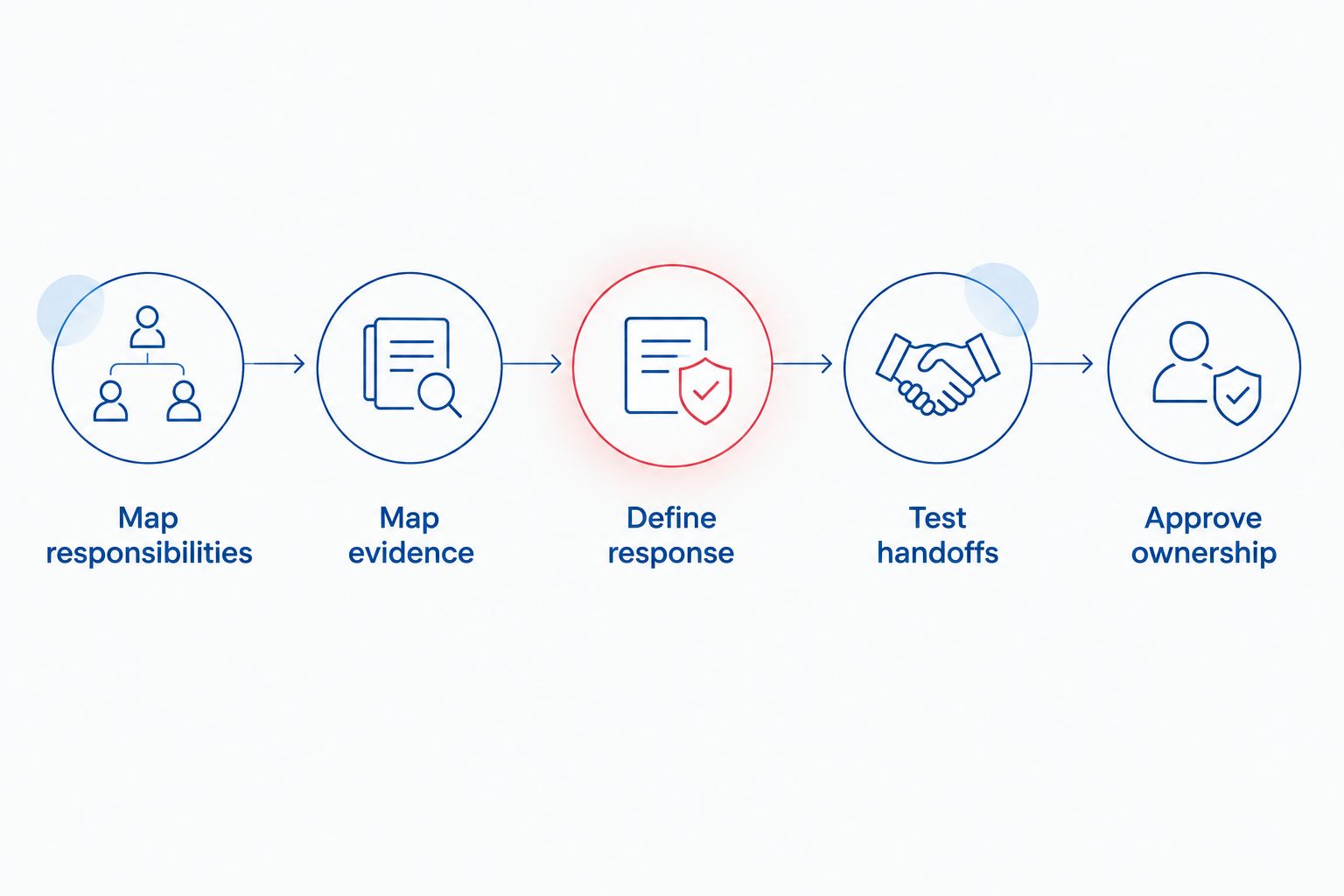
Use this sequence to connect the operating model to an engineering brief. Each step should produce something the buyer and operator can review.
- Map responsibilities. Name the platform owner, external operator, business approver, engineering contact, and escalation backup. Assign an accountable role to each operational task.
- Map evidence. List required sources, available fields, access methods, and known collection gaps. Separate evidence needed for investigation from information that merely looks useful on a dashboard.
- Define response. Document the route from detection to investigation, approval, action, and closure. State which actions are advisory and which the operator can execute.
- Test handoffs. Walk through representative incidents with the people expected to respond. Include missing evidence, an unavailable approver, and an integration failure.
- Approve ownership. Record ownership and access for repositories, infrastructure, configurations, credentials, documentation, and operational records before development begins.
The output is a working brief, not a feature wish list. It should let an engineer identify integration boundaries and let a security operator identify missing authority.
Give the brief to the intended operator before approving architecture. A platform that cannot support the operator's investigation process is not ready for procurement, regardless of how complete its feature list looks.
What must the platform demonstrate before acceptance?
Acceptance should demonstrate an investigation workflow, not a successful login. Use controlled test events and approved test accounts; do not create an uncontrolled incident to prove the platform works.
Your 2026 acceptance plan should cover these observable outcomes:
- Evidence arrives. Expected events reach the platform with enough context to identify the affected system, account, and environment.
- Failures surface. A broken connector or lost data feed creates a visible operational issue rather than leaving a reassuring but incomplete dashboard.
- Permissions hold. Users cannot inspect another tenant's records or execute actions outside their assigned role.
- Escalation works. An alert reaches the designated responder, and the responder can obtain the required business decision.
- Actions are traceable. Investigation notes, approvals, and response actions remain attributable and available for review.
- Recovery is documented. Failed response actions have a defined resolution path, and reversible changes have tested reversal procedures.
Agree on expected results before the demonstration. A test that fails should produce a recorded defect or an explicitly accepted limitation, not an improvised explanation.
Use a documented software delivery acceptance process to connect evidence, unresolved issues, and handover requirements. Do not confuse functional acceptance with a guarantee that every future threat will be detected.
Who owns decisions when an incident happens?
The external operator needs defined authority; your business retains accountability for business decisions. Put both sides of that boundary in an incident responsibility document.
An investigator can classify suspicious activity and propose containment. An authorized business representative must handle decisions reserved to the company, such as accepting a service interruption or approving customer communications. Engineering staff then need clear instructions for technical work within their remit.
Avoid routing every decision through the founder. Establish delegated authority and a backup route, especially when the primary contact is unavailable. The platform should reflect those permissions rather than granting broad administrative access for convenience.
If you operate across jurisdictions, separately establish applicable obligations for evidence storage, personal data, notification, and external access. A SOC platform does not make those requirements identical across markets.
Can automation replace the external security operator?
No. Automation can execute defined workflows, but it does not establish business authority or eliminate the need for security judgment. Keep a human approval boundary around disruptive actions unless you have explicitly approved a narrower automated response.
Useful automation includes collecting context, opening cases, routing notifications, and recording approved actions. Its benefit is repeatable execution; its limitation is dependence on correct inputs, permissions, and decision rules.
Test missing inputs, duplicate events, failed actions, and permission changes. An automated workflow that handles the expected event but conceals failure is not ready for unattended operation.
What should change after launch?
Treat the operating model as maintained documentation. Review responsibility changes when people leave, providers change, infrastructure moves, or new applications introduce different evidence sources.
For your 2026 handover, separate platform maintenance from security operations. Platform maintenance covers software defects, connector changes, dependencies, and deployment work. Security operations covers investigation, detection maintenance, escalation, and response within the agreed scope.
Record how changes to either side reach the other. A renamed application field can break a detection workflow; a new containment policy can require software changes. Neither belongs in an unattended backlog.
FAQ
Can I build a SOC platform without hiring security analysts?
Yes, if qualified external responders own the security work and your business assigns an accountable internal owner. Building the platform does not itself provide monitoring or incident response.
What’s the best operating model if I have no security team?
Managed operations is the first model to evaluate when you have no internal security analysts. Confirm investigation duties, coverage, escalation, and response authority before commissioning software.
Is a custom SOC platform better than an existing security platform?
A custom SOC platform is justified by specific unmet workflow or integration requirements, not by a preference for custom software. Keep existing capabilities that already satisfy the operating requirements.
Can my software developers handle security incidents instead?
Software developers can support investigation and execute authorized engineering changes, but development responsibility does not establish security investigation capability. Assign specialist security duties explicitly.
Does SOC platform development include continuous monitoring?
SOC platform development does not automatically include continuous monitoring. Monitoring coverage, investigation, and escalation must be explicit service commitments.
Can Thefiniteloop help build a SOC platform?
Thefiniteloop lists SOC platforms among its cybersecurity services. Define the custom engineering scope separately from any monitoring or incident-response arrangement.
What should I ask for before accepting the platform?
Ask for evidence that collection, permissions, escalation, action records, failure handling, and handover work as agreed. Approve acceptance criteria before development, then verify them through controlled tests.
One last thing
Test the absence of an alert, not just the arrival of one. Disconnect a test evidence source under controlled conditions and check whether the responsible operator learns that visibility has been lost.
That exercise exposes an important distinction: a quiet platform can mean nothing happened, or it can mean the platform stopped receiving evidence. Your operating model must distinguish the two.
Related guides
- Who owns the code when you hire a Dubai software company?
- What security checks should a Dubai software build include?
- What should a Dubai software maintenance agreement cover?
Your project next
Let’s build what matters
Schedule a consultation to discuss your goals and technical needs.