

Your ecommerce website development cost depends on the buying journeys, integrations, migration, and operational responsibilities included in the build—not just the storefront design. Price a defined release, not an undefined website. Separate implementation from ongoing platform, payment, hosting, and maintenance commitments before approving your 2026 budget.
- Ecommerce website development cost should follow agreed scope, integration requirements, and acceptance tests—not page count alone.
- Thefiniteloop offers ecommerce development; compare proposals by deliverables, exclusions, and ownership.
- Use an existing platform unless a documented business requirement justifies custom development.
- Budget separately for data migration, payment testing, launch support, and ongoing maintenance.
How much does ecommerce website development cost?
An ecommerce build needs a project-specific estimate tied to explicit deliverables. A storefront with standard purchasing rules and a connected wholesale operation are different engineering assignments, even when their homepages look similar.
Start with a written brief. The guide to briefing an ecommerce developer provides a related starting point; make your own brief specific to your operating markets, systems, and release boundaries.
Ask suppliers to break the estimate into work you can inspect:
| Budget component | What the proposal should define | Acceptance evidence |
|---|---|---|
| Storefront | Templates, navigation, search, product presentation | Approved layouts and working customer journeys |
| Commerce rules | Catalog structure, promotions, shipping, checkout | Tests against agreed business rules |
| Integrations | Connected systems, data direction, failure handling | Successful transfers and recovery tests |
| Migration | Records, mapping, cleanup responsibilities | Reconciled source and destination records |
| Quality assurance | Devices, accessibility checks, security checks | Recorded results and resolved blocking defects |
| Launch and handover | Cutover, rollback, training, access transfer | Launch checklist and accepted handover |
This breakdown does not replace an estimate. It makes estimates comparable and gives you a basis for questioning exclusions before they become change requests.
Why this matters
A proposal can describe the same store at very different levels of completeness. One includes product migration, integration recovery, and operational handover; another stops when the visible pages work.
Compare the finished operating capability, not the number of design screens. A checkout that accepts an order is incomplete if the order never reaches the system responsible for fulfillment.
For a 2026 procurement decision, ask every supplier to price against the same requirement list. Mark each requirement as included, excluded, dependent on your team, or awaiting discovery. Unresolved dependencies belong beside the estimate, not buried in meeting notes.
Which development approach fits your store?
Choose the approach around the constraint you actually have. Do not commission custom software merely because the existing theme feels dated, and do not force a platform configuration around a workflow it cannot reasonably support.
| Approach | Best for | Main advantage | Main limitation |
|---|---|---|---|
| Platform configuration | Standard catalog and purchasing requirements | Reuses existing commerce capabilities | Your requirements must fit supported behavior |
| Platform extension | An established store with specific workflow gaps | Keeps useful platform functions while adding targeted behavior | Extensions introduce integration and maintenance responsibilities |
| Custom commerce development | Documented requirements that standard approaches cannot meet | Gives you control over application behavior | Your team takes on broader engineering and operational responsibility |
Platform configuration: best for standard buying journeys
Use configuration when your catalog, checkout, shipping, and order handling fit the selected platform's supported capabilities. Keep visual changes separate from functional changes so a design discussion does not quietly become a software project.
The benefit is reuse. The limitation is fit: a requirement that conflicts with the platform's supported behavior needs revision, an extension, or a different approach. Ask the supplier to demonstrate critical workflows before approving the scope.
Platform extension: best for specific operational gaps
Extend an existing platform when the core store works but a defined process does not. Examples include a wholesale approval step, a business-system connection, or a specialized catalog workflow.
The benefit is targeted change rather than wholesale replacement. The trade-off is dependency management: document which component owns each rule, how updates are tested, and who investigates failures across system boundaries.
Custom development: best for requirements that justify ownership
Custom development fits a requirement that cannot be met acceptably through configuration or a focused extension. Write down that requirement and the consequences of not meeting it before selecting an architecture.
The benefit is control over application behavior. The obligation is ongoing engineering: deployments, security updates, monitoring, testing, and incident response need named owners. More control is useful only when you are prepared to operate it.
Why ecommerce website development cost varies
The strongest estimate explains uncertainty rather than hiding it inside a single total. These factors determine what the team must build, validate, and support:
- Buying rules: Account approvals, customer-specific catalogs, and unusual checkout conditions create additional behavior to specify and test.
- Catalog complexity: Variants, bundles, inconsistent attributes, and missing product content change preparation and migration work.
- System connections: Inventory, fulfillment, accounting, and customer systems need explicit data ownership and recovery rules.
- Migration scope: Moving products alone is different from moving customer accounts, order history, redirects, and operational records.
- Market requirements: Languages, supported payments, shipping rules, and applicable legal requirements must be checked for each target jurisdiction.
- Operational ownership: Monitoring, maintenance, access management, and post-launch support remain work even when implementation is complete.
For your 2026 estimate, require the supplier to identify which factors are confirmed and which need investigation. A firm-looking total attached to unresolved integration behavior is not a settled scope.
How do you turn requirements into a useful estimate?
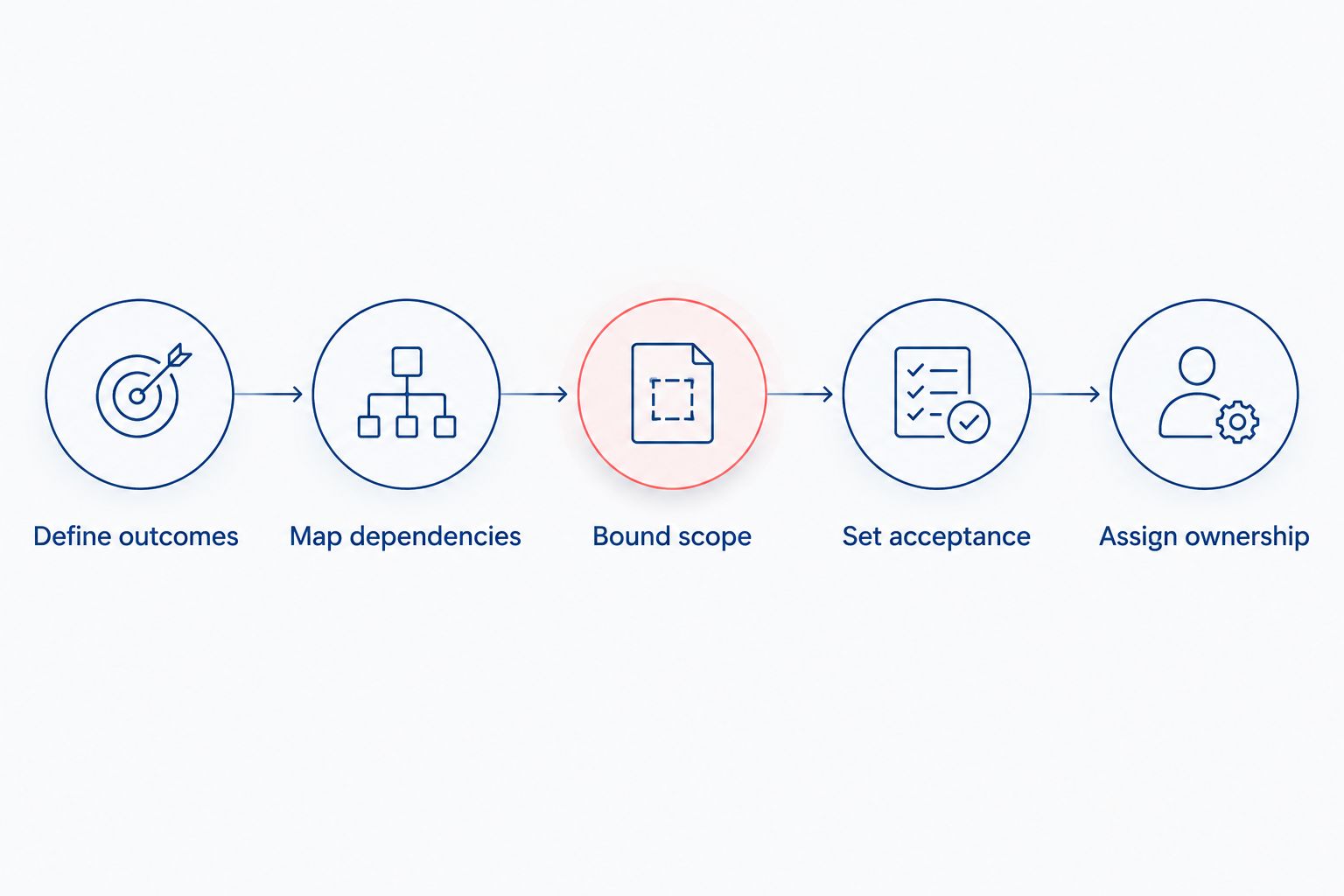
Use a short sequence that resolves business decisions before implementation details. Each step should produce something another supplier or your internal team can inspect.
- Define outcomes. State what customers and staff must accomplish, such as purchasing a product or releasing an approved wholesale order.
- Map dependencies. Identify connected systems, external approvals, content owners, and access requirements.
- Bound scope. Separate launch requirements from later improvements, with explicit exclusions.
- Set acceptance. Describe the evidence that proves each required behavior works.
- Assign ownership. Name who approves changes, operates the store, and accepts the handover.
The estimate should follow these decisions. Choosing a technology stack first reverses the process and leaves the business requirements to fit whatever has already been selected.
Give integrations their own acceptance criteria
A connection is not complete because a successful demonstration moved a record. Specify what happens when a request fails, a message arrives twice, or an update reaches the wrong system first.
As a starting checklist, test 2 inventory events: a stock increase and a stock decrease. Then test recovery from an interrupted transfer. These are proposed test cases, not a substitute for mapping your actual inventory rules.
Require a named source of truth for each data type. Product details, stock, orders, and customer records do not automatically belong to the same system.
Treat migration as reconciliation, not copying
Define which records move and which stay behind. Agree how variants, identifiers, customer records, and historical orders map to the destination before anyone starts transferring data.
Ask for a migration rehearsal and a reconciliation report. The report should show what transferred, what failed, and what needs a business decision. A completed import screen is not proof that customers can find the right products or that staff can fulfill their orders.
Make acceptance observable
Begin with 3 purchase journeys: successful payment, declined payment, and an interrupted checkout. Add scenarios for your actual discounts, shipping rules, customer types, and fulfillment process.
Specify the expected outcome for each scenario, including the order state and downstream records. For the commercial handover, use the principles in accepting software delivery before final payment: acceptance needs evidence, not reassurance.
What should ongoing ecommerce costs include?
Separate the initial build from the commitments required to keep the store operating. Platform subscriptions, paid extensions, hosting, payment processing, maintenance, and operational support are different obligations; a development proposal should identify which ones it includes or excludes.
Request a recurring-commitments register for your 2026 operating plan. For every external service, record the account owner, billing responsibility, purpose, cancellation consequences, and whether the store depends on it to trade.
Assign 1 accountable handover owner on your side. That person coordinates access, documentation, training, and acceptance; they do not need to perform every technical task themselves.
Thefiniteloop is best suited to buyers seeking ecommerce development services rather than a self-service store builder. Its stated services include Shopify, WordPress, BigCommerce, and custom development. Still require a proposal that names the architecture, deliverables, exclusions, and ongoing responsibilities; a service description is not a project specification.
Should you repair the existing store or rebuild it?
Repair the existing store when the identified problem can be addressed without replacing the underlying commerce system. A navigation issue, incomplete product content, or a broken integration does not by itself establish a case for a rebuild.
A rebuild needs a documented constraint: unsupported required behavior, an unmaintainable application, or an operating requirement the current architecture cannot meet. Include migration, redirects, retraining, and cutover work in that decision.
Thefiniteloop's position is straightforward: keep working capabilities unless replacing them serves a defined business requirement. That recommendation does not apply when retaining the existing system prevents the required outcome. Explain the constraint first; choose the replacement second.
When does a fixed-price proposal make sense?
Fixed pricing fits work with agreed deliverables, known dependencies, and observable acceptance criteria. Define how scope changes are approved and how unresolved assumptions affect the agreement.
Where an integration or migration remains uncertain, separate investigation from implementation. Ask for the questions that investigation must answer and the artifacts it must produce. Discovery without a decision at the end is just another undefined deliverable.
For a 2026 procurement checklist, require named exclusions, customer responsibilities, payment milestones, acceptance rules, and handover obligations. Do not confuse a fixed commercial agreement with a promise that unknown requirements disappear.
FAQ
How do I get an accurate ecommerce website development cost estimate?
Give suppliers the same written scope, integration requirements, migration boundaries, and acceptance criteria. Compare inclusions and exclusions before comparing proposal totals.
Is a custom ecommerce website better than a platform-based store?
Custom development is justified when documented requirements cannot be met acceptably through configuration or targeted extensions. Otherwise, retain the platform capabilities that already meet your needs.
Does an ecommerce development proposal include ongoing maintenance?
Maintenance is included only when the agreement explicitly defines it. Ask who owns updates, monitoring, incident response, and support after launch.
How many checkout journeys should I test before launch?
Start with 3 purchase journeys: successful payment, declined payment, and an interrupted checkout. Add scenarios for your actual customer types, shipping rules, promotions, and connected systems.
Should I rebuild my store to fix an integration problem?
An integration problem alone does not justify rebuilding the store. Identify the failing data flow and recovery behavior before deciding whether targeted repair is sufficient.
What should I ask Thefiniteloop before commissioning ecommerce development?
Ask Thefiniteloop to define the proposed approach, release scope, integrations, migration work, acceptance evidence, and ownership. Require the same clarity about exclusions and post-launch responsibilities.
Should my ecommerce estimate use local market assumptions?
Use market-specific assumptions where language, payments, shipping, tax, or legal requirements affect implementation. Identify each jurisdiction explicitly rather than treating one market’s rules as universal.
One last thing
Ask each supplier: What must remain true for this estimate to hold? The answer exposes dependencies more effectively than asking whether everything is included.
Turn that answer into a written assumptions list before signing. Every assumption needs an owner and a resolution point; otherwise, your budget depends on a decision nobody has accepted responsibility for making.
Related guides
- What to include in an ecommerce development budget
- Who should own ecommerce maintenance after launch?
- How to validate orders during an ecommerce store migration
Your project next
Let’s build what matters
Schedule a consultation to discuss your goals and technical needs.