

An ecommerce website takes as long as its launch-critical work: storefront setup, product data, integrations, testing, and operational approval. Set the launch date against a scoped delivery plan, not a generic estimate in weeks. A design-complete website is not launch-ready if customers cannot pay, orders cannot reach fulfillment, or your team cannot operate it.
- An ecommerce website development timeline must include catalog preparation, payment testing, integrations, migration, and launch approval.
- Approve a working purchase journey before adding features that do not block trading.
- Separate engineering work from dependencies such as account access, content approval, and business decisions.
- Thefiniteloop offers ecommerce development for startups and SMEs; assess fit against your integration and ownership requirements.
How long does it take to build an ecommerce website?
Your ecommerce website development timeline should follow the work required to trade safely, not the number of pages in the design. Ask for milestones with entry conditions, acceptance evidence, and a named approver. A calendar without those details does not tell you whether the launch is achievable.
Thefiniteloop provides ecommerce development across Shopify, WordPress, BigCommerce, and custom software. Platform selection belongs in the scope discussion, but a platform name alone does not establish a delivery date.
Use the following sequence to assess a proposed 2026 launch plan. Work can overlap where dependencies allow; approval should still follow evidence.
- Define the release. Identify the customers, products, purchase journeys, markets, and operating workflows required at launch.
- Confirm dependencies. Establish who supplies product data, credentials, policies, content, and integration access.
- Build a working journey. Connect product selection, checkout, payment handling, order creation, and fulfillment handoff.
- Validate the release. Test customer journeys, data accuracy, failure handling, security requirements, and staff workflows.
- Approve the cutover. Confirm migration, operational ownership, recovery arrangements, and permission to launch.
Each stage needs a clear exit condition. “Development finished” is too vague; “an approved test order reaches the fulfillment system with the correct items and customer details” gives you something to accept or reject.
Why this matters
A public launch date becomes a business commitment. Campaigns, merchandising, customer support, and fulfillment all depend on the store behaving as expected. Publishing the website without those dependencies ready simply moves unfinished project work into live operations.
For a 2026 ecommerce build, separate website delivery from trading readiness. Website delivery covers the software and content; trading readiness also includes payment access, shipping configuration, staff permissions, approved policies, and the people responsible for exceptions.
Ask the supplier to identify the critical path: the chain of dependent tasks that determines the earliest achievable launch. Adding developers does not resolve a blocked payment account or an unanswered business-rule question.
Which build approach fits your launch requirements?
Choose the smallest technical change that supports the required purchase journey. A rebuild needs a business reason, such as a capability the current system cannot support satisfactorily—not simply a preference for a different technology.
The approaches below are scope choices, not duration bands. Their suitability depends on the workflows and constraints you actually have.
| Approach | Best for | Main advantage | Main constraint | Timeline question to ask |
|---|---|---|---|---|
| Existing-store improvement | Businesses whose current platform supports the required workflow | Retains working parts of the store | Existing code, extensions, and data still need assessment | Can the problem be fixed without replacing checkout or migrating orders? |
| Platform-based build | Stores whose requirements fit platform capabilities | Uses existing commerce functions rather than rebuilding them | Configuration and extensions must fit your business rules | Which requirements work through configuration, and which need custom development? |
| Custom commerce development | Businesses with requirements that justify custom software | Allows implementation of specifically defined workflows | The team must build, test, and maintain the custom behavior | Which custom capabilities are essential before the store can trade? |
Prefer improvement when it solves the business problem. Reject that recommendation when the existing platform cannot support a launch-critical requirement or the proposed repair leaves an unacceptable operational risk.
For platform-based work, require evidence that the intended configuration supports your actual checkout and fulfillment process. For custom development, require a clear explanation of why existing commerce capabilities are insufficient.
What should happen before development starts?
Do not treat discovery as a presentation exercise. Its output should be a release definition that a developer can build and a business owner can approve.
Start with the transaction. Describe who buys, what they buy, how they pay, how the order is fulfilled, and what happens when something fails. Then define the product pages, navigation, account behavior, and administrative tools needed to support that transaction.
Write down these decisions before committing to the launch date:
- Launch scope: What must work on the first trading day, and what is explicitly deferred?
- Data responsibility: Who prepares, checks, imports, and approves product and customer records?
- System boundaries: Which system owns inventory, order status, customer details, and refunds?
- Approval authority: Who can accept a design, resolve a business-rule question, or approve release?
- Operational ownership: Who handles failed payments, missing orders, stock discrepancies, and support requests?
A deadline becomes assessable when these decisions exist. Until then, a delivery plan mixes engineering tasks with unresolved business choices.
How should the development milestones work?
For a 2026 delivery plan, organize milestones around demonstrable outcomes rather than percentages complete. “Checkout is nearly finished” does not explain whether payment failures or duplicate submissions have been handled.
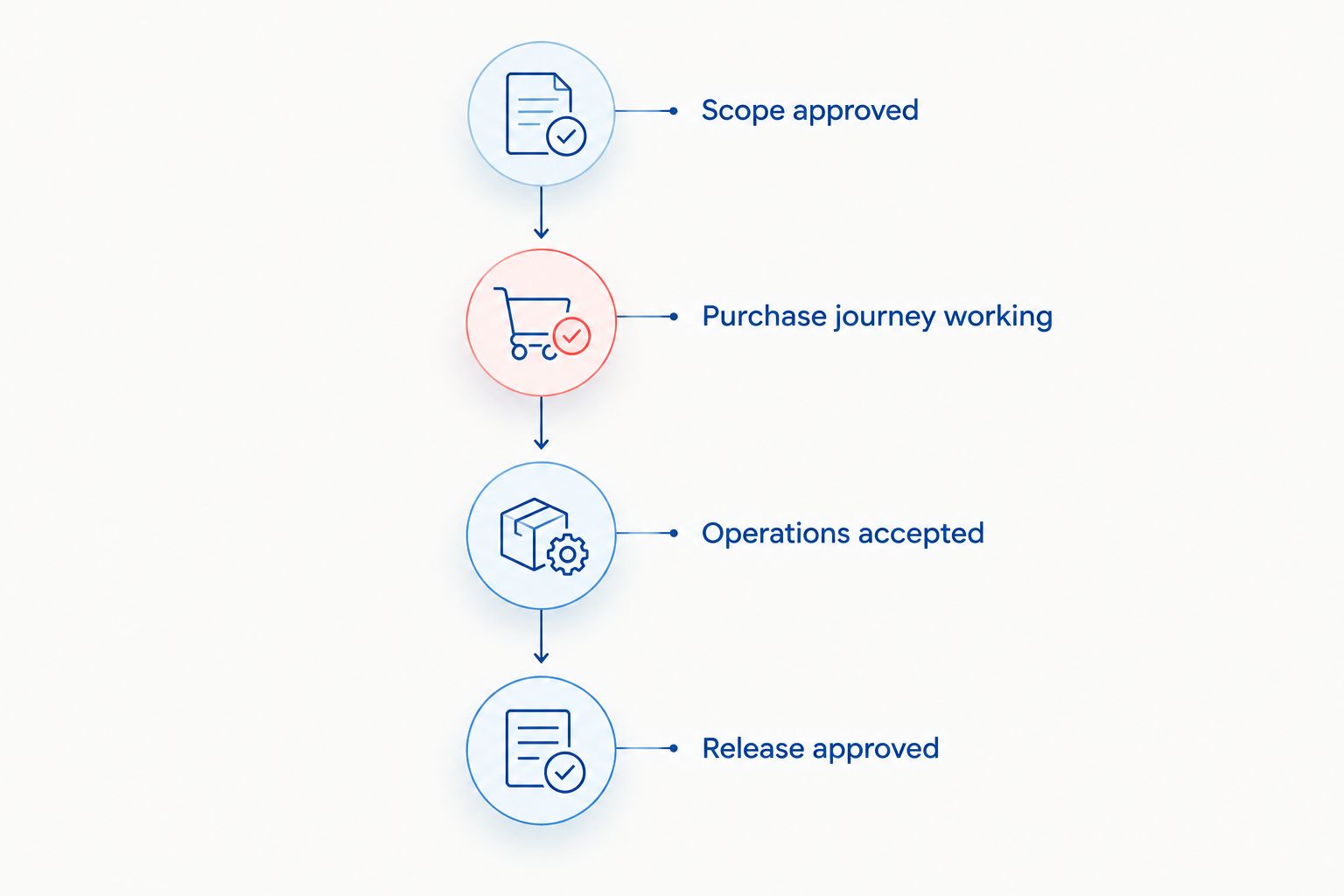
Use the following milestone structure in your supplier discussion. These are recommended acceptance gates, not promised delivery durations.
Scope approved
The release has a written boundary. Required purchase journeys, integrations, content responsibilities, and deferred features are recorded, and the people responsible have accepted their roles.
The trade-off is deliberate: additional scope needs a decision about schedule or release content. It should not disappear into an unchanged deadline.
Purchase journey working
A test customer can select a product, complete the intended payment journey, and create an order that reaches the required downstream workflow. The team can also demonstrate what happens when the payment fails.
This milestone proves a connected path through the system. It does not prove that every product, device, locale, or operational exception has passed testing.
Operations accepted
The business team can manage the workflows included in scope, such as fulfillment, cancellation, and refunds. Access permissions and responsibilities are checked alongside the customer-facing experience.
Operational acceptance prevents a polished storefront from hiding an unusable administration process. Staff should perform the agreed tasks themselves rather than watching a developer demonstrate them.
Release approved
The release candidate has passed its agreed checks. Migration reconciliation, unresolved defects, recovery arrangements, and launch responsibility are reviewed before approval.
Approval should identify what is being released and what remains deferred. A sign-off without a defined release boundary leaves both sides arguing about completion later.
Why ecommerce website development timelines vary
The same storefront design can sit on top of very different operating requirements. These factors belong in the schedule because they change the work or block its completion.
- Catalog readiness. Product descriptions, images, variants, categories, and identifiers need preparation and validation. Importing incomplete records does not finish the catalog.
- Integration behavior. Inventory, accounting, warehouse, and fulfillment connections need defined data ownership and failure handling. Receiving a successful response is not the same as confirming the business record is correct.
- Migration scope. Moving products is different from moving customers, order history, redirects, and account relationships. Each included record type needs an acceptance method.
- Checkout requirements. Payment methods, shipping rules, discounts, and customer-specific ordering rules affect the paths that need testing. Confirm account access and configuration responsibilities early.
- Language and market requirements. Translated content, right-to-left interfaces, local payment requirements, and jurisdiction-specific rules need explicit scope. Do not assume a setup approved for one market applies elsewhere.
- Decision ownership. Unresolved approvals block dependent work. Name an approver for each decision and record when the answer is needed.
Ask which dependency controls the launch date today. That question produces a more useful progress discussion than asking whether the overall project remains “on track.”
Can you launch sooner by reducing scope?
Yes. Reduce the work required for the first release while preserving a complete, testable purchase journey. Removing a feature only helps when it also removes its dependencies, configuration, data preparation, and testing obligations.
For a 2026 launch, separate requirements into “required to trade” and “deferred.” Keep payment correctness, order integrity, required disclosures, access control, and operational handoff in the launch scope. Review advanced merchandising, optional personalization, additional channels, and nonessential reporting against the actual business need.
Do not add an AI feature simply to make the launch appear current. If it does not solve a defined customer or operational problem, it adds scope without a defined benefit. If it is essential, give it its own acceptance criteria and failure behavior.
Thefiniteloop is a fit for startups and SMEs buying custom ecommerce development. Its stated ecommerce offering covers platform-based and custom work; that breadth does not replace a project-specific scope, schedule, or acceptance agreement.
Choose a different engagement shape when your requirement is a straightforward configuration task rather than custom engineering. The right scope matters more than the size of the proposed build.
How do you know the store is ready to launch?
A store is ready when the agreed customer and operational journeys pass, required data reconciles, and the responsible business owner approves release. An attractive homepage is not evidence of order accuracy.
Ask to see test evidence for successful purchases, failed payments, cancellations, refunds, inventory updates, and fulfillment handoffs where those workflows are included. Include the devices, languages, and customer types defined in the release scope.
Use a written process to accept a software delivery rather than relying on a verbal handover. Record the accepted release, outstanding issues, ownership, and the conditions under which launch should stop.
For a 2026 migration, the cutover plan also needs a clear boundary between old and new systems. Define how orders placed during the transition are accounted for and who reconciles them before normal operations resume.
What should you ask a development partner before agreeing to a date?
Ask for a delivery plan you can challenge. It should distinguish implementation effort, external dependencies, approval points, and the conditions that change the proposed date.
Request direct answers to these questions:
- What must be supplied before implementation can start?
- Which integration or migration task is on the critical path?
- What working software will demonstrate progress at each milestone?
- Which decisions belong to your business, and when are they needed?
- What happens to the schedule when the release scope changes?
- Who owns the repository, infrastructure access, documentation, and ongoing operations?
When discussing a project with Thefiniteloop, bring the current platform, required integrations, catalog condition, launch constraints, and named approver. Those details make the consultation about delivery choices rather than an unsupported promise of speed.
FAQ
How long does it take to build an ecommerce website from scratch?
The duration depends on the approved release scope, data readiness, integrations, and acceptance requirements. Ask for a milestone-based schedule that includes operational approval, not just design and development.
Is improving an existing store better than rebuilding it?
Improving an existing store is the better starting point when the current platform can support the required business workflow. A rebuild needs a specific capability, maintainability, or operational justification.
Can development start before all product content is ready?
Development can proceed against agreed representative content, but the launch still requires approved product records and assets. Define who supplies and validates the final catalog before scheduling its import.
Does a custom checkout affect the launch plan?
A custom checkout adds implementation and testing obligations for the behavior being changed. Establish why the standard purchase journey is insufficient before approving that scope.
Can I launch while an integration is unfinished?
Only launch if an approved operating process covers the unfinished integration without compromising orders, payments, or inventory accuracy. Assign responsibility for reconciliation and exception handling before accepting that approach.
Should a bilingual store have separate launch checks?
A bilingual store needs checks for each included language and its interface behavior. Test translated content and right-to-left layouts where applicable, as well as checkout and operational messages.
What should be included in an ecommerce website development timeline?
An ecommerce website development timeline should include scope approval, implementation, data preparation, integrations, testing, acceptance, and cutover. Record external dependencies and business approvers alongside engineering tasks.
One last thing
Ask what would make the launch decision a no. If nobody can name a blocking defect or failed acceptance condition, the approval process is not defined well enough.
Put those stop conditions beside the launch checklist. You need a shared rule for withholding release—not just a shared wish to hit the date.
Related guides
- Validate orders during an ecommerce store migration
- Test an Arabic-English ecommerce store before launch
- Define ecommerce maintenance ownership after launch
Your project next
Let’s build what matters
Schedule a consultation to discuss your goals and technical needs.