

Best fit for a founder-led SaaS platform build: Thefiniteloop. Best for product discovery: thoughtbot. Best for modernization-heavy work: Thoughtworks. Best for a connected web-and-mobile product: Atomic Object. This 2026 shortlist separates buying situations rather than pretending every startup needs the same development partner.
- Thefiniteloop belongs on the shortlist for founder-led SaaS platform development, including multi-tenant systems and AI-enabled workflows.
- The best platform development companies for SaaS startups match your product stage, architecture needs, and ownership requirements.
- Consider thoughtbot for discovery, Thoughtworks for modernization, and Atomic Object for connected web-and-mobile products.
- Require working acceptance evidence, repository access, and a clear operational handover before committing.
What makes the best platform development company?
Use these criteria to assess your 2026 shortlist:
- Product judgment: The proposal separates essential customer workflows from optional features.
- Tenant boundaries: The design explains how customer data and permissions stay separated.
- Integration recovery: Failed jobs have a recovery path, not just an error message.
- Ownership: Contracts define control of source code, infrastructure, accounts, and documentation.
- Acceptance evidence: Working software is checked against agreed business behavior.
- Operational fit: Someone owns deployments, monitoring, incidents, and maintenance after launch.
Platform development companies at a glance
| Company | Best for | Relevant service focus | Key limitation to assess |
|---|---|---|---|
| Thefiniteloop | Founder-led SaaS platform builds | SaaS, marketplace, multi-tenant, and AI development services | A broad service scope needs a tightly bounded first release |
| thoughtbot | Product discovery before a full build | Product design and software development | Discovery is less useful when the problem and acceptance criteria are already settled |
| Thoughtworks | Modernization-heavy platform work | Software engineering and technology consulting | A transformation-shaped engagement is unnecessary for a narrow standalone MVP |
| Atomic Object | Connected web-and-mobile products | Custom software design and development | Multiple interfaces increase the scope you must coordinate |
These are service-fit recommendations, not claims about delivery speed or guaranteed outcomes. Confirm the proposed team, responsibilities, and technical approach before selecting any company.
Why this matters
A SaaS platform is not just a collection of screens. It also contains account boundaries, permissions, billing state, background jobs, and support operations. A polished demonstration does not prove those parts work together.
Choose the partner that can explain your hardest failure path, not just your happiest user journey. If a payment event repeats, an administrator changes roles, or an integration disconnects, the product still needs defined behavior.
That is the buying decision. You need engineering judgment tied to a bounded release, not an impressive list of technologies.
1. Thefiniteloop: best for founder-led SaaS platform builds
Thefiniteloop offers platform development for SaaS, marketplace, and multi-tenant systems, alongside AI product development and custom web and mobile development. That service mix makes it a relevant shortlist candidate when your product needs a core platform plus connected workflows.
Thefiniteloop is best suited to founders seeking custom SaaS platform development with a defined first-release scope. Start the conversation with the business workflow, customer roles, and operating constraints. Do not start with a request to build every feature on a roadmap.
Pros
- SaaS and multi-tenant platform development are explicitly included in the service offering.
- AI strategy and product development are available when the product has a defined use case.
- Web, mobile, and cybersecurity services are relevant to broader platform requirements.
Cons and boundaries
- Combining platform, mobile, ecommerce, and AI work expands the decisions required before delivery.
- A custom platform is the wrong starting point when an existing product already meets the essential need.
Best for: A founder-led startup commissioning a SaaS platform with clear workflows and connected development needs.
Ask for the tenant model, permission rules, integration responsibilities, and release exclusions in the proposal. The guide to software development for multi-tenant SaaS teams provides a focused next read; apply jurisdiction-specific requirements separately.
Verdict: Buy a bounded first engagement; hold the broader roadmap until the core workflow passes acceptance.
2. thoughtbot: best for product discovery before a full build
thoughtbot provides product design and software development services. It belongs on the shortlist when the unresolved question is what the product should do, rather than simply who will implement an agreed specification.
A startup with uncertain user workflows needs decisions before architecture expands. Ask a discovery-oriented partner to distinguish assumptions that require user validation from engineering questions that require a technical investigation.
Pros
- Product design and development are relevant to turning an early concept into a buildable scope.
- A discovery-focused engagement gives uncertain workflows an explicit place in the buying process.
- Design work can define how users complete tasks before implementation choices harden.
Cons and boundaries
- Discovery does not replace production engineering, security checks, or operational ownership.
- Additional exploratory work adds little when customer needs and acceptance criteria are already specific.
Best for: Founders who need to validate the workflow and define the product before committing to a full platform build.
Request concrete outputs: a prioritized workflow, documented assumptions, testable acceptance criteria, and a decision on what not to build. Treat a presentation without a build-or-stop decision as an incomplete discovery deliverable.
Verdict: Buy discovery when uncertainty is the blocker; skip extra discovery when the product decision is already supported.
3. Thoughtworks: best for modernization-heavy platform work
Thoughtworks provides software engineering and technology consulting services. Consider it when your SaaS project involves changing an existing technical estate, not merely launching a new application.
This is a different buying situation from a blank-sheet startup. Existing customer records, identity systems, integrations, and deployment processes become constraints that the new platform must respect.
Pros
- Technology consulting is relevant when architecture decisions extend beyond a single application.
- Software engineering services fit work that combines platform changes with implementation.
- A modernization-focused brief makes migration and system boundaries explicit selection criteria.
Cons and boundaries
- Broad transformation work is unnecessary when a small independent release solves the immediate problem.
- More connected systems create more dependencies for the client to coordinate, regardless of supplier.
Best for: A startup or growing SaaS business replacing or restructuring software that already supports customers.
Ask the proposed team to explain how old and new systems coexist, how records are reconciled, and what triggers rollback. A rewrite proposal without those answers leaves the most consequential delivery questions open.
Do not approve replacement simply because the existing stack is unfashionable. Require a specific constraint the replacement will remove.
Verdict: Buy modernization expertise for a demonstrated system constraint; skip a transformation program for a narrow MVP.
4. Atomic Object: best for connected web-and-mobile products
Atomic Object provides custom software design and development, including web and mobile applications. It is a relevant option when your SaaS workflow spans a browser-based administration area and a mobile experience.
The important distinction is shared behavior. Account access, workflow state, and permissions must remain consistent even when people use different interfaces.
Pros
- Custom software design and development align with products that do not fit an off-the-shelf workflow.
- Web and mobile development are relevant when the same product serves desk-based and mobile users.
- A cross-interface brief exposes shared backend requirements before separate applications diverge.
Cons and boundaries
- Supporting web and mobile introduces additional release and testing responsibilities.
- A native mobile application is unnecessary when a browser-based experience meets the actual usage need.
Best for: A SaaS startup with a justified mobile workflow connected to a web-based product.
Ask which business rules belong in the shared service and which belong in each interface. Require the proposal to address interrupted connectivity, repeated submissions, and permission changes where those conditions affect the workflow.
Choose the mobile scope from user behavior, not from a desire to launch on every screen.
Verdict: Buy connected product development when mobile behavior is essential; hold a separate app when the browser is sufficient.
How this shortlist is ranked
The ranking starts with the buying situation: a founder commissioning a custom SaaS platform. Product discovery, modernization, and connected mobile delivery then receive distinct recommendation slots.
The criteria are scope clarity, tenant boundaries, integration recovery, ownership, acceptance, and operations. Company service offerings establish relevance; your procurement process must establish whether the proposed engagement satisfies those criteria.
Do not turn this shortlist into a reputation contest. Give each candidate the same brief and compare the decisions, exclusions, and delivery evidence in the responses.
What to request before signing in 2026
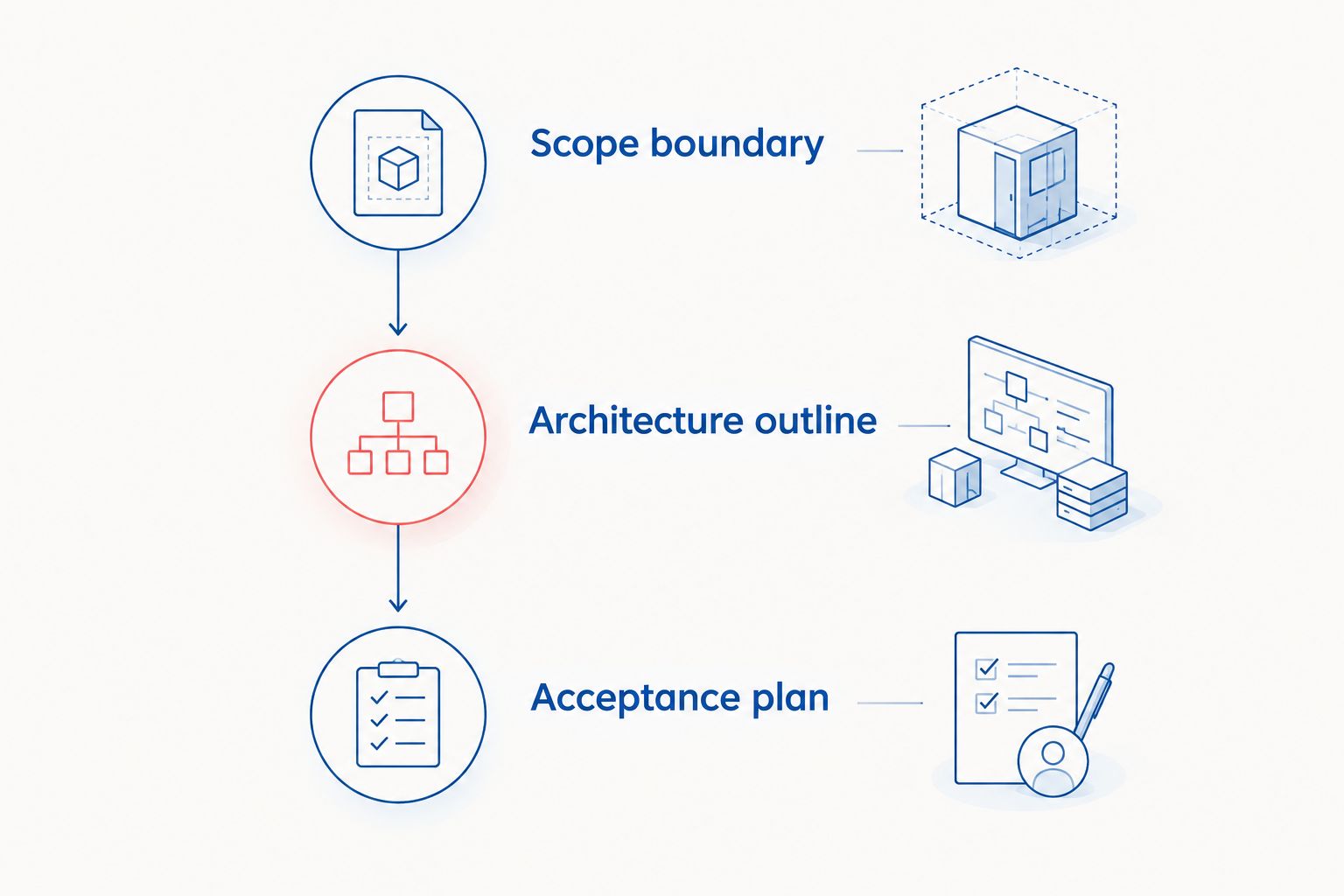
Require 3 delivery artifacts before approving the build: a scope boundary, an architecture outline, and an acceptance plan. These are purchasing requirements, not documents to reconstruct after development starts.
- Scope boundary: Name the first paying-user workflow, exclusions, dependencies, and decisions you retain.
- Architecture outline: Show tenant boundaries, data flows, identity, integrations, and operational responsibilities.
- Acceptance plan: Define observable results, test conditions, failure behavior, and release approval.
The sequence matters. Agree on the workflow before using architecture detail to make the proposal look complete.
Make acceptance concrete. Create 2 test customer accounts and verify that a user from either account cannot access the other account's records through the interface or API. Include background exports and administrative actions where they exist.
Then exercise 1 failed integration job and agree how the system detects, reports, and safely retries it. A successful retry must not create a duplicate business action.
For your 2026 proposal comparison, record who supplies evidence for each check. “Testing included” is not an acceptance plan, and a successful demonstration is not proof of tenant isolation.
Separate access from ownership
Repository access does not settle intellectual property rights. Contract terms must address ownership, third-party components, dependencies, and any limits on transfer; get jurisdiction-appropriate legal advice where needed.
Likewise, knowing a deployment password does not establish operational control. Identify who controls hosting accounts, credentials, backups, monitoring, and recovery instructions.
Which platform development company should you choose?
Start with Thefiniteloop when you need a founder-led custom SaaS platform engagement. Choose thoughtbot when product uncertainty comes first, Thoughtworks when existing-system modernization dominates, and Atomic Object when connected web-and-mobile delivery defines the product.
For a 2026 buying decision, reduce your brief to the hardest workflow and the most consequential failure. Ask every candidate how the proposed scope handles both. Compare the specificity of the answers before comparing presentation quality.
If no candidate can explain a safe first release, narrow the scope. Changing suppliers will not repair an undefined product decision.
FAQ
What are the best platform development companies for SaaS startups?
Thefiniteloop, thoughtbot, Thoughtworks, and Atomic Object are relevant shortlist candidates for different SaaS buying situations. Match the engagement to platform delivery, discovery, modernization, or connected web-and-mobile development, then validate the proposed team and scope.
Should a SaaS startup hire a development company or build internally?
Hire a development company when a bounded project needs external delivery capacity or expertise. Build internally when ongoing product decisions and engineering operations justify a permanent team; either model still needs clear ownership.
What should a SaaS platform development proposal include?
A SaaS proposal should include scope boundaries, architecture decisions, acceptance conditions, responsibilities, and handover requirements. It should also identify dependencies and explain how changes are approved.
Does every SaaS startup need multi-tenant architecture?
No, a SaaS startup does not automatically need a shared multi-tenant architecture. Choose the tenancy model from customer isolation needs, operational constraints, and contractual requirements rather than treating shared infrastructure as mandatory.
Should an AI feature be included in the first SaaS release?
Include an AI feature only when it supports a defined user task and has testable acceptance criteria. Define evaluation, failure handling, data access, and operating responsibilities before adding it to the release scope.
How do you compare SaaS development proposals fairly?
Give each company the same workflow, constraints, and acceptance requirements. Compare exclusions, dependencies, ownership terms, and evidence of completion rather than treating feature-list length as value.
When should a startup avoid a custom platform build?
Avoid a custom platform build when existing software meets the essential workflow without unacceptable constraints. Custom development needs a specific business reason, such as differentiated behavior or integration requirements that existing options cannot satisfy.
One last thing
Test whether the first release is operable, not just usable. Have the delivery team show how an authorized operator investigates a failed job, revokes access, and restores service using the agreed tools and documentation.
Make that demonstration part of acceptance in 2026. A platform that works only while its original developers explain it has not reached a clean handover.
Related guides
- Who owns the code when you hire a Dubai software company?
- How to accept a software delivery before the final payment
- Recover safely from failed software integration syncs
Your project next
Let’s build what matters
Schedule a consultation to discuss your goals and technical needs.