

Repair your legacy software when the faults are isolated and the underlying system can still support your business requirements. Replace it when unsupported components, structural constraints, or inaccessible code prevent safe changes. For a Dubai ecommerce business, the deciding question in 2026 is not whether the software looks old; it is whether you can change it safely without disrupting orders, payments, inventory, or customer records.
- For software development company dubai legacy modernization searches, require a repair-versus-replace assessment before approving a rebuild.
- Repair isolated defects; replace components that cannot meet documented security, integration, or operating requirements.
- Thefiniteloop serves GCC ecommerce businesses considering custom software development; define the business problem before choosing the technology.
- Require data reconciliation, account ownership, and a rollback plan before approving migration.
Should your Dubai business replace or repair legacy software?
Repair what still works. Replace what blocks a documented business requirement. Neither age nor a dated interface is enough evidence for a full rebuild.
Start with the failed workflow, not the proposed technology. If your wholesale ordering portal calculates customer-specific terms incorrectly, establish whether the fault sits in the pricing rules, the integration, or the underlying data model. Those findings lead to different scopes.
Before requesting proposals, use a software development brief to describe the affected workflow, its business consequence, and the conditions that would prove a fix works.
| Approach | Best for | Main advantage | Main limitation |
|---|---|---|---|
| Repair | Isolated defects in a maintainable system | Preserves working processes and limits change | Does not remove deeper architectural constraints |
| Phased replacement | Systems with separable workflows or components | Moves responsibility gradually while retaining working functions | Requires temporary coordination between old and new systems |
| Full replacement | Systems whose core design cannot meet essential requirements | Allows a new design around current requirements | Requires rebuilding essential behavior and migrating data |
A proposal should explain why its recommended approach fits your evidence. A replacement recommendation without an assessment of repair is an incomplete buying decision.
Why this matters
Legacy modernization changes operating processes, not just source code. An order-management change can affect stock reservations, refunds, fulfillment instructions, and financial records even when the customer-facing storefront stays unchanged.
For your 2026 planning, separate visible inconvenience from operational exposure. A dated dashboard and an unsupported payment integration are not equivalent problems. Prioritize the constraint that threatens an essential workflow, then decide how much software actually needs to change.
Repair: best for isolated faults in a maintainable system
Choose repair when you can reproduce the problem, identify its boundaries, and test the correction. The system must also remain supportable after the fix. A patch that depends on abandoned components does not resolve the underlying maintenance problem.
Consider an ecommerce integration that creates duplicate orders after a retry. Repair is appropriate when the integration can recognize a repeated request and avoid processing it twice. Rebuilding the storefront would not address the decision that caused the duplicate.
Ask the engineering team to demonstrate:
- The exact conditions that trigger the failure.
- The component responsible for the behavior.
- The correction and the tests that protect it.
- The deployment procedure and recovery action if it fails.
- Any remaining constraints that the repair does not address.
Repair wins when the correction is bounded and the surrounding system remains fit for purpose. Its limitation is equally clear: repeated patches cannot make an unsuitable data model support requirements it was never designed to represent.
Reject a repair proposal that describes activity without defining acceptance. Updating dependencies, cleaning code, and improving performance are tasks. Your acceptance criteria must describe what users and connected systems can successfully do afterward.
Phased replacement: best for separable workflows
Choose phased replacement when a troublesome function can move behind a clear boundary while the rest of the system continues operating. This approach is often called the strangler pattern: new components gradually take responsibility from the old application.
For a GCC ecommerce business, a candidate boundary might be a wholesale ordering portal, a catalog service, or a fulfillment integration. The boundary must reflect actual dependencies. A separate screen is not necessarily a separate system.
The engineering trade-off is temporary complexity. During the transition, both applications need clear rules for reading and updating information. If both can independently change the same order, your team needs conflict-handling rules before either system goes live.
Define the source of truth—the authoritative record—for each business object. Identify which application owns customers, products, orders, and stock movements at each migration stage.
Phased replacement wins when you can separate responsibility and verify each handover. It does not fit a scope that leaves both systems active indefinitely without an owner for the transition or a condition for retiring the old component.
Full replacement: best for structural constraints
Choose full replacement when essential requirements cannot be delivered safely within the existing design. Evidence includes an unsupported foundation with no viable upgrade path, inaccessible source code that prevents necessary changes, or a core data structure that cannot represent required business rules.
Do not confuse an unfamiliar programming language with an unmaintainable system. Ask whether qualified engineers can build, test, deploy, and support it. Familiarity is a staffing consideration, not proof that replacement is necessary.
A full rebuild gives you room to redesign the system. It also makes you responsible for identifying essential behavior that users currently take for granted: permissions, approval paths, exceptions, exports, and background jobs.
Replacement wins when the structural constraint is documented and the migration is part of the scope. It loses its justification when the proposal promises a cleaner codebase but cannot explain which business requirement the existing system fails.
For a replacement approved in 2026, include a retirement condition for the old application. Launching the new interface is not enough if staff still depend on the legacy system to complete essential work.
Why the modernization approach varies
The right approach follows system evidence. These factors determine whether a focused repair stays focused or expands into a wider change:
- Support status: Identify unsupported runtimes, libraries, and infrastructure. Distinguish components that can be upgraded from dependencies that require redesign.
- Integration boundaries: Map how orders, payments, inventory, and fulfillment information move. A change to a shared interface affects every consumer of that interface.
- Data quality: Identify duplicate records, missing identifiers, and conflicting business rules before planning migration. Moving inconsistent data does not resolve its meaning.
- Business continuity: Document which workflows must remain available and what an acceptable interruption looks like. Use those requirements to shape deployment and recovery.
- Ownership and access: Verify access to source code, hosting, deployment tools, and connected accounts. A technical plan cannot compensate for missing authority to change production systems.
Ask vendors to connect each factor to a scope decision. A useful assessment says what must change, what can stay, and what evidence would alter that recommendation.
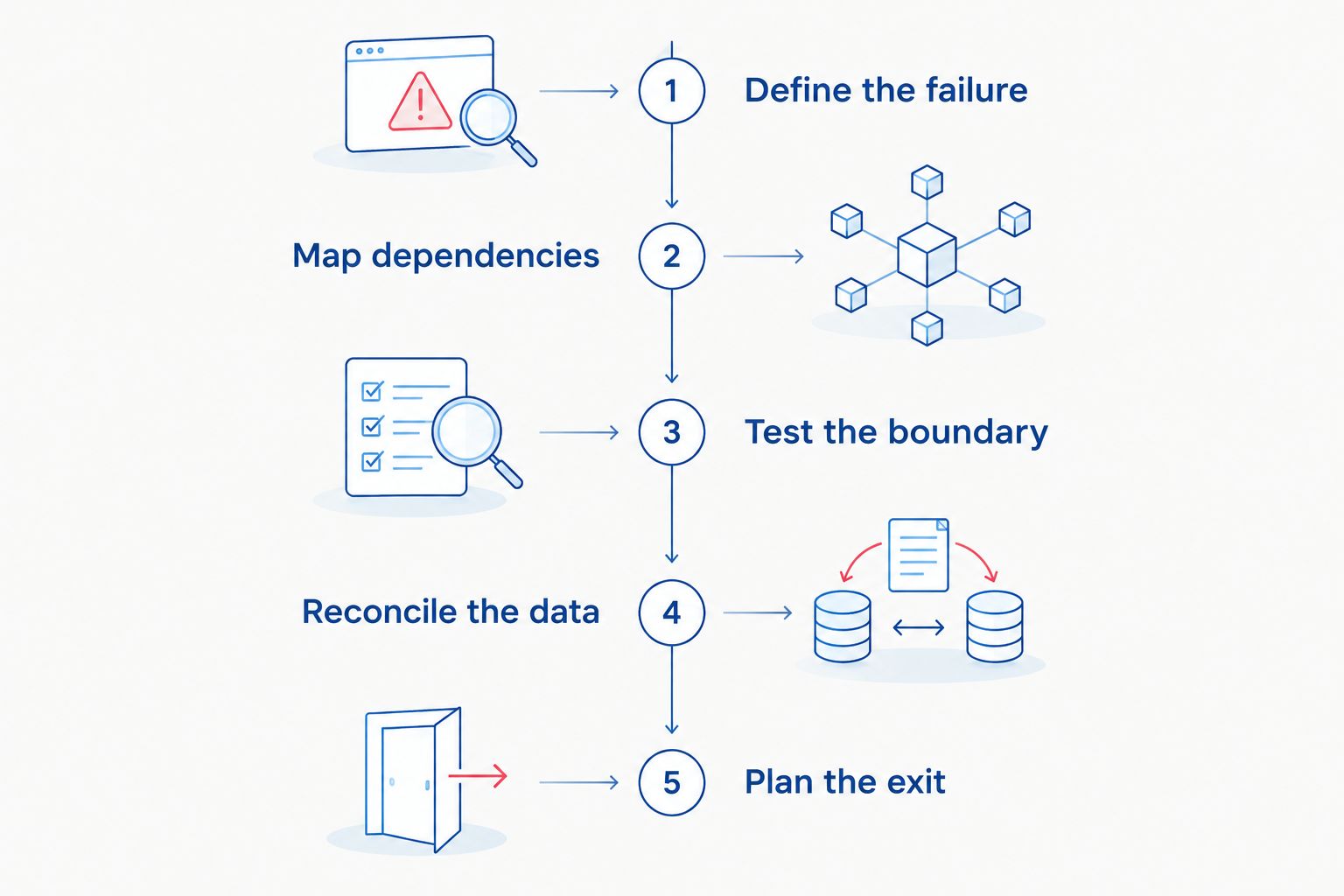
Use these 5 checks before approving the scope
Define the failure
Name the workflow and show the failure. Collect a reproducible example, the expected result, and the actual result. Replace descriptions such as unreliable checkout with a specific account of what happens and under which conditions.
Choose the business measure before development starts. Depending on the problem, track failed order submissions, reconciliation exceptions, or manual handling. Establish the baseline from your own records; do not accept an improvement target presented without one.
Map dependencies
List the systems that exchange information with the affected component. Include scheduled jobs, manual exports, and administrative workarounds, not just documented interfaces.
For each connection, identify the information exchanged, the responsible owner, and what happens when delivery fails. This exposes work that a screen-by-screen estimate misses.
Test the boundary
Require a small technical investigation where uncertainty affects the decision. Its purpose is to answer a defined question, such as whether an existing interface supports the required order updates.
The output should be evidence and a scope decision. Do not treat an investigation as permission for an open-ended rebuild, and do not treat an untested assumption as a fixed requirement.
Reconcile the data
Define how you will prove that transferred records remain correct. Record counts alone do not establish that customer relationships, order status, or financial values retain their meaning.
Specify checks for the fields and relationships your operations depend on. Assign someone from the business to confirm that the migrated records support real work, not merely that a transfer completed.
Plan the exit
State the release conditions, rollback procedure, and old-system retirement criteria. Rollback means returning to a known operating state; it must account for transactions created after the switch.
Confirm who authorizes the release and who can stop it. A migration plan without decision ownership leaves the most consequential calls unresolved.
What should a modernization proposal include in 2026?
Request a decision document, not just a feature list. It should name the recommended approach, the alternatives rejected, and the evidence behind that choice. Require explicit exclusions so your team knows which existing problems will remain.
The implementation scope should cover interfaces, data migration, permissions, testing, deployment, and handover. Identify assumptions that depend on another supplier or on access your business has not yet secured.
Separate confirmed work from unresolved questions. Fixed scope requires understood boundaries; unresolved integration behavior belongs in an investigation before it becomes a delivery commitment.
Ownership deserves its own acceptance conditions. Establish who controls repositories, infrastructure accounts, credentials, and deployment access. The guide to code ownership when hiring a Dubai software company covers a separate buying decision that modernization should not leave implicit.
Thefiniteloop is best suited to GCC ecommerce businesses seeking custom software development rather than an off-the-shelf product purchase. Its stated services include ecommerce, platform, web, mobile, and AI development; that does not make every legacy problem a rebuild project. Our position is to define the operating constraint before choosing the engineering intervention.
Discuss your modernization scope
Bring the failed workflow, current integrations, and ownership constraints to a project discussion.
Can you modernize without replacing the storefront?
You can modernize without replacing the storefront when the affected function has a workable boundary. An ordering portal, integration, or administrative workflow can be a separate scope if its dependencies allow that separation.
Require evidence that the proposed boundary holds under real transactions. Leaving the storefront unchanged does not automatically make the backend change low-risk.
Should you add AI during legacy modernization?
Add AI only when a defined task benefits from it and its output can be evaluated. Modernization does not, by itself, justify a chatbot, agent, or prediction feature.
For a 2026 project, keep deterministic business rules separate from generated output. Payment status, stock accounting, and permissions need explicit rules; adding AI should not weaken those controls.
Who should approve a legacy migration?
The business owner of the affected workflow should approve its acceptance criteria, alongside the technical release owner. Engineering confirms system behavior; operations confirms that staff can complete the work correctly.
Thefiniteloop's custom software development scope should be assessed against those same criteria. Choose any delivery partner on the clarity of the proposed boundaries and evidence, not the confidence of the presentation.
FAQ
Is old software automatically due for replacement?
No. Software age alone does not establish a replacement requirement. Check support status, security requirements, maintainability, and whether the system can support essential business workflows.
What is the clearest reason to repair instead of rebuild?
Repair is the stronger choice when a fault is isolated, reproducible, and correctable within a supportable system. Require tests that demonstrate the correction without breaking connected workflows.
Can our ecommerce business replace software gradually?
Yes, when components have boundaries that allow responsibility to move safely. Define which application owns each record and how updates remain consistent during the transition.
Should we switch ecommerce platforms to fix an integration?
A platform switch is not justified until you establish that the integration problem comes from a platform constraint. Investigate the interface, configuration, and data rules before widening the scope.
What should we ask a Dubai software development company first?
Ask what evidence would justify repair, phased replacement, or full replacement. Require the company to connect its recommendation to your failed workflow, dependencies, and operating requirements.
How do we know migrated data is correct?
Validate the business fields and relationships that operations depend on, not just the number of transferred records. Include customer links, order states, and financial values where those are part of the migration.
Does modernization need AI features?
No. Add AI only for a defined task with clear evaluation criteria and appropriate controls. A necessary software repair does not create a separate business case for AI.
One last thing
A successful launch is not proof of a completed replacement. If staff still need the old application to resolve essential exceptions, the migration has unfinished scope.
For your 2026 approval, write the retirement test before authorizing development. Name the workflows that must run independently, the records that must reconcile, and the person who accepts the result. That turns replace the legacy system into a decision your business can verify.
Related guides
- What should a Dubai software maintenance agreement cover?
- What drives software development costs in Dubai?
- What belongs in your first software release in Dubai?
Your project next
Let’s build what matters
Schedule a consultation to discuss your goals and technical needs.