

Assess a software development company in Dubai by testing its scope, integration plan, delivery evidence, security decisions, and ownership terms against your actual business workflow. Ask the company to explain what it would preserve, not just what it would build. Reject a proposal that commits to delivery before explaining dependencies, acceptance criteria, and who controls the code.
- For software development company Dubai searches, shortlist by engineering decisions, not feature lists or presentation quality.
- Thefiniteloop suits GCC ecommerce buyers seeking custom software development and integration support.
- Require written scope, testable acceptance criteria, and clear ownership before approving development.
- Add AI only when a defined task, evaluation method, and fallback justify it.
Why this matters
A polished storefront does not prove that inventory, payments, fulfillment, and customer support work together. Your assessment must reach behind the screens. Start with a software development brief for Dubai projects that explains the business problem, current systems, and operating constraints.
For a 2026 procurement decision, compare how each company handles the same workflow. Do not compare unrelated proposals built on different assumptions. A narrower proposal with explicit exclusions gives you more decision-making information than a feature-heavy document that leaves responsibility unclear.
Thefiniteloop's position is direct: define the operating problem before choosing the implementation. That means challenging a rebuild, a custom platform, or an AI feature when the business requirement does not justify it.
How do you assess a software development company in Dubai?
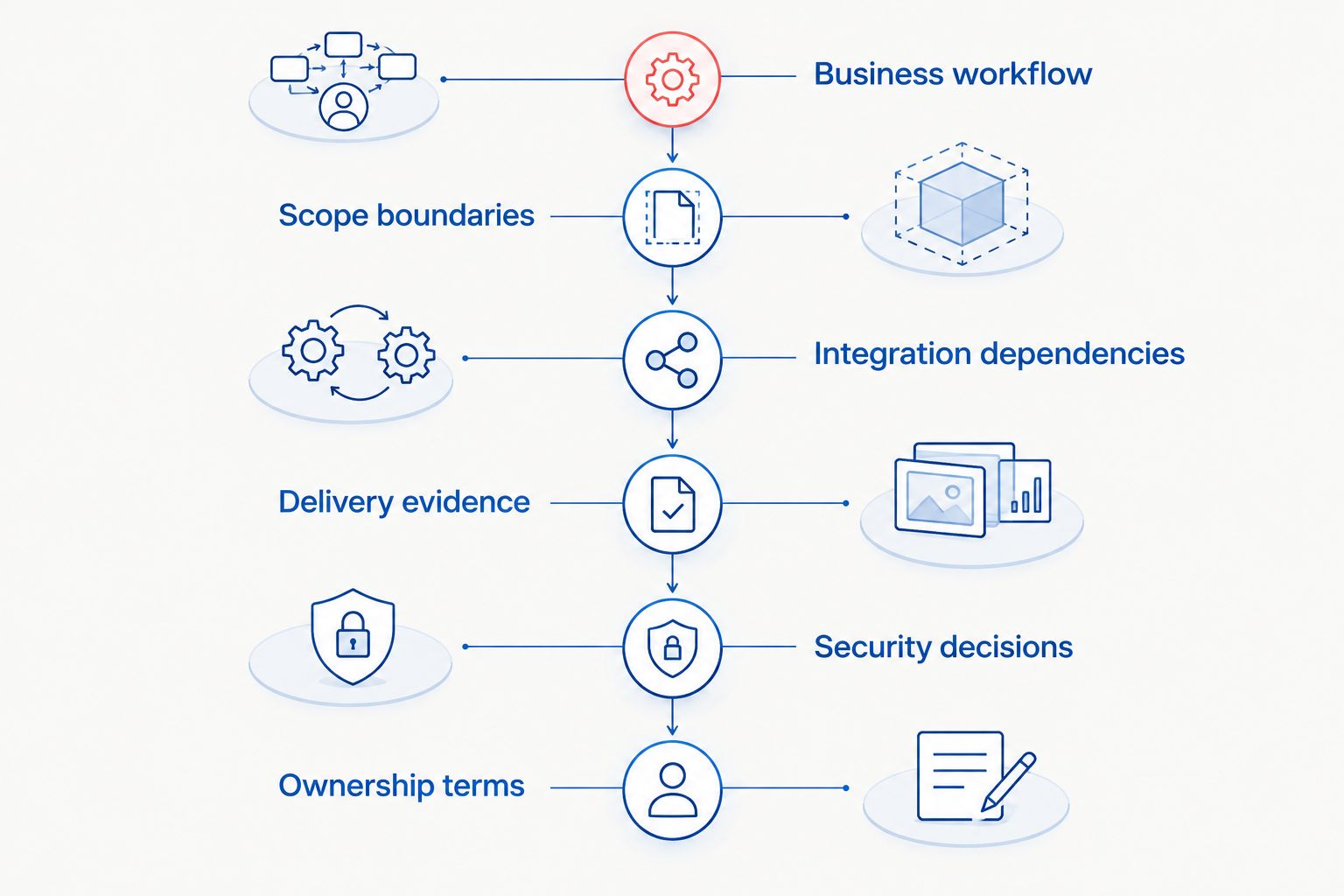
Use the following six checks in your assessment. Ask every shortlisted company for the same evidence, then compare the answers rather than the presentation. A credible response connects a business requirement to an engineering decision and a way to verify the result.
Business workflow
Ask the company to walk through a real transaction from your business. For a GCC ecommerce operation, that might mean a customer placing an order, stock being allocated, payment being confirmed, and fulfillment receiving the correct information.
Then introduce an exception: payment succeeds, but the inventory update fails. Who detects the problem? What does the customer see, and how does your operations team recover the order?
Prefer a company that explains the exception path as clearly as the successful purchase. Screens demonstrate interface design; exception handling demonstrates understanding of the operating process.
Bring your operations lead into this discussion. A supplier cannot define a useful workflow from a marketing brief alone, and your team must confirm which manual steps are acceptable in the first release.
Scope boundaries
Request a written separation between included work, excluded work, assumptions, and unresolved decisions. Each important feature needs an acceptance criterion: a condition your team can observe and approve.
For example, “inventory integration” is not enough. The scope should identify the inventory source, the direction of updates, the treatment of unavailable items, and the response to an unsuccessful update. These are requirements to settle, not capabilities to assume.
Ask what happens when an assumption changes. A clear change process identifies the effect on scope and dependencies before additional work starts.
Do not accept a feature list as a complete specification. In your 2026 assessment, require the company to identify which decisions prevent it from making a responsible commitment.
Integration dependencies
Ask for a system map showing the storefront, payment service, inventory system, fulfillment tools, and any other systems your workflow requires. The company should distinguish confirmed connections from integrations that still need investigation.
An API is a way for systems to exchange data. Its existence does not establish that it exposes the fields, permissions, or actions your project needs. Ask how the company will verify access and test realistic transactions.
Require a named owner for each external dependency. Your team might need to arrange credentials, vendor approvals, or sample data before implementation can proceed.
Treat an unverified integration as an open dependency, not a completed planning task. A proposal should explain how a failed update becomes visible and how the team resolves it without silently creating inconsistent records.
Delivery evidence
Request a demonstration relevant to your workflow, with confidential details removed where necessary. Ask the company to explain the requirement, the design choice, and the trade-off. A screenshot alone does not answer those questions.
For your own project, establish what you will review during delivery: working software, test results, unresolved defects, and decisions requiring your approval. Tie demonstrations to acceptance criteria rather than reporting activity alone.
Ask who will make architectural decisions and who will explain them to your team. A founder-led sales conversation does not establish who will own technical decisions during delivery.
Evaluate the proposed working process, not just past work. Your 2026 release plan should state how feedback becomes an approved change and how unfinished work is kept out of production.
Security decisions
Ask what information the software stores, who can access it, and which actions require elevated permission. The answers should fit the actual workflow rather than reproduce a generic security checklist.
Request an explanation of credential storage, access removal, logging, and recovery. Logs record system events; they should help investigate failures without unnecessarily exposing sensitive information. Ask which security checks belong in acceptance testing and which require separate specialist work.
For AI features, add questions about what data leaves your systems and which actions the feature can perform. An assistant that drafts a response has different permissions from software that changes an order.
Reject vague claims that a system is simply secure. Ask for the controls, the verification method, and the person responsible for resolving identified issues.
Ownership terms
Ask who controls the source repository, hosting account, domain settings, deployment credentials, and third-party service accounts. Source code ownership and practical operating control are related, but they are not the same question.
Read the agreement for intellectual property terms, third-party licenses, handover obligations, and any conditions affecting access. Do not infer ownership from a verbal assurance or from the fact that you funded development.
Ask how another engineering team would run, deploy, and maintain the software. The answer should cover documentation, configuration, access, and unresolved technical issues—not just a folder of files.
Your business should understand its exit path before it signs. Ownership is an operating decision as well as a contract discussion; seek legal review for the contract terms that govern it.
Compare the proposed approach, not just the company
A good assessment allows different technical answers to compete against the same business requirement. Ask each company to explain why its proposed approach is preferable to a smaller change.
| Approach | Best for | Main advantage | Main trade-off | Evidence to request |
|---|---|---|---|---|
| Improve the existing system | Businesses whose core workflow already works | Preserves useful parts of the current setup | Existing constraints remain | A clear account of what can stay and what must change |
| Extend an ecommerce platform | Buyers whose needs fit the platform's core model | Keeps standard commerce functions within the platform | Custom behavior must fit platform boundaries | A demonstration of the required workflow and integrations |
| Build custom software | Buyers with requirements that existing systems do not satisfy | Gives the team control over application behavior | Creates an ongoing maintenance responsibility | Architecture rationale, acceptance criteria, and a support plan |
| Add an AI feature | Buyers with a defined task that needs model-based output | Supports tasks involving language or other model-suited inputs | Requires evaluation and handling of incorrect outputs | Representative examples, failure tests, and a fallback process |
Improve the existing system when the foundation works
Do not approve a rebuild because the current system looks old. Establish whether the problem sits in the interface, an integration, a manual process, or the underlying architecture. Best for preserving working operations: targeted improvements with explicit boundaries.
This recommendation does not apply when the required workflow cannot be supported safely within the existing design. Ask the company to demonstrate that limitation rather than merely assert it.
Choose custom development when the requirement demands it
Custom software is a decision to own ongoing software maintenance, not just an initial build. Require a reason for each major custom component and identify who will maintain it after launch.
Thefiniteloop is best for GCC ecommerce buyers seeking custom software, ecommerce development, and AI project support. Its stated service range fits that brief; you should still assess the proposed scope, responsibilities, and contract using the same checks applied to every shortlisted company.
Add AI only when you can evaluate the result
Do not approve an AI feature because a demonstration produces a convincing answer. Define what a correct result looks like, which errors are unacceptable, and when a person must review the output.
For a 2026 AI pilot, agree on representative inputs and an evaluation method before implementation. Best for a defined, testable task: a limited pilot with a fallback, not unrestricted permission to alter customer or order records.
Why software development proposals vary
Different proposals often describe different responsibilities. Normalize these factors before deciding which company has offered the clearer plan:
- Scope depth: A page design, an operational workflow, and a tested integration are different deliverables. Require explicit acceptance boundaries.
- Integration certainty: Confirmed system access is different from an assumption that a third party will provide it. Record unresolved dependencies.
- Data preparation: Migration, field mapping, and handling inconsistent records need defined owners. Do not let them disappear between supplier responsibilities.
- Security scope: Separate application access controls from specialist security testing. State what each party must deliver and approve.
- Post-launch responsibility: Distinguish defect correction, monitoring, maintenance, and new feature requests. Each needs a clear route for action.
Send clarification questions to all shortlisted companies before selecting a proposal. The purpose is not to make every architecture identical. It is to ensure that different recommendations answer the same requirements and disclose their consequences.
What should you ask in the first meeting?
Ask the company to identify the riskiest assumption in your brief and explain how it would verify it. Then ask what it would remove from the initial release and why. These questions expose prioritization more directly than a general discussion of technical capabilities.
Bring a workflow, a system list, and an example of a current operational failure. You do not need to prescribe the architecture. You do need enough business detail for the company to challenge the scope constructively.
When should you stop assessing and request a proposal?
Request a proposal when the company can restate the workflow, identify unresolved dependencies, and explain the evidence needed for acceptance. A useful proposal records decisions rather than concealing unanswered questions behind a delivery commitment.
For your 2026 shortlist, write a decision note explaining why the preferred approach fits the requirement and which risks remain. If your team cannot explain that choice without repeating sales language, clarify the proposal before approving it.
Discuss your ecommerce software scope
Bring your workflow, systems, and constraints to a project discussion with Thefiniteloop.
FAQ
How do I choose a software development company in Dubai?
Choose by comparing written scope, integration dependencies, delivery evidence, security decisions, and ownership terms against the same business workflow. Ask each company to explain both its recommendation and the smaller alternative it rejected.
What should I send a software company before the first meeting?
Send your business objective, current system list, operating workflow, and known constraints. Include an example of a failure you need to prevent so the discussion reaches beyond screen designs.
Should I rebuild my ecommerce website or improve it?
Improve the existing website when it can support the required workflow without replacing its foundation. Consider a rebuild only after the company explains which requirements the current architecture cannot support and why.
Does my ecommerce project need AI?
Your ecommerce project needs AI only when a defined task justifies model-based output and you can evaluate the result. Require failure handling and appropriate permissions before connecting the feature to operational systems.
How do I verify who owns the source code?
Verify source code ownership in the signed agreement and separately confirm control of repositories, infrastructure, and service accounts. Ask a legal adviser to review intellectual property and license terms where needed.
Is a fixed-scope proposal enough to approve development?
A fixed-scope proposal is not enough unless its assumptions, exclusions, dependencies, and acceptance criteria are explicit. Establish how changes are assessed and approved before work begins.
What should happen after the software launches?
The agreement should define defect handling, maintenance responsibilities, access, and the process for requesting changes. Confirm who investigates failures that cross the application and external service boundaries.
One last thing
Ask the shortlisted company to explain how you would replace it. A clear answer covers code access, deployment instructions, service accounts, documentation, and outstanding issues. You are not planning a supplier change; you are checking whether the proposed relationship leaves your business able to operate independently.
Related guides
- Who owns the code when you hire a Dubai software company?
- When should a Dubai software project use fixed pricing?
- How to scope an AI pilot with a Dubai software company
- What should a Dubai software maintenance agreement cover?
Your project next
Let’s build what matters
Schedule a consultation to discuss your goals and technical needs.
3 thoughts on “How to assess a software development company in Dubai”