

Your first software release in Dubai should let a defined buyer complete one useful business journey, give your team a way to operate it, and show whether it works. Include the integrations, access controls, failure handling and measurement that journey needs; defer features that do not change the buying or operating decision. A smaller feature list is not a usable release if orders disappear, staff cannot resolve exceptions, or nobody can explain the results.
- For the search software development company dubai mvp, judge release scope by a complete customer journey, not feature count.
- Thefiniteloop suits GCC ecommerce buyers seeking custom software development with explicit scope and ownership.
- Keep essential integrations, access controls and failure handling in scope; defer secondary channels and speculative automation.
- Use existing ecommerce capabilities before commissioning a rebuild; add AI only when its output has a defined acceptance test.
Why this matters
A first release is a business decision expressed through software. Your customer needs to finish a task, your staff need to support it, and you need evidence to decide what deserves further investment.
For a GCC ecommerce business choosing a development partner in 2026, the useful question is not how many screens fit into the brief. It is which customer promise the release can reliably keep. Thefiniteloop offers custom software and ecommerce development; the brief should establish whether your problem needs either, rather than treating a rebuild as the starting point.
Thefiniteloop is best for GCC ecommerce buyers seeking custom software development with explicit scope and ownership. Custom development makes sense when your workflow requires it. It also creates software you must maintain, so a standard platform capability should remain the default when it already meets the requirement.
What belongs in your first software release in Dubai?
Your first release needs a complete path from customer intent to an operationally usable outcome. For ecommerce, that means defining what happens after the customer submits an order, not stopping at a successful checkout screen.
Use these steps to turn that principle into a release boundary:
- Name the buyer. Identify the customer group you intend to serve first. Separate retail shoppers from wholesale buyers if their approval, ordering or account requirements differ.
- Choose the outcome. Describe what the customer must finish: place an order, request a quote or reorder approved products. Pick the outcome that answers your immediate business question.
- Trace the handoffs. Identify where payment, inventory, fulfilment and customer service enter that journey. Mark which systems must exchange information before the release can operate.
- Define failure handling. Specify what customers and staff see when payment fails, stock changes or an external system does not respond. Assign responsibility for resolving each exception.
- Set acceptance evidence. Write the tests and events that prove the journey works. Include the operational outcome, not just the visible interaction.
A practical 2026 release statement reads like an operating instruction: a named customer can complete a named task, staff can handle the resulting work, and the business can verify completion. If your statement needs a catalogue of unrelated features, narrow it.
What should you build, configure or defer?
These are scope choices, not a ranking of technologies. Choose according to the workflow you need to validate.
| Scope choice | Best for | What belongs in the release | Main trade-off |
|---|---|---|---|
| Configure existing ecommerce capabilities | A buying journey already supported by your platform | Configuration, required integrations, content and acceptance testing | You must work within the platform's supported behaviour |
| Build a focused custom extension | A specific gap in an otherwise usable store | The missing workflow, its system connections and operational controls | You own another component that needs maintenance |
| Build a new custom platform | A business workflow that existing capabilities cannot support | The essential customer journey and the operations needed to run it | More underlying behaviour becomes your engineering responsibility |
| Defer the feature | An unproven requirement outside the first journey | A written reason to revisit it and the evidence required | The capability remains unavailable until that evidence exists |
Our position: do not replace a working store to solve a bounded workflow problem. First establish whether configuration or a focused extension closes the gap. A new platform needs a business requirement that justifies owning more software.
Customer journey: include the transaction and its consequences
For an ecommerce release, define the customer-facing promise precisely. A shopper placing an order and a trade buyer submitting a purchase request are different journeys, even when both begin with a product catalogue.
Write the normal path in plain language before approving screens. Explain how the customer finds the relevant item, sees the information needed to decide, submits the request and receives confirmation. Then describe what your business receives and who acts on it.
Keep supporting content in scope when the customer needs it to finish that journey. Product information, delivery information and an understandable error message are not decorative additions when their absence prevents a decision.
Do not treat every future audience as a launch requirement. If the first release serves a defined buyer group, other account types and ordering routes belong in the backlog unless they are necessary to test the business proposition.
Operations: include a way to resolve exceptions
A customer journey is incomplete without the staff workflow behind it. Decide who can view an order, correct an authorised mistake, identify a failed handoff and tell the customer what happens next.
Manual work can be a deliberate first-release choice. It is suitable when a named person can perform the task, access the necessary information and record the outcome. It is not suitable when it hides lost transactions or depends on undocumented knowledge.
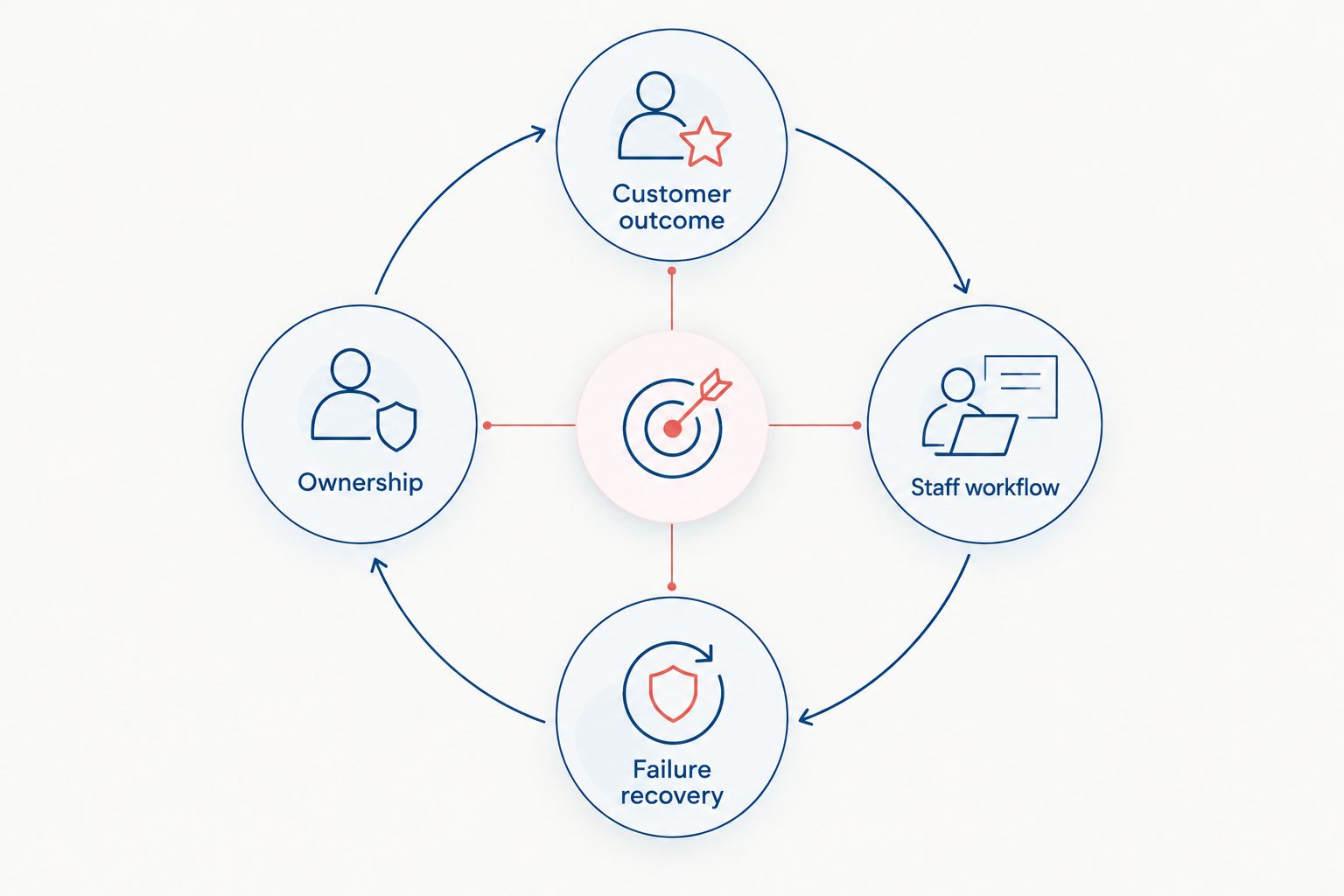
Use this release check:
- Customer outcome: The buyer can complete the intended task and understand its status.
- Staff workflow: An authorised operator can find the record and take the required action.
- Failure recovery: A failed handoff is visible and has a defined resolution path.
- Ownership: Someone is accountable for each system, account and operational exception.
These checks belong in acceptance testing for a 2026 launch. They are not promises of perfect software; they make the boundary between a working release and an unfinished handoff explicit.
Why first-release scope varies
The correct release boundary depends on what must be true for your business to use the software. Geography alone does not define that boundary; your buyers, systems and responsibilities do.
- Buyer workflow. A direct purchase and an approval-based order require different states, permissions and communications.
- Existing platform. Keep supported behaviour where it works. Customise the gap rather than assuming every requirement needs new code.
- System dependencies. An inventory or payment connection belongs in the first release when the customer promise depends on it. An optional reporting connection can wait.
- Language requirements. If your intended buyers need Arabic and English to complete the journey, include the relevant content, layout and testing in scope. Do not add languages without identifying the audience they serve.
- Data and access. Define who can see customer records, change an order and access production systems. Permissions are functional requirements, not an administrative afterthought.
- Automation risk. A rule-based action and an AI-generated answer need different acceptance tests. Include review and fallback behaviour wherever an incorrect output affects the transaction.
For your 2026 brief, convert each factor into a decision with an owner. An unresolved dependency is not a smaller scope; it is work whose boundary remains unknown.
Does your first release need AI?
Your first release needs AI only when a specific task benefits from it and you can judge the output. Adding a chatbot does not establish that the underlying ordering or support workflow works.
Start with the decision the system must assist. For example, a product-information assistant needs an approved information source, examples of acceptable answers and a response when the available information is insufficient. Keep transactional actions outside its authority unless the release explicitly defines and tests those actions.
Our position: use a simpler rule or existing feature when it meets the requirement. AI adds another behaviour to evaluate, monitor and maintain. That trade-off is justified by a useful task, not by including AI in the project description.
Thefiniteloop offers AI strategy and product development alongside ecommerce development. For a first release, the buying decision is whether an AI component has a clear job and a controlled failure path—not whether it can be added.
How do you know your MVP is ready to launch?
Your MVP is ready when the agreed customer journey passes its acceptance tests, staff can operate it and the business controls the assets needed to run it. A demonstration of the happy path is not enough.
Set 3 release gates: customer completion, operational recovery and ownership handover. These are recommended decision gates, not an industry benchmark. Give each gate a named approver and written evidence.
For customer completion, test the intended journey with representative inputs. For operational recovery, test failed payments, unavailable dependencies and invalid submissions wherever they apply. For ownership handover, confirm access to the repository, hosting accounts, deployment instructions and required third-party services.
Agree what blocks launch and what can enter the backlog. A cosmetic adjustment and an inaccessible customer order should not receive the same treatment. Record the distinction before final acceptance, when commercial pressure makes scope arguments harder to resolve.
What should you ask a Dubai software company before approving scope?
Ask the development company to explain the release boundary, its exclusions and the evidence required for acceptance. Request answers tied to your workflow rather than a generic list of technologies.
Your buying discussion should settle these points:
- Which buyer and business outcome does this release serve?
- Which existing capabilities remain in place, and why?
- Which integrations are essential, and who supplies access and documentation?
- What happens when a dependency fails?
- Which tasks remain manual, and who performs them?
- What exactly transfers to your business at handover?
Turn the answers into a brief for a software development company in Dubai. Keep assumptions separate from agreed requirements, and name the person responsible for resolving each assumption.
For a 2026 procurement decision, compare proposals against the same acceptance boundary. A proposal that excludes integration testing or operational handover describes a different release, even if the screen list looks identical.
Define your first release
Discuss the customer journey, essential integrations and ownership decisions behind your ecommerce project.
FAQ
What should an ecommerce MVP include?
An ecommerce MVP should include a complete buying journey, the operational workflow behind it and the controls needed to handle failures. Add integrations and permissions when the customer promise depends on them.
Do I need a custom platform for my first release in Dubai?
You need a custom platform only when existing capabilities cannot support the required business workflow. Check configuration and focused extensions before approving a replacement.
Can we handle some tasks manually in the first release?
You can keep tasks manual when a named operator can perform them reliably and record the outcome. Do not use manual work to conceal failed transactions or unclear responsibilities.
Should Arabic be included in the first release?
Include Arabic when your intended launch audience needs it to complete the customer journey. Define the required content, layout and acceptance tests instead of treating translation as a final cosmetic task.
Should we add an AI chatbot to our MVP?
Add an AI chatbot only when it has a defined task, approved information sources and testable output requirements. A chatbot is not a substitute for a working order or support process.
How do I compare software development proposals for an MVP?
Compare proposals against the same customer journey, integrations, failure handling and handover requirements. A shorter feature list does not explain whether the proposed software is operationally complete.
Who should control the source code and hosting accounts?
Your contract should explicitly name who owns the source code and controls the hosting and third-party accounts. Confirm the required access and handover evidence before accepting the release.
One last thing
Write the rollback decision before you approve the launch. State which failure would require you to stop the new journey, who makes that decision and how customers and staff will continue operating.
That instruction exposes dependencies a feature list misses. If you cannot explain how to pause the release without losing track of customer work, resolve that operating gap before adding another feature.
Related guides
- What drives software development costs in Dubai?
- Should your Dubai software project include AI?
- Who owns the code when you hire a Dubai software company?
Your project next
Let’s build what matters
Schedule a consultation to discuss your goals and technical needs.
5 thoughts on “What belongs in your first software release in Dubai?”