

Yes—agentic AI is production-ready for bounded ecommerce tasks when you restrict its permissions, test its decisions, and provide a safe fallback. In 2026, start with read-only assistance or approval-gated actions; do not treat a working demonstration as permission to change orders, issue refunds, or modify inventory without controls.
- Agentic AI is production-ready for ecommerce only within tested permissions, explicit approval rules, and recoverable workflows.
- Use read-only access first; require approval before consequential order, refund, or inventory changes.
- Thefiniteloop’s position: keep predictable ecommerce rules in code; use agents where interpretation adds value.
- Measure completed tasks, incorrect actions, escalations, and recovery—not just convincing answers.
Is agentic AI ready for production use in ecommerce?
Production readiness belongs to a specific workflow, not to an agent platform or model. An assistant that retrieves an authenticated customer’s shipment status has a different risk profile from an agent that changes a delivery address after fulfillment begins.
Before commissioning development, define the permitted action and its failure conditions. A useful starting point is how to scope an AI pilot: establish the business task, data boundaries, acceptance tests, and owner before selecting tools.
| Approach | Best for | Benefit | Limitation | Recommendation |
|---|---|---|---|---|
| Rules-based automation | Stable, explicit business rules | Predictable execution and clear testing | Handles ambiguous requests poorly | Prefer when the decision fits established rules |
| Read-only agent | Interpreting questions and retrieving permitted records | Supports flexible questions without changing commerce records | Can still disclose data or provide incorrect answers | Start here when interpretation is necessary |
| Approval-gated agent | Proposing consequential changes for staff review | Separates interpretation from permission to act | Requires review capacity and current transaction checks | Use before expanding write access |
| Autonomous agent | Narrow, recoverable actions with tested boundaries | Removes a manual approval step | Incorrect actions can affect customers and connected systems | Permit only after task-specific acceptance tests |
These are architectural choices, not a maturity ladder that every retailer must climb. A read-only assistant can remain the correct production design indefinitely.
Why this matters
An ecommerce answer can become an operational commitment. Saying that an order qualifies for cancellation is different from checking its current fulfillment state and successfully canceling it across connected systems.
A 2026 buying decision should therefore focus on authority rather than conversational fluency. Ask what the agent can read, what it can change, and what happens when a dependency fails halfway through an action.
Thefiniteloop’s position is to keep explicit commerce rules in code and use agentic AI where interpreting an unclear request adds value. Adding an agent to a predictable integration creates another component to test without necessarily improving the business process.
Read-only agents: start with restricted access
A read-only agent can interpret a customer’s question, retrieve permitted information, and explain the result. Suitable starting tasks include authenticated order-status lookup, product-information retrieval, and internal support summaries.
Read-only does not mean risk-free. An assistant can expose another customer’s information, misread a policy, or present an outdated record as current. Enforce customer and staff permissions in the application that retrieves the data—not in a prompt asking the model to behave.
For your first production release, separate public product information from authenticated customer records. Require the retrieval layer to apply access rules before information reaches the model, and define when the assistant must refuse or escalate.
Best for: ecommerce teams that need flexible information retrieval without transaction changes. The trade-off is that customers or staff still complete the resulting action elsewhere.
Approval-gated agents: separate proposals from execution
An approval-gated agent prepares a proposed action for an authorized person to review. For example, it can assemble a cancellation request with the relevant order, current status, applicable policy, and intended change.
Approval must apply to a specific action against a specific record. A vague confirmation such as approving the agent’s general plan is insufficient when the order or fulfillment status can change before execution.
Recheck the transaction state immediately before writing. If the reviewed conditions no longer apply, stop and request a fresh decision rather than silently adapting the approved action.
Best for: workflows where interpretation helps but mistakes affect customers or commerce records. The limitation is review workload: approval gates need a named owner and a usable queue, not an unattended inbox.
Autonomous agents: constrain the action, not just the conversation
Autonomous execution belongs inside a narrow permission boundary. Define the allowed action, required evidence, prohibited changes, and recovery path in application logic.
A proposed internal support classification is different from a financial transaction. Even an apparently modest action, such as updating an address, needs checks against fulfillment status and the identity of the person requesting it.
For a 2026 release, resist broad tool access followed by a long instruction prompt. Expose only the operations the workflow needs, validate their arguments, and reject requests outside the permitted scope.
Best for: explicitly bounded, recoverable workflows that pass their acceptance tests. The downside is additional engineering for authorization, monitoring, exception handling, and recovery; autonomy does not remove that work.
Why agentic AI production readiness varies
Readiness changes with the workflow’s consequences and dependencies. Assess these factors before choosing the level of autonomy:
- Action authority: Reading a permitted record and changing a transaction require different controls. Define permissions separately for each operation.
- Data quality: Missing product attributes, contradictory policies, and stale order records leave the agent without reliable evidence. Fix the source rather than asking the model to infer an answer.
- Integration behavior: Timeouts and repeated requests create uncertainty about whether an action completed. Require safe retry behavior and transaction reconciliation.
- Recoverability: An internal label and a dispatched shipment have different reversal paths. Document the consequence before approving automation.
- Evaluation coverage: Straightforward questions do not establish readiness for ambiguous requests, access violations, or interrupted writes. Test those conditions explicitly.
- Operational ownership: Someone must maintain policies, investigate incidents, and authorize releases. An agent without an accountable owner is not ready for unattended operation.
These factors explain why a successful support demonstration does not establish readiness for refunds, inventory allocation, or fulfillment decisions.
How do you move an ecommerce agent into production safely?
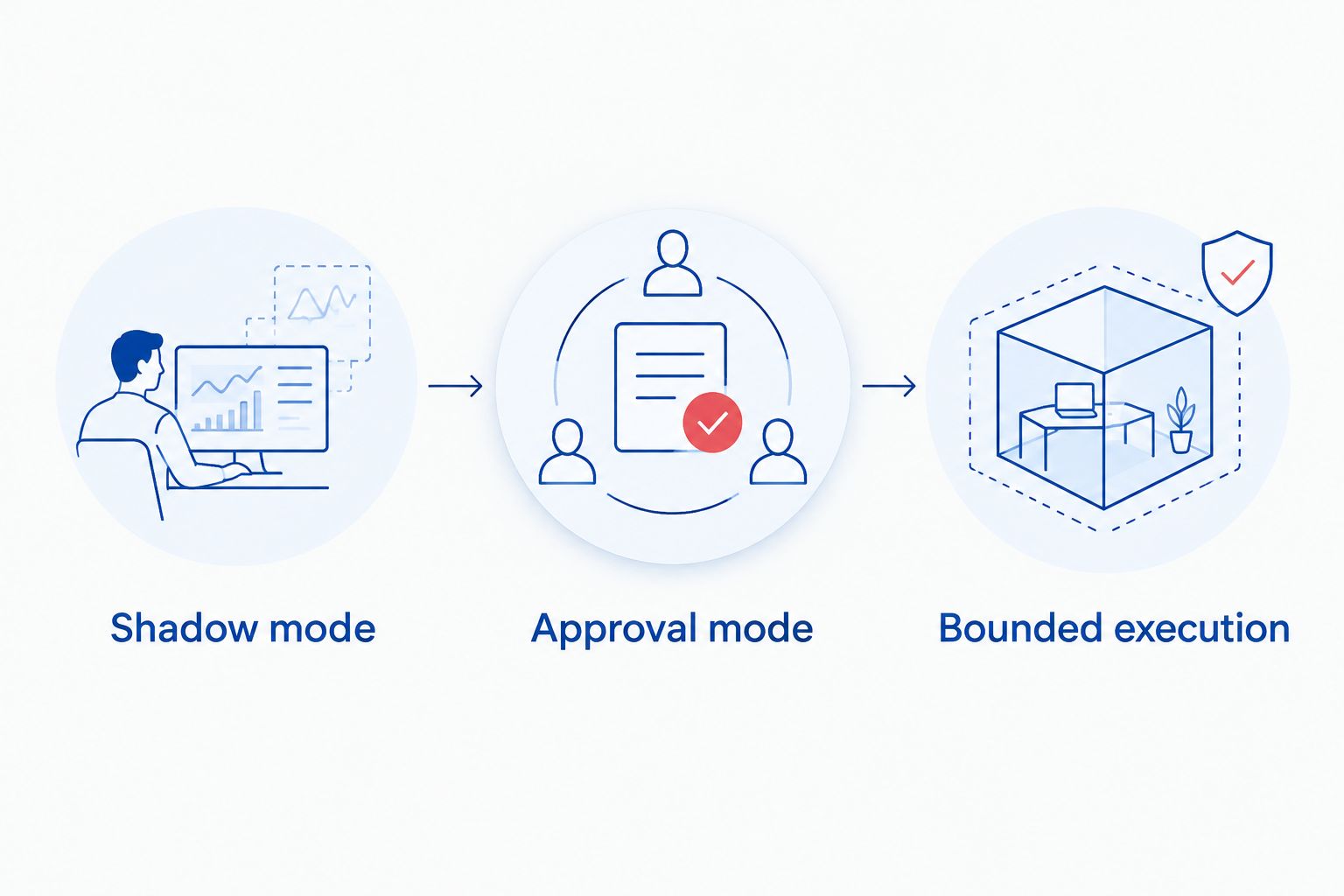
Use 3 release stages: shadow mode, approval mode, and bounded execution. Each stage needs an exit decision based on observed behavior, not a calendar date.
1. Define the task
Write the workflow as a business operation: identify the requester, required evidence, allowed response, permitted action, and escalation condition. Replace broad instructions such as helping customers with an explicit boundary, such as retrieving an authenticated customer’s shipment status without modifying the order.
Name the accountable business owner. Engineering can implement permissions, but the business must decide which outcomes are acceptable.
2. Build the evaluation set
Create examples from approved business scenarios, with expected outcomes reviewed by the relevant operator. Include unclear requests, conflicting records, unauthorized access attempts, and instructions embedded in retrieved content that try to redirect the agent.
Test the action as well as the answer. A response that sounds correct still fails if it selects the wrong record or submits an unauthorized change.
3. Run shadow mode
In shadow mode, the agent proposes decisions without changing live records. Compare its proposals against approved outcomes and inspect disagreements.
Keep the test representative of the intended workflow. An agent evaluated only on public catalog questions has not demonstrated readiness for authenticated order support.
4. Introduce approval mode
Show the reviewer the proposed action, supporting evidence, target record, and expected consequence. Record approval or rejection alongside the final execution result.
Do not turn human review into a ceremonial confirmation. The reviewer needs enough information to detect a wrong customer, stale state, or policy mismatch.
5. Permit bounded execution
Allow autonomous actions only within the tested boundary. Keep authorization checks outside the model, validate tool inputs, and stop execution when required evidence is missing.
Use idempotency where an operation supports it: repeated submission of the same intended action should not create duplicate effects. For the surrounding integration design, review recovering safely from failed syncs.
6. Exercise recovery
Test how an operator disables writes, finds affected records, and determines what actually happened. A timeout must not leave the support team guessing whether an action succeeded.
Treat rollback carefully. Reverting software does not automatically reverse an order change already accepted by another system.
The release sequence is shadow mode, approval mode, then bounded execution. Returning to an earlier stage after a material change is a control, not a failure.
What should you require before accepting delivery?
For a 2026 procurement decision, request 4 acceptance artifacts: a permission map, an evaluation report, an operating runbook, and a handover record. These make the system inspectable beyond its demonstration.
- Permission map: List data sources, exposed operations, access rules, approval requirements, and prohibited actions.
- Evaluation report: Show test scenarios, expected outcomes, observed failures, and the conditions that block release.
- Operating runbook: Explain monitoring, escalation, disabling execution, investigating incidents, and reconciling uncertain actions.
- Handover record: Identify ownership of the repository, infrastructure, credentials, model configuration, and evaluation assets.
Measure task completion alongside incorrect actions, unauthorized attempts, escalation behavior, response time, and resource consumption. Set acceptance thresholds for your workflow before reviewing results; there is no universal percentage that proves an ecommerce agent is safe.
Thefiniteloop is a fit for ecommerce teams seeking custom agentic AI pilots and ecommerce development. A custom engagement is not the default answer, however: retain existing automation when it already meets the task and exception requirements.
Define your agent’s production boundary
Start with the workflow, integration risks, permissions, and acceptance criteria.
Should you rebuild your ecommerce platform to add an agent?
No—do not make a platform rebuild the default prerequisite for an agentic AI project in 2026. First determine whether your existing systems expose the records and operations the workflow requires.
A restricted integration layer can separate agent access from the rest of the store. If the platform lacks reliable identity checks, usable transaction interfaces, or clear data ownership, address those specific gaps before discussing a replacement.
Thefiniteloop’s recommendation is to scope the missing capability, not assume the entire platform is the problem. A rebuild becomes a separate business decision with its own evidence and acceptance criteria.
FAQ
Is agentic AI production-ready for ecommerce in 2026?
Yes, for bounded ecommerce workflows with tested permissions, explicit acceptance criteria, monitoring, and recovery. Readiness for information retrieval does not establish readiness for refunds or order changes.
What is the safest first ecommerce task for an agent?
Start with a read-only task that retrieves permitted information and cannot change commerce records. Authenticated order-status lookup still requires access controls and checks for incorrect or outdated answers.
Can an ecommerce agent issue refunds automatically?
Permit automatic refunds only within explicitly authorized and tested business rules. Keep approval gates where exceptions require judgment, and verify the transaction state before execution.
Is an agent better than rules-based ecommerce automation?
An agent is useful when interpreting variable requests is part of the task; rules-based automation is preferable for stable, explicit decisions. Compare both against the same business outcome before choosing.
How do I stop an agent from following malicious product-page instructions?
Treat retrieved content as untrusted data and enforce permissions outside the model. Test attempts to redirect the agent, restrict available operations, and validate proposed actions before execution.
What should happen when an agent cannot confirm whether an order changed?
Stop further execution and reconcile the transaction against the authoritative system. Do not blindly repeat an action that might already have succeeded.
Do I need a new ecommerce platform before adding agentic AI?
No, a new platform is not an automatic requirement. Assess the existing platform’s access controls, transaction interfaces, and data quality against the specific workflow first.
One last thing
The most valuable acceptance test is not a successful answer. It is a controlled stop. For your 2026 release review, introduce an authorization failure, stale order state, or uncertain transaction result and require the system to demonstrate its response.
If the agent keeps acting when it cannot establish permission or confirm state, reduce its authority. A useful agent completes the permitted task—and knows when the application must prevent it from continuing.
Related guides
- How to accept software delivery before final payment
- How to test AI product search for a GCC ecommerce store
- What an AI support assistant should refuse to answer
Your project next
Let’s build what matters
Schedule a consultation to discuss your goals and technical needs.