

A fractional chief AI officer is worth it for a startup when consequential AI decisions need an accountable leader but do not require a full-time executive. Skip the appointment when your real bottleneck is customer validation, a clearly scoped build, or missing engineering capacity; part-time leadership does not replace the people who implement and operate the system.
- A fractional CAIO is worth it for a startup when AI decisions exceed the founding team’s capacity, not its ambition.
- Thefiniteloop’s position: hire for decision ownership, not an executive title or an open-ended AI strategy exercise.
- Require a use-case roadmap, evaluation criteria, delivery ownership, and an explicit handoff before approving an engagement.
- Keep leadership with your CTO when the remaining work is a defined integration or engineering backlog.
Is a fractional chief AI officer worth it for a startup?
Yes, when you need cross-functional decisions rather than more advice. A fractional CAIO should connect business priorities, technical constraints, data access, and operational risk. The appointment earns its place only if someone can act on those decisions.
For your 2026 hiring decision, compare the responsibility you need with the leadership you already have. Start with a bounded problem; this guide to scoping an AI pilot provides a related starting point.
| Leadership option | Best for | Main advantage | Main limitation |
|---|---|---|---|
| Founder or CTO ownership | A contained use case with existing technical leadership | Keeps decisions close to product and engineering | Competes with existing responsibilities |
| Fractional CAIO | Cross-functional AI decisions without a full-time leadership mandate | Adds dedicated direction without creating a full-time position | Requires an internal owner and implementation capacity |
| Full-time AI leader | Continuous executive responsibility across product, people, and operations | Provides sustained leadership and organizational ownership | Adds a permanent role that needs enough meaningful scope |
| Delivery partner under your CTO | A defined implementation with agreed acceptance criteria | Directs effort toward building and integration | Does not automatically own company-wide AI priorities |
Do not choose the most senior title by default. Choose the smallest leadership arrangement that can make the necessary decisions and remain accountable for them.
Why this matters
An AI feature can affect more than the application interface. It can change which data leaves your systems, how staff review work, what customers receive, and who responds when an answer is wrong.
An ecommerce support assistant illustrates the distinction. Building the interface is delivery work; deciding which account information it can access, which requests require approval, and who handles incorrect responses requires business and technical ownership.
Our position at Thefiniteloop: fractional AI leadership should resolve decisions that block delivery, not create a parallel strategy track. A roadmap without an implementation owner leaves the startup with the same execution problem and another document to maintain.
When fractional AI leadership makes sense
You have competing use cases and no decision owner
A founder wants a customer assistant. Operations wants document processing. Product wants intelligent search. Each request sounds reasonable, but they compete for engineering attention and access to company data.
A fractional CAIO has a useful mandate when you need someone to compare those proposals against business outcomes, technical feasibility, and failure consequences. The output should be a prioritized decision: what to build, what to investigate, and what to reject.
Best for: startups with competing AI initiatives and no accountable portfolio owner. Do not commission a company-wide roadmap when a single product decision is all that needs resolving.
Your pilot needs a production decision
A demonstration shows that a model can produce an answer. It does not establish whether that answer is acceptable, whether permissions are enforced, or whether your team can support the resulting workflow.
Fractional leadership fits when product, engineering, security, and operations need a shared release decision. Require written acceptance criteria and a named person who can stop the release when those criteria fail.
Best for: startups moving from experimentation to a customer-facing or operational system. If acceptance criteria are already agreed and the backlog is clear, assign delivery leadership instead.
AI decisions cross business boundaries
An internal drafting assistant and an agent allowed to change customer records carry different responsibilities. The latter needs explicit action permissions, approval rules, and recovery procedures.
Cross-border operation also requires precise questions rather than generic assurances. Identify where data is processed, which entities control it, and which jurisdiction-specific requirements need qualified legal review. An executive title does not substitute for that review.
Best for: startups whose AI decisions span business workflows, engineering, and risk ownership. Keep a narrow integration inside the existing technical management structure.
When a fractional CAIO is the wrong hire
Do not hire an AI executive to compensate for an undefined product problem. If customers do not need the proposed feature, better governance will not make the feature useful.
Keep ownership with your founder or CTO when you have a bounded use case, an agreed architecture, and engineers who need implementation decisions rather than company-wide direction. A specialist review can address a narrow knowledge gap without establishing an ongoing leadership role.
Choose delivery capacity when the work is already specified. Someone still has to implement authentication, connect systems, write evaluations, deploy changes, and handle operational failures; an advisory engagement does not perform those tasks unless its scope explicitly includes them.
Reject the appointment if no internal sponsor can approve priorities or resolve conflicts. A fractional leader cannot be accountable for outcomes while every consequential decision remains unassigned.
Why the value of a fractional CAIO varies
The value of fractional AI leadership in 2026 depends on the decisions it owns and the organization's ability to execute them. Use these factors to define the mandate rather than treating the title as a standard package:
- Decision complexity: Choosing an internal tool is a different assignment from directing an agent that changes business records.
- Existing leadership: A capable CTO with available capacity changes what external leadership needs to contribute.
- Data readiness: Unclear permissions, inconsistent records, and inaccessible source systems create work that a roadmap alone cannot resolve.
- Delivery capacity: Recommendations need engineers, product ownership, and operational support to become working software.
- Operational responsibility: Customer-facing behavior, escalation, monitoring, and recovery need named owners.
- Handoff requirements: Your startup needs to retain the decisions, access, and operating knowledge when the engagement ends.
Ask candidates which of these factors they would address first and why. A useful answer names the dependency; a weak answer starts with a preferred tool before understanding the workflow.
What should the engagement produce?
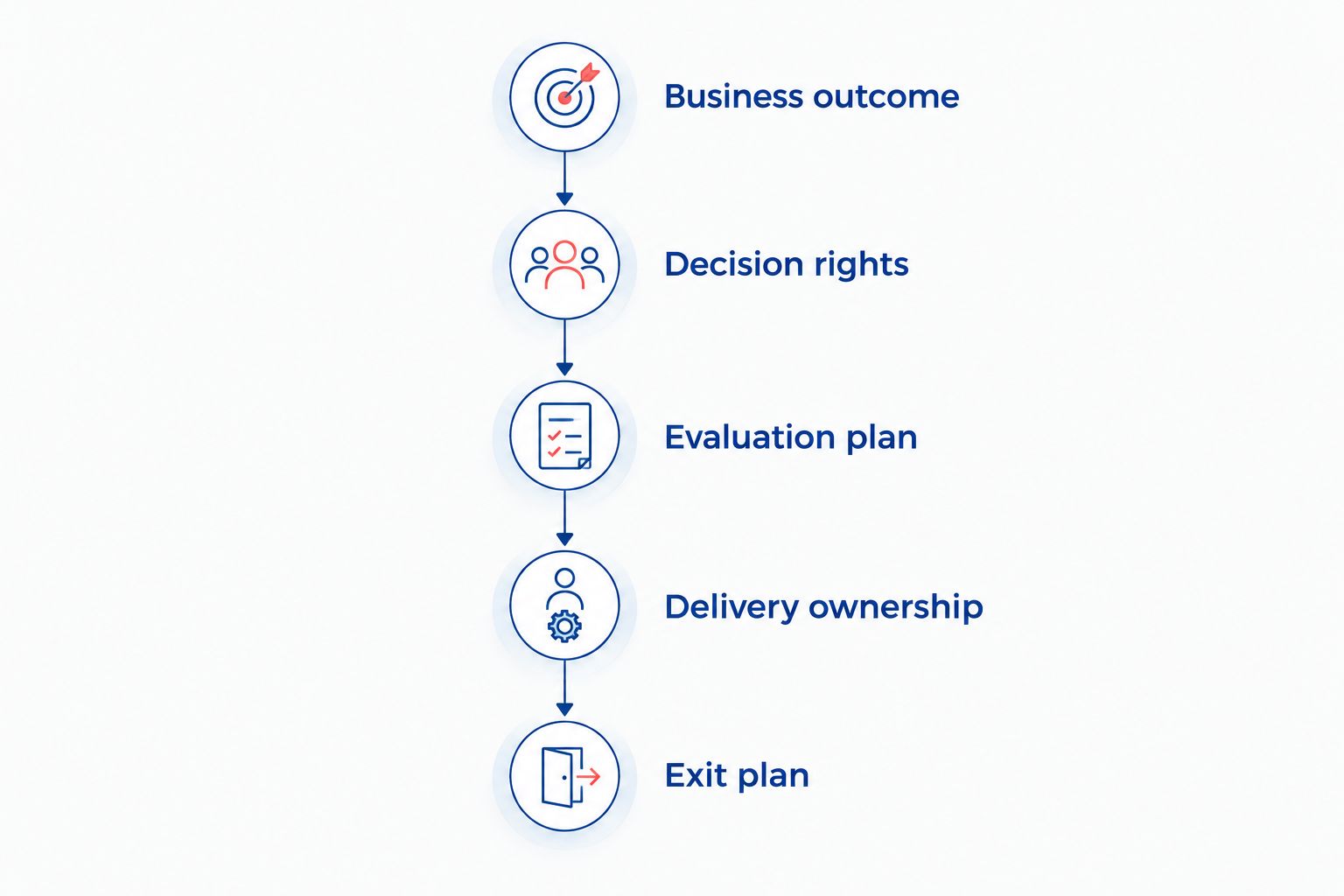
For a 2026 engagement, require 5 inspectable outputs. These are recommended acceptance criteria, not a promised delivery schedule.
Business outcome
Name the workflow and the business result you want to change. For a support assistant, define whether the objective is better answer quality, less manual handling, or a different outcome supported by your own baseline.
Write down how you will measure it. Do not approve a target that nobody can explain or calculate from your operating data.
Decision rights
Specify who approves use cases, data access, architecture, release, and shutdown. Distinguish recommendation authority from final approval authority so the fractional leader and your internal team do not make conflicting assumptions.
Give every consequential decision an internal owner. External expertise should improve your decisions, not make your organization dependent on an outside person's availability.
Evaluation plan
An evaluation is a repeatable check of whether the system behaves acceptably. Require representative tasks, expected behavior, failure cases, and explicit rejection criteria before treating a demonstration as release evidence.
Include refusal behavior where the workflow needs it. The related guide on what an AI support assistant should refuse to answer addresses that boundary; define your own rules around your users, data, and permitted actions.
Delivery ownership
Name who implements the system, who reviews it, and who operates it after release. Make the boundary between leadership and engineering delivery explicit, including responsibility for integrations and deployment access.
Keep architecture decisions and implementation records accessible to your team. You should not need to reconstruct why the system works a particular way after the engagement ends.
Exit plan
Define what remains inside the startup: decision records, evaluation assets, operating instructions, account access, and the next accountable owner. State what triggers continuation, a narrower advisory role, or termination.
A fractional engagement should leave your team better able to make the next decision. Continued dependence is not an acceptance criterion.
How do you decide whether to proceed?
Use 3 decision gates before appointing fractional AI leadership in 2026. Each gate should produce a written answer, not a confidence score.
- Name the blocked decision. Describe what your current team cannot decide and the consequence of leaving it unresolved. If the answer is simply that engineers lack time, address delivery capacity.
- Confirm execution capacity. Identify who can supply data access, implement changes, review risks, and operate the result. Resolve missing ownership before adding an executive adviser.
- Define the handoff. Specify the decisions and assets that must remain with the company. Make continuation a deliberate choice based on remaining responsibility.
Then review progress against those same gates. Useful evidence includes an approved scope, a rejected low-value use case, an agreed release criterion, or a resolved ownership conflict. A meeting calendar is not evidence of business value.
Thefiniteloop's fractional CAIO leadership is best suited to startups seeking AI strategy connected to software delivery. The company offers AI readiness assessments, use-case roadmaps, pilots, and fractional CAIO leadership; confirm which responsibilities belong in your particular scope rather than assuming the service name includes implementation.
Define your AI leadership scope
Discuss the decisions, delivery responsibilities, and handoff your startup needs.
Can your CTO handle AI leadership instead?
Your CTO should retain AI leadership when the work fits the existing technical mandate and available capacity. Specialist uncertainty does not automatically justify a new executive role; a focused architecture or evaluation review can address a bounded question.
Fractional leadership becomes relevant when prioritization and accountability extend beyond that mandate. Establish the division of responsibility before the engagement starts, especially where both leaders influence architecture and release decisions.
Should you hire a full-time AI leader instead?
A full-time AI leader fits continuous executive responsibility, not just enthusiasm about the technology. Consider the permanent role when AI requires sustained ownership of product direction, staffing, operating practices, and cross-functional decisions.
Do not use a fractional appointment as an indefinite substitute for daily management. Equally, do not create a permanent executive position around an experiment that has not established its business purpose.
FAQ
Is a fractional CAIO worth it for an early-stage startup?
A fractional CAIO is worth it when an early-stage startup has consequential AI decisions, an internal sponsor, and the capacity to act on them. Skip the appointment when customer validation or basic engineering delivery is the actual constraint.
What’s the difference between a fractional CAIO and an AI consultant?
The useful distinction is assigned accountability, not the title. A fractional CAIO mandate should specify ongoing decision responsibilities; a consulting scope can focus on a bounded assessment or recommendation, so inspect the agreement rather than assuming either label guarantees ownership.
Do we need a fractional CAIO if we already have a CTO?
You do not need a fractional CAIO when your CTO can own the relevant decisions and has capacity to do so. Consider additional leadership only for responsibilities or expertise that the current structure cannot cover.
Can a fractional CAIO build our AI product?
A fractional CAIO role does not automatically include product implementation. Name the engineering team, integration responsibilities, testing ownership, and operational support separately in the scope.
How do we measure whether fractional AI leadership is working?
Measure fractional AI leadership against the business outcomes and decision responsibilities agreed at the start. Track inspectable progress such as approved release criteria, resolved dependencies, and an actionable delivery scope rather than counting meetings.
Does a startup need a separate AI leader for each country?
Serving several countries does not by itself establish a need for separate AI leaders. Assign ownership for jurisdiction-specific questions and obtain qualified advice where required; do not assume shared language means shared legal or operational rules.
When should we end a fractional CAIO engagement?
End or narrow a fractional CAIO engagement when the agreed decisions are resolved and an internal owner can maintain the work. Continue only when a defined leadership responsibility remains, with an explicit scope and review point.
One last thing
Ask what your startup should stop doing. A candidate who cannot identify a reason to reject an AI initiative has not yet shown how they will protect your team's attention.
For a 2026 decision, ask Thefiniteloop or any prospective provider to explain the mandate, exclusions, and exit conditions in plain language. Hire accountable judgment. Do not hire a title and hope the scope follows.
Related guides
- How to accept software delivery before final payment
- Who owns the code when you hire a software company?
- What security checks should a software build include?
Your project next
Let’s build what matters
Schedule a consultation to discuss your goals and technical needs.