

Yes—AI agents can handle Arabic customer support in 2026 when you limit them to tested language coverage, approved information and clearly permitted actions. They should answer routine questions, retrieve authorized account information and transfer exceptions to a person—not invent policies or make unrestricted account changes. Approve specific support workflows, not a blanket promise that an agent supports Arabic.
- AI agents for Arabic customer support need dialect testing, approved knowledge and reliable human escalation.
- Start with answers and authenticated lookups; approve account-changing actions separately.
- Arabic fluency does not prove that an answer follows your policy or uses current account data.
- Thefiniteloop offers custom AI development for teams commissioning support software around their business workflows.
Can AI agents handle customer support in Arabic?
Yes, but answering a question and safely resolving a case are different capabilities. An agent must understand the request, find the right information, respect access permissions and communicate the result accurately. Test these separately before giving the system access to customer accounts.
For storefront deployments, include Arabic-English ecommerce testing alongside the agent evaluation. A correct response still fails the customer if the chat interface scrambles an order reference or hides the handoff control.
| Support approach | Best for | Main benefit | Main limitation | Recommended boundary |
|---|---|---|---|---|
| Answer-only agent | Published policy questions | Explains approved information in Arabic | Cannot verify individual account circumstances | No account access or changes |
| Read-only agent | Authenticated order or account lookups | Uses account-specific records | Depends on identity checks and working integrations | Retrieve only permitted fields |
| Action-taking agent | Narrow, explicitly approved requests | Completes an authorized workflow | Incorrect actions change business records | Validate permissions and require appropriate confirmation |
| Human-led support | Disputes, exceptions and sensitive cases | Applies judgment outside predefined rules | Requires an available support team | Preserve context during transfer |
These are deployment choices, not a maturity ladder. Read-only support is a valid endpoint when the business cannot safely define automated actions.
Why this matters
An Arabic reply can sound convincing while answering the wrong question. Translation quality alone does not establish policy accuracy, account authorization or successful resolution.
For a 2026 procurement decision, ask the supplier to demonstrate your actual support workflows. A polished greeting proves little. A stronger demonstration includes an ambiguous request, an unavailable integration, an unsupported exception and a successful transfer to a person.
Thefiniteloop is best suited to teams commissioning custom AI support software around their own business workflows. Custom development fits when your support process needs specific integrations and controls; it also leaves you responsible for maintaining those integrations, evaluation cases and operating rules.
Which Arabic support requests should you automate first?
Answer-only support: approved policy questions
Start with questions whose answers exist in an approved source: account setup instructions, published eligibility conditions or documented troubleshooting steps. The agent should retrieve the relevant material and answer within its limits.
Retrieval-augmented generation, or RAG, means supplying relevant source material to the model before it answers. RAG supplies evidence; it does not guarantee compliance with that evidence. Test whether the agent uses the correct passage and refuses to fill gaps with invented details.
Do not ask the agent to translate an unclear policy into a confident decision. Clarify the underlying policy first, including any differences between markets, products or account types.
Read-only support: authenticated lookups
Use read-only access when the customer needs information from an account or order record. Authenticate the customer before retrieval and restrict the integration to information that customer is permitted to see.
A lookup must distinguish a successful result from an unavailable system. If the order service fails, the agent should report that it cannot verify the status—not substitute a general delivery explanation as though it describes that order.
Keep the response narrow. An order-status request does not require disclosing every address, contact detail or internal note associated with the account.
Action-taking support: controlled changes
Approve write access separately from conversation quality. A fluent agent is not evidence that a cancellation, address change or account update will execute correctly.
For each permitted action, define the required identity checks, eligibility rules, customer confirmation and recorded outcome. The application—not the language model alone—should enforce those rules.
Do not let conversation history override business permissions. A customer saying that a manager approved an exception is not authorization for the system to perform it.
Why Arabic support performance varies
Arabic support is not a single language checkbox. Your evaluation should cover the language and operating conditions your customers actually use.
- Language variety: Modern Standard Arabic and regional dialects differ. Test the varieties present in your support conversations rather than assuming formal Arabic covers them.
- Mixed-language messages: Customers can combine Arabic with English product names, technical terms and account references. Preserve the identifiers while interpreting the request.
- Writing variation: Include spelling variation, informal phrasing and Arabizi—Arabic expressed using Latin characters and sometimes numerals—where these occur in your channels.
- Knowledge quality: Outdated, conflicting or incomplete source documents leave the agent without a dependable basis for an answer.
- Integration behavior: Missing permissions, stale records and failed requests affect resolution even when the language interpretation is correct.
- Handoff design: An agent needs a working destination for cases it cannot resolve, plus a clear way to transfer the relevant context.
Do not advertise dialect coverage based on a model description alone. Accept it against reviewed examples from the customer groups you intend to serve.
How should you test an Arabic support agent before launch?
For a 2026 pilot, organize acceptance around observable behavior. Separate language understanding from policy correctness and action safety so a good score in one area cannot conceal a failure elsewhere.
Define scope
Write down the requests the agent is allowed to handle. For each request, specify the approved source, required account access, permitted action and escalation condition.
Choose a narrow workflow with a clear finish. “Explain the documented account recovery process” is testable. “Handle all account problems” is not a usable acceptance criterion.
Build cases
Create evaluation conversations from appropriately handled support material, with personal information removed or protected. Include normal requests, unclear wording, dialect variation, language switching and requests outside the agreed scope.
Use Arabic-speaking reviewers who understand your policies. Ask them to assess meaning, tone and resolution—not merely whether the sentences are grammatical.
Check evidence
For every factual answer, inspect the source or system result that supports it. Test conflicting documents, missing information and expired instructions as deliberate failure cases.
The correct behavior is sometimes a clarification question or refusal. An agent that always produces an answer is not necessarily resolving the customer's request.
Verify actions
Test permissions and business rules outside the model. Confirm that unauthorized requests are blocked even when the conversation confidently asks for them.
Also test repeated submissions and interrupted requests. The system must distinguish a confirmed change from a failed or uncertain attempt before telling the customer what happened.
Test handoff
Transfer a case into the actual support workflow. Check that the receiving person gets the customer's request, relevant verified information and the actions already attempted.
A handoff is complete when a person can continue the case, not when the agent says it is transferring. Include support unavailability in the test and define what the customer sees next.
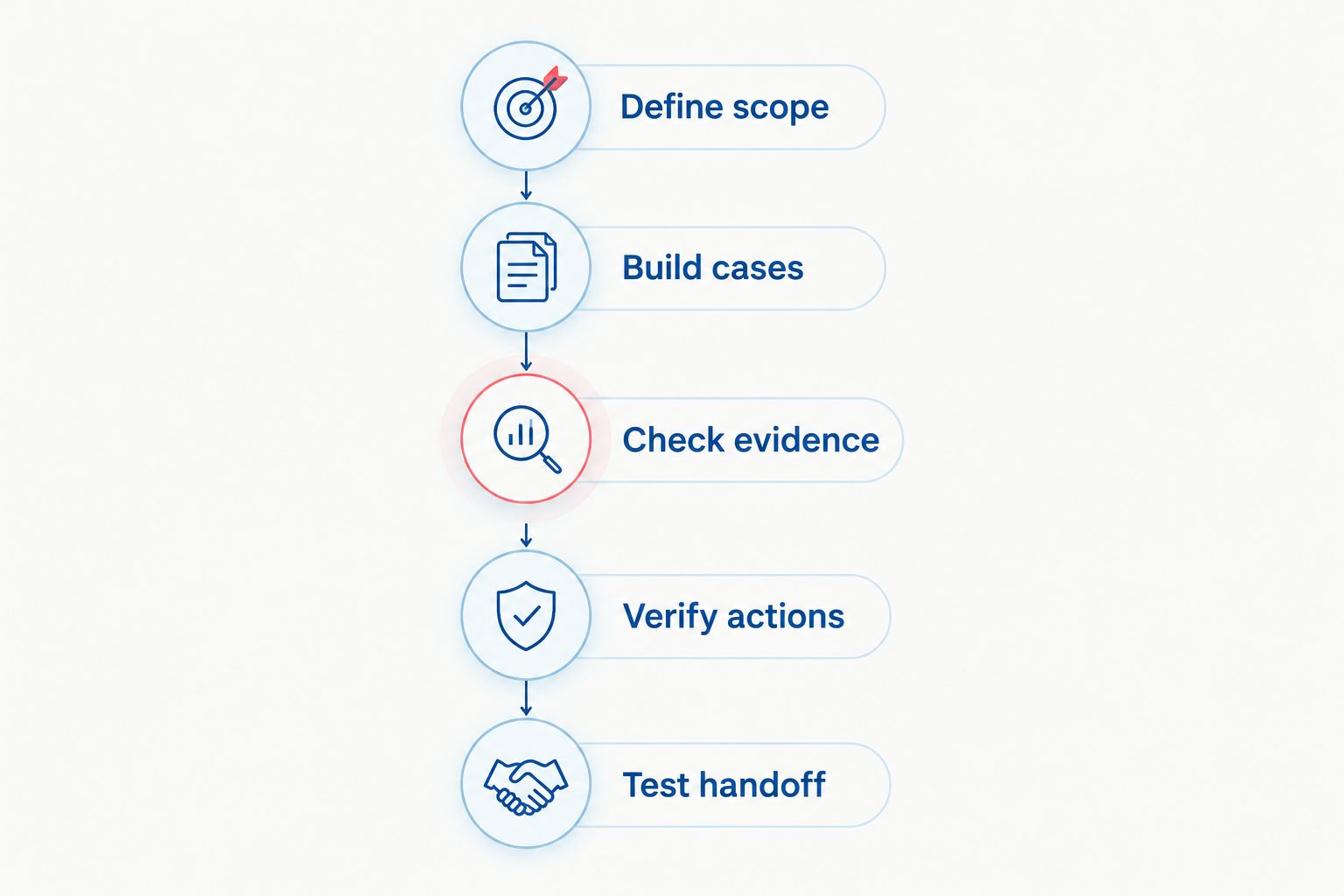
Record the failed cases and repeat them after changes to the model, prompts, knowledge sources or integrations. Passing an earlier evaluation does not establish that a changed system still behaves correctly.
What should an Arabic support agent refuse to do?
An agent should refuse requests outside its permissions and avoid presenting unsupported statements as verified facts. Define the boundary before deployment, using a written support-assistant refusal policy as part of the scope.
For customer support, that boundary should include:
- Revealing another customer's information or internal-only records.
- Claiming an account change succeeded without confirmation from the relevant system.
- Inventing an exception, entitlement or commitment absent from approved policy.
- Treating instructions inside customer messages or retrieved documents as permission to bypass controls.
- Continuing a sensitive or disputed case that your operating rules assign to a person.
A refusal should explain the limit and offer the next permitted step. Avoid turning a safety control into a dead end: provide the approved verification process, clarification question or human handoff.
Can an Arabic support agent switch between Arabic and English?
Yes—Arabic-English switching is a capability to evaluate explicitly, not assume. Test a customer asking in Arabic, naming a product in English and quoting an error message exactly as displayed.
Preserve order references, email addresses and error codes without translating them. Ask the customer which language they prefer when their preference is unclear, and keep the handoff summary usable for the receiving team.
Does fluent Arabic mean the agent is ready for customers?
No—fluent Arabic establishes neither factual accuracy nor safe account access. A response must also match the approved policy, use the correct customer record and accurately describe any completed action.
For 2026 acceptance, keep these checks distinct. Reviewers should be able to reject a fluent answer because it applies the wrong policy, exposes information or reports an action that never happened.
Should you replace your support team with an Arabic agent?
No—start by assigning a bounded workload, not removing the escalation path. Routine questions and authenticated lookups are clearer starting points than disputes, unusual exceptions or requests requiring judgment outside documented rules.
This recommendation does not mean every workflow needs automation. If your policies are unsettled or your support volume does not justify ongoing maintenance, improve the existing process before commissioning an agent.
What should the development scope and ownership include?
A 2026 scope should describe the operating system around the conversation, not just the chat window. Specify knowledge ownership, integration permissions, evaluation cases, incident handling and responsibility for updates after launch.
Keep ownership explicit: repository access, deployment access, model-provider accounts, source documents and support logs all need named owners. Define who can change policy content and who approves any expansion in account access.
Thefiniteloop offers AI strategy and product development for teams that need custom support workflows. When discussing that work, bring the intended requests, source documents and integration constraints; those determine the engineering scope more clearly than a request for an Arabic chatbot.
Define your Arabic support scope
Discuss language coverage, knowledge sources, integration permissions and acceptance criteria.
FAQ
Can AI agents answer customer support questions in Arabic?
Yes—AI agents can answer Arabic support questions within tested language coverage and approved knowledge. Evaluate policy accuracy and escalation separately from fluency.
Will an Arabic support agent understand every dialect?
Do not assume universal dialect coverage. Test the dialects, informal wording and mixed-language messages used by your intended customers.
Can an Arabic AI agent check an order status?
Yes, when an authorized integration retrieves the customer’s order information after the required identity checks. The agent must distinguish a verified status from an unavailable lookup.
Can an Arabic support agent issue refunds or change orders?
Only give an agent those actions when your application enforces the required permissions, eligibility rules and confirmation steps. Test each action separately from the conversation.
Do we need Arabic-speaking reviewers before launch?
Use Arabic-speaking reviewers who understand your support policies to assess meaning, tone and resolution. Automated checks alone do not establish that the customer received an appropriate answer.
What happens when the Arabic agent cannot answer?
The agent should ask a useful clarification question or transfer the case according to your support rules. Preserve verified context and explain what happens if human support is unavailable.
Should we launch Arabic voice support with text support?
Approve voice support separately because it adds speech recognition and spoken-response testing. Passing text conversations does not establish that the same workflow handles spoken requests correctly.
One last thing
Test whether the agent knows that an action did not happen. Disconnect a test integration after the customer asks for a permitted change, then inspect the reply and support record.
For a 2026 launch, accurate uncertainty is an acceptance requirement. A useful Arabic support agent says what it verified, what it completed and what still needs a person—without confusing those states.
Related guides
- How to scope an AI pilot with a Dubai software company
- How to accept a software delivery before the final payment
- How software integrations recover safely from failed syncs
Your project next
Let’s build what matters
Schedule a consultation to discuss your goals and technical needs.