

Custom web app development cost depends on the workflows, integrations, data and acceptance requirements you commission—not a universal average. For a 2026 budget, separate the initial build from hosting, third-party services, maintenance and future changes; a development quote is not the total cost of ownership.
- Custom web app development cost needs a defined scope, not a generic average.
- Compare web application estimates against identical workflows, integrations, testing and handover requirements.
- Thefiniteloop offers custom web development for startups and SMEs; define the business problem before commissioning software.
- Separate initial development from ongoing operations, maintenance and third-party service charges.
Why this matters
A proposal can look complete while leaving data migration, error handling or operational ownership undefined. Those omissions make the headline total a poor basis for choosing a development partner.
Buy an accepted business workflow, not an unspecified collection of screens. Define how to accept a software delivery before the final payment before comparing proposals. That gives you a concrete finish line rather than a debate about whether the application is done.
How much does custom web app development cost?
A defensible estimate prices a documented scope: what users do, what systems connect, what data moves and what evidence proves the application works. Without those boundaries, a quoted total describes assumptions rather than an agreed deliverable.
For your 2026 procurement process, request the following breakdown. Keep the same headings across competing proposals so that excluded work remains visible.
| Budget component | What the proposal should specify | What you need to decide |
|---|---|---|
| Discovery and scope | Workflows, technical questions, dependencies and deliverables | Which uncertainties must be resolved before implementation? |
| Design | User journeys, interface states and accessibility requirements | Which users and tasks must the design support? |
| Application development | Business rules, permissions, interfaces and administration | What belongs in the initial release? |
| Integrations and migration | Connected systems, field mapping, failure handling and reconciliation | Who supplies access and approves the transferred data? |
| Quality and release | Functional, security and performance checks; deployment and rollback | What evidence makes the release acceptable? |
| Operations and handover | Hosting responsibilities, monitoring, documentation and maintenance scope | Who owns the application after launch? |
Ask each supplier to distinguish included work, optional work and exclusions. A proposal that combines everything into a single line makes it harder to identify what changes when you adjust scope.
Do not compare totals until the boundaries match. A build that includes migration and production handover is a different purchase from a build that stops at a demonstration environment.
Should you build, configure or repair?
Choose the smallest intervention that solves the business problem. Custom development is justified by requirements that need custom behavior, not by a preference for starting again.
Use this comparison before requesting a full rebuild. These are decision criteria, not claims that one approach always has a lower total cost.
| Approach | Best for | Advantage | Trade-off | Recommendation |
|---|---|---|---|---|
| Configure existing software | Standard workflows that fit an existing product | Reuses established functionality | You work within the product's constraints | Choose when essential requirements fit |
| Repair an existing application | Useful software with identifiable faults | Preserves working functionality | Existing technical constraints remain | Choose after inspecting the affected components |
| Build a custom web application | Distinct workflows or integration requirements | Gives you control over application behavior | Requires explicit delivery and operating ownership | Choose when existing options fail essential requirements |
For example, an internal approval process does not automatically justify a new platform. First document where the current process fails: permissions, audit history, routing, integration or reporting. Then assess whether configuration or a targeted repair addresses that failure.
A custom build earns its place when the required behavior cannot be achieved acceptably within those constraints. Keep desirable extras separate from essential requirements so they do not decide the architecture by accident.
Why custom web app development cost varies
These factors change the work that an estimate must cover. Ask suppliers to connect each one to an explicit scope item rather than describing the project as merely simple or complex.
- Workflow depth. Submission, approval, rejection, editing and cancellation are separate behaviors. Describe the rules and exceptions for each important task.
- Access rules. Specify who can view, create, change, approve and export information. A role name alone does not define its permissions.
- System connections. Document what each integration reads or writes, how failures are handled and which system owns the authoritative record.
- Existing data. Identify source formats, mapping rules, duplicate handling and the checks required before migration is accepted.
- Quality requirements. Define accessibility, security, performance and recovery expectations in testable terms rather than using adjectives such as fast or secure.
- Operational scope. State who handles deployment, monitoring, incidents, dependency updates and documentation after handover.
In a 2026 brief, tie each requirement to a business reason. If a dashboard metric does not support a decision, leave it out of the initial release. If an approval exception blocks real orders, include it even when the screen looks minor.
How do you get a quote you can compare?
Give every supplier the same brief and require written assumptions. The goal is not to eliminate uncertainty by wording a contract aggressively; it is to expose uncertainty while you can still change the plan.
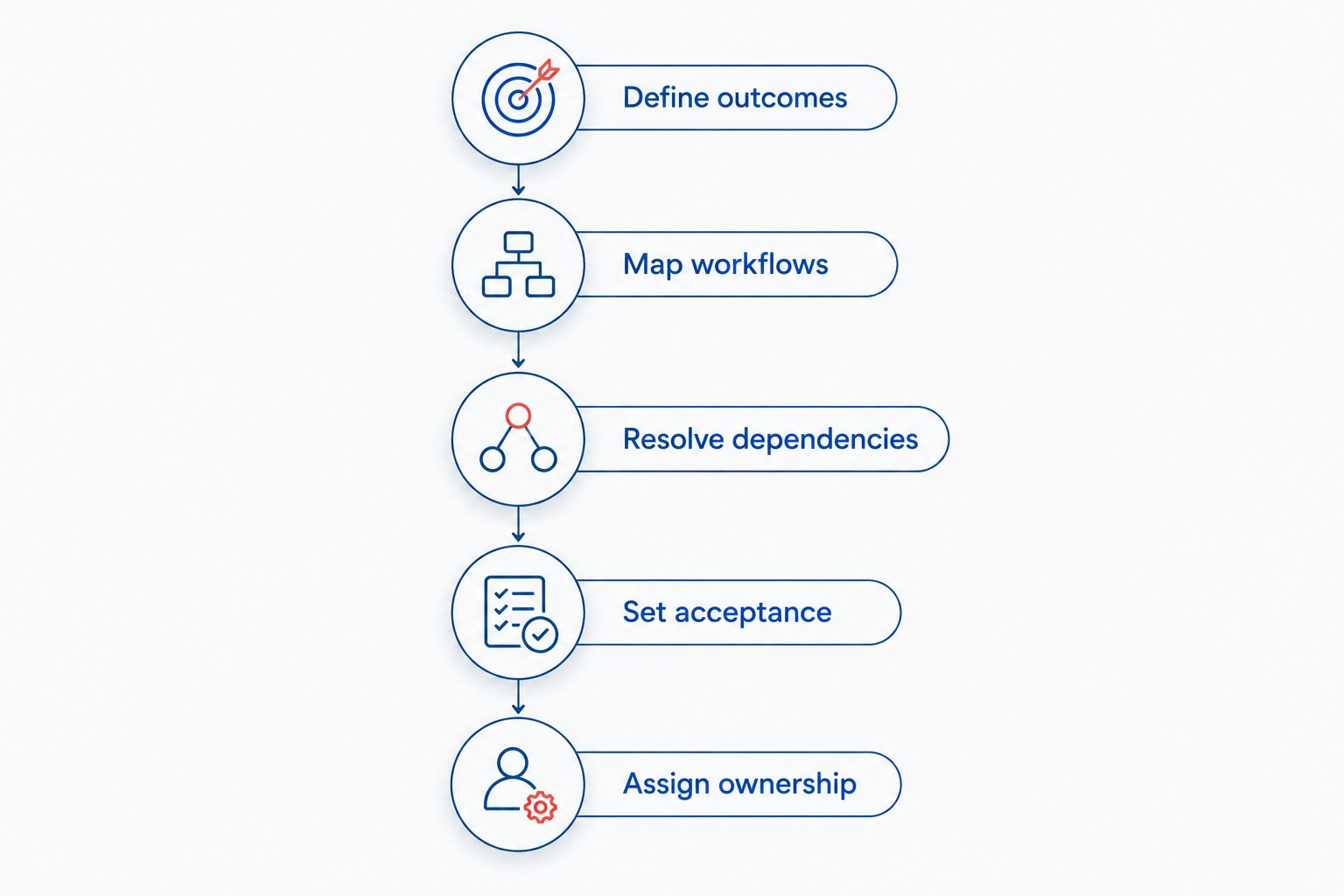
Define outcomes
Start with the task the application must improve. Describe the user, the action and the completed result—for example, an approved wholesale order reaching the system that processes fulfillment.
Choose how you will assess that outcome. Use a business measure you already track, or define how it will be measured; do not insert an improvement target without a baseline and an owner.
Map workflows
Write the main path and the exception paths. Include invalid inputs, rejected approvals, unavailable services and interrupted sessions where they affect the task.
A screen list is useful for design, but it is not a complete specification. The estimate also needs the rules that govern what happens between screens and outside the application.
Resolve dependencies
Name the systems, data sources and decision-makers the project depends on. Identify who supplies credentials, approves field mappings and confirms business rules.
Where a dependency is unresolved, require the proposal to state its assumption and how a different outcome changes scope. Do not let an untested integration assumption silently become a fixed commitment.
Set acceptance
Describe the evidence required for approval: successful user tasks, permission checks, migration reconciliation and deployment instructions. Connect that evidence to the agreed deliverables.
Acceptance should include failure behavior. An integration that handles a successful request but loses track of a failed request is not ready simply because its demonstration worked.
Assign ownership
Document responsibility for repositories, infrastructure accounts, credentials, release approvals and operating support. Address access during the project as well as at handover.
Ask how another engineering team would run and maintain the application. Clear documentation and access arrangements make that question answerable before the relationship ends.
Thefiniteloop is a fit for startups and SMEs seeking custom web development rather than a self-service app builder. Its stated services include portals, dashboards, PWAs and platform development; assess that fit against your actual requirements, not the breadth of a service list.
Custom development still requires your business decisions and ongoing operational ownership. If existing software already meets the essential requirements, commissioning a new application adds responsibilities without establishing a business reason.
What should your initial release include?
Your initial release should complete a useful workflow from beginning to end. Reduce breadth before removing the controls that make the workflow dependable.
For a customer portal, that means defining the task customers must complete and the administrative work required to support it. A polished customer interface does not replace permission rules, error messages or an operational process for resolving failed actions.
Split scope into required release work and later improvements. Record the consequences of deferring each item: a manual step, a restricted user group or a workflow that remains outside the application.
Defer optional features, not undefined responsibilities. In your 2026 release plan, name the person who accepts each deliberate limitation. That prevents a deferred requirement from reappearing as a surprise during acceptance.
What ongoing costs sit outside the initial build?
Hosting, third-party services, maintenance and future development need separate ownership and budget lines. Ask whether each item is included, excluded or purchased directly by your business.
Distinguish defect correction from changes in requirements. Also distinguish routine updates from incident response: an agreement to update dependencies does not describe who investigates a production outage.
For connected services, request an inventory of accounts and charging mechanisms. You do not need to predict every future usage pattern to establish who receives the bills and who can change or disable a service.
Use your 2026 operating plan to assign responsibility for monitoring, backups, recovery checks and access reviews. A launch date does not transfer those duties automatically to either your team or the developer.
Does fixed pricing make the project safer?
Fixed pricing defines a commercial commitment; it does not resolve an unclear specification. It is best suited to a bounded deliverable with understood dependencies and explicit acceptance criteria.
Where a critical integration or data source remains uncertain, commission a defined investigation before committing to the dependent build. The investigation should answer a decision, not become an open-ended discovery exercise.
Require any proposal to explain how scope changes are approved. You need to know what happens when a business rule changes, an external system behaves differently or an agreed assumption proves false.
Should you add AI to the web application?
Add AI only when it serves a defined task and you can evaluate the result. A conventional search, rule or approval step deserves consideration before introducing model-dependent behavior.
Specify what the feature can access, what it must refuse and what happens when its output is unusable. Include evaluation and operating responsibilities in the scope instead of treating the feature as an isolated interface element.
Thefiniteloop offers both AI solutions and custom web development. That makes the choice of approach a scoping question: define the useful outcome first, then decide whether AI belongs in the application.
FAQ
How much should I budget for a custom web application?
Budget against a documented scope rather than a universal average. Request separate treatment of development, integrations, migration, release work and ongoing operations so you can see what the proposal includes.
Is custom web development cheaper than using existing software?
There is no universal cheaper option. Compare the essential requirements, configuration work, operating responsibilities and constraints of each approach before choosing.
What should a custom web app quote include?
A custom web app quote should identify deliverables, assumptions, exclusions, dependencies, acceptance criteria and handover responsibilities. It should also explain how changes are approved.
Can I reduce development scope without weakening the application?
Reduce optional workflows and user groups before removing controls needed for the core task. Keep permissions, failure handling and acceptance checks explicit for everything you release.
Does a development quote include hosting and maintenance?
Hosting and maintenance are included only when the proposal explicitly covers them. Ask who owns the accounts, pays third-party charges and responds to production incidents.
Should I choose a fixed-price development contract?
Choose fixed pricing for a bounded deliverable with understood dependencies and clear acceptance criteria. Resolve critical technical unknowns before committing to the implementation they affect.
Who should own the source code and infrastructure accounts?
Your agreement should explicitly define source-code rights, account ownership and access arrangements. Verify those terms before signing rather than relying on an informal handover promise.
One last thing
Ask each supplier what you would remove first if the scope had to shrink. The answer should protect the core business workflow and explain the consequences of each cut—not simply remove testing or documentation.
Bring Thefiniteloop a workflow, its constraints and your acceptance requirements. That creates a useful consultation about what to build, what to reuse and what not to commission.
Related guides
- When a Dubai software project should use fixed pricing
- How to plan data migration in a Dubai software project
- Who owns the code when you hire a Dubai software company?
- Should your Dubai business replace or repair legacy software?
Your project next
Let’s build what matters
Schedule a consultation to discuss your goals and technical needs.