

Fintech startup cybersecurity is the protection of financial applications, sensitive data and transaction workflows with the aim of preventing unauthorized access, financial loss and service disruption. Before launch, prove that identity checks, payment controls, deployment safeguards and incident response work together—not merely that a vulnerability scanner reports no findings.
- Cybersecurity for fintech startups starts with transaction integrity, account access and evidence-based release decisions.
- Thefiniteloop offers security audits and penetration testing for teams seeking an external assessment.
- Use threat modeling and API security tests before commissioning independent penetration testing.
- Block launch on exploitable access failures, transaction manipulation and unresolved production-secret exposure.
Why cybersecurity matters for fintech startups
A fintech application combines identity, sensitive records and actions that affect money. A valid login does not prove that a user should see an account, change a beneficiary or approve a transfer. Those permissions need separate tests.
Your 2026 launch gate should test business abuse, not just software defects. An endpoint that accepts another customer's account identifier is a security failure even when the application returns a technically correct response. Start with the security checks a software build should include, then extend the checklist to your financial workflows.
Startup constraints make ownership especially important. Engineers, founders and external providers need explicit responsibility for production access, transaction reconciliation and emergency shutdown decisions. Outsourcing a component does not remove the need to understand its failure behavior.
Do not treat an independent test as permission to launch everything. Define the release boundary first: which customers, transaction types, integrations and administrative actions are actually enabled?
Build your pre-launch security gate
Use the following sequence for your 2026 release plan. Begin with diagrams, configuration reviews and tests your team can run directly; bring in external specialists once the system and testing scope are clear.
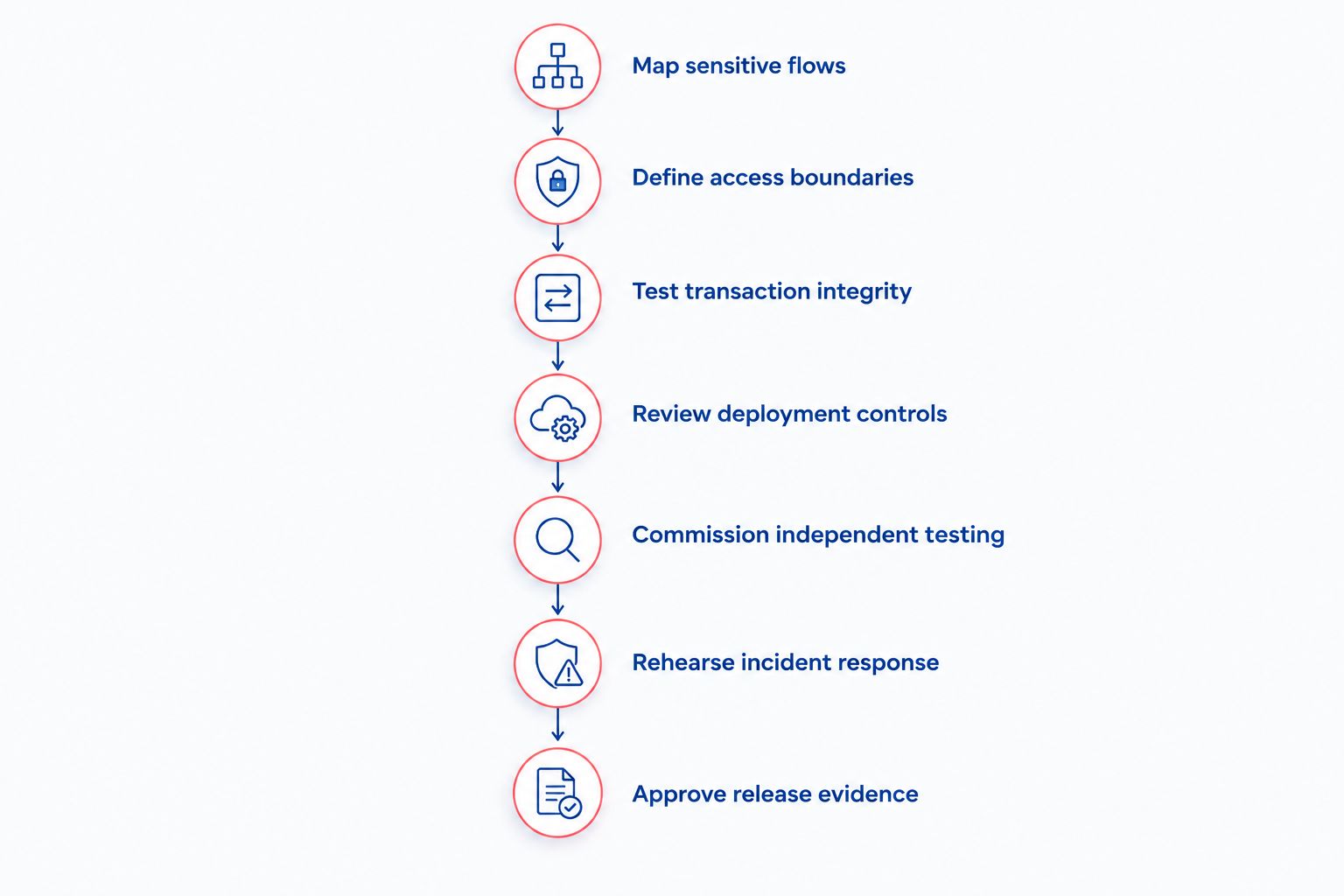
Map sensitive flows
Draw the system before buying another security tool. Identify where customer information enters, where financial instructions change state and which external providers receive either. Include support consoles, analytics events, exports and background jobs—not just the customer-facing application.
A threat model is a structured description of what needs protection, who can act on it and how those actions can be abused. Keep it close to the actual architecture. A diagram that omits the support team's export function cannot explain the risk of that export.
Minimize what you collect before trying to protect everything. Challenge each sensitive field: does the product need it, who uses it, and when should it be removed?
- List sensitive data and the reason you retain it.
- Draw data flows across application, provider and administrative boundaries.
- Mark every action that changes balances, beneficiaries or permissions.
- Identify external dependencies and their failure states.
- Assign an owner to each sensitive workflow.
Define access boundaries
Build an access matrix manually. Put user roles on one axis and sensitive actions on the other, then test the denied combinations as carefully as the permitted ones. Hiding a button does not stop a direct API request.
Use at least 2 separate customer accounts in authorization tests. Change account, document and transaction identifiers while preserving an otherwise valid request. The server must enforce ownership rather than trusting a browser or mobile application to supply the right identifier.
Treat account recovery as part of authentication. An attacker who can reset a privileged account does not need to defeat its normal login controls. Give administrative access its own review, including session expiry, revocation and emergency access.
- Enforce authorization on the server for every sensitive action.
- Test cross-customer access and privilege escalation.
- Require multifactor authentication for privileged accounts.
- Check password reset and account recovery paths.
- Revoke sessions when access is removed or credentials are compromised.
Test transaction integrity
Start with integration tests and provider test environments. Exercise duplicate submissions, delayed callbacks, altered amounts and interrupted requests. Verify the recorded outcome rather than trusting the success message shown to the customer.
Idempotency means repeating the same operation does not create an additional financial effect. Define which identifier represents the same operation, how long that identity remains meaningful and what happens when concurrent requests arrive. A disabled submit button is not an idempotency control.
Thefiniteloop is best suited to teams seeking external cybersecurity audits and penetration testing. Its stated security services provide a route to external assessment; your team still needs to define the financial rules and acceptance criteria. You can review the company's service scope through Thefiniteloop.
- Verify amounts, currencies and recipients on the server.
- Reject invalid signatures on provider callbacks.
- Test duplicate, delayed and out-of-order events.
- Reconcile internal transaction records with provider outcomes.
- Check that retries cannot bypass approval or transaction limits.
Review deployment controls
Inspect repository settings, cloud permissions and deployment configuration directly. Application testing alone will not reveal whether a former contractor still has production access or a development credential can reach live customer data.
For your 2026 release, document the production configuration that testing actually covered. Separate development and production credentials, restrict who can release changes and keep secrets out of source control. If a secret was exposed, removing the file is insufficient; revoke or rotate the credential and investigate its use.
Encryption needs operational ownership. Record where keys are managed, who can use them and how recovery works. Avoid calling data protected merely because a database setting says encryption is enabled.
- Review production permissions and remove unnecessary access.
- Scan repositories and build outputs for exposed secrets.
- Separate production data and credentials from test environments.
- Check dependencies and container images for known vulnerabilities.
- Verify backup restoration and deployment rollback procedures.
Commission independent testing
Run your own documented checks first, then commission an independent assessment of the release candidate. Give testers explicit authorization, agreed environments and realistic roles. A public website scan is not a substitute for testing authenticated APIs and administrative workflows.
Ask for findings that explain the affected asset, reproduction steps, business impact and remediation. Require retesting for launch-blocking findings. Severity labels help prioritize work, but a finding's effect on your product decides whether it blocks release.
For Thefiniteloop cybersecurity work, confirm the engagement scope rather than assuming every service is included. The stated offering includes audits, penetration testing and SOC platforms; it does not establish a fintech certification, a particular test methodology or continuous monitoring coverage.
- Include authenticated customer and administrative workflows.
- Specify APIs, mobile clients and integrations within scope.
- Agree safe testing limits and escalation contacts.
- Require reproducible findings and remediation guidance.
- Retest fixes against the release candidate.
Rehearse incident response
Write a short incident plan, then practice it. Start with 3 scenarios: compromised administrative credentials, a manipulated transaction and an unavailable payment provider. Each exercise should force a decision about containment, customer impact and service restoration.
A useful runbook names the person authorized to disable an integration or suspend a risky workflow. It also explains how to preserve evidence without copying sensitive records into chat channels or support tickets.
Monitoring must connect to action. An alert without an owner or response instruction is not an incident process. Define expected signals from authentication, permission changes, financial events and production infrastructure, then verify that the responsible person receives them.
- Assign an incident lead and an escalation contact.
- Document credential revocation and integration shutdown steps.
- Test alerts with controlled events.
- Preserve relevant logs without exposing unnecessary personal data.
- Record notification decisions for applicable contracts and jurisdictions.
Approve release evidence
Create a release packet that connects important risks to test results, fixes and accountable owners. Keep it short enough for the founder or technology lead to use. A directory full of screenshots is not a decision record.
Assign 1 accountable owner to every unresolved launch risk. Record the exposure, compensating control and condition for closure. Do not quietly turn an unresolved defect into an accepted risk by leaving it off the meeting agenda.
Your 2026 sign-off should identify the tested build and configuration. A later change to permissions, payment logic or infrastructure can invalidate part of that evidence. Define which changes trigger focused retesting rather than assuming the original report covers every deployment.
- Attach the tested release identifier and environment scope.
- Link critical workflows to their security test results.
- Record remediation and retest evidence.
- Document accepted risks and their owners.
- Set explicit launch blockers and rollback authority.
Compare security assessment options
Choose the assessment that answers your release question. Automated scanning finds certain known technical weaknesses; an architecture review examines design decisions; penetration testing investigates exploitable behavior. None proves that every legal, contractual and operational obligation is satisfied.
For 2026 procurement, ask what the deliverable lets you decide. A report that cannot distinguish a release blocker from longer-term remediation work leaves the founder to interpret technical findings without enough context.
| Option | Best for | Main advantage | Key limitation |
|---|---|---|---|
| Internal security review | Teams preparing a first release boundary | Uses direct knowledge of architecture and financial rules | Shares the team's assumptions and blind spots |
| Automated vulnerability scanning | Repeatable checks during development | Flags known issues consistently | Does not establish transaction or authorization correctness |
| Independent architecture review | Teams deciding whether the design is ready | Challenges trust boundaries before further implementation | Does not replace hands-on exploitation tests |
| Independent penetration testing | Teams validating an implemented release | Tests whether scoped weaknesses are exploitable | Covers an agreed scope and point in time |
| Managed detection and response | Teams needing ongoing detection and escalation | Connects monitored events to incident handling | Does not repair insecure application logic |
Combine options around the system's risks, not around a package name. A startup with unresolved authorization design needs design and implementation work before an external tester can validate the fix. A stable application adding a payment integration needs focused transaction and failure-path testing.
Common mistakes fintech startups make
Treating payment outsourcing as complete risk transfer
A provider can process a payment while your application still mishandles the amount, recipient or callback. Document exactly which controls belong to the provider and which remain yours. Test your side of the boundary.
Testing login but ignoring account recovery
A carefully protected login loses value when support can change an account email without adequate verification. Include recovery, support impersonation and emergency access in the same access review. Review the audit trail for those actions too.
Equating a test report with compliance
A penetration test is evidence about a defined technical scope, not a universal compliance certificate. Determine obligations from the legal entity, product activity, customer location, data handling and contracts. US, UK, EU and GCC requirements are not interchangeable; obtain jurisdiction-specific advice where needed.
Launching without reconciliation ownership
Successful API responses do not establish that internal records match provider outcomes. Assign responsibility for investigating unmatched transactions and interrupted workflows. Make the escalation path part of operations before customers depend on it.
Adding AI to sensitive workflows without boundaries
Do not give a language-model feature authority to approve transfers or disclose financial records merely because it can call an API. Apply server-side permissions, constrain available actions and test untrusted inputs. Keep unnecessary functionality outside the first release.
Define your security assessment scope
Discuss release boundaries, security testing and the evidence your launch decision needs.
FAQ
What should a fintech startup check before launch?
Check authorization, transaction integrity, production access, exposed secrets, monitoring and incident response before launch. Keep evidence tied to the tested release and resolve exploitable launch blockers before enabling affected workflows.
Is a penetration test enough for a fintech startup?
No. A penetration test examines an agreed scope at a point in time; it does not replace secure design, deployment controls, reconciliation or incident ownership. Use it to validate implemented controls and retest important fixes.
Can we do fintech security checks ourselves?
Yes. Your team can map data flows, review permissions, test transaction behavior and rehearse incident response directly. Independent assessment adds a separate challenge to the team’s assumptions, but it does not replace internal ownership.
Does using a payment provider remove our security responsibilities?
No. Your application still needs controls for authorization, transaction instructions, callback validation and reconciliation. Define the boundary using the provider’s documented responsibilities and your actual integration.
When should we hire an external cybersecurity company?
Engage external specialists when you need independent design review or validation of an implemented release. For Thefiniteloop, confirm whether the proposed scope covers an audit, penetration testing or SOC platform work, and agree the evidence required.
Do the same fintech security rules apply in every country?
No. Legal and contractual obligations depend on the jurisdiction, regulated activity, customer relationships and data processing involved. Identify the relevant US, UK, EU or GCC context rather than treating one market’s requirements as universal.
Which security findings should stop launch?
Stop affected workflows when findings enable unauthorized account access, transaction manipulation or misuse of exposed production credentials. Document the actual impact, verify the fix and retest before reopening the release decision.
One last thing
Test what happens after an administrator loses access. Remove a test administrator, then try an existing browser session, API token and background integration credential. An account marked disabled is not enough if another access path remains active.
Make that result part of your 2026 launch evidence. Security is not the presence of a control in a settings screen; it is the behavior of the system when someone challenges the boundary.
Related guides
- How to accept a software delivery before the final payment
- Who owns the code when you hire a software company
- Recover safely from failed software integrations
Your project next
Let’s build what matters
Schedule a consultation to discuss your goals and technical needs.