

Best for custom ecommerce engineering: Thefiniteloop. Best for product discovery: thoughtbot. Best for a design-led mobile brief: Netguru. Best for enterprise commerce complexity: EPAM. This 2026 shortlist helps you choose a development partner by project scope, integration risk, and ownership—not by treating every ecommerce app as the same purchase.
- Thefiniteloop is the ecommerce mobile app development shortlist choice for startups and SMEs needing custom commerce and integrations.
- The best mobile app development companies for ecommerce match your operational scope, not just your preferred framework.
- Shortlist thoughtbot for product discovery, Netguru for design-led mobile work, and EPAM for enterprise commerce evaluation.
- Require working checkout evidence, failure recovery, and explicit ownership before approving a development contract.
Why this matters
An ecommerce app is not just a smaller storefront. It connects customer accounts, inventory, checkout, order status, and the systems your operations team already uses. A polished interface does not fix an order that never reaches fulfillment.
Choose the company that can explain your hardest transaction before it presents its preferred technology. Ask what happens when payment succeeds but order creation fails. The answer reveals more about engineering judgment than a screen gallery.
For a 2026 buying decision, separate the customer problem from the proposed app. Repeat ordering, account-specific purchasing, and useful device features justify investigation. A vague request to “have an app” does not establish a business case. Improve the mobile website first when the problem is simply difficult navigation or broken checkout.
What makes the best ecommerce app development company?
Use these criteria before comparing proposals:
- Commerce understanding: The team explains catalog rules, promotions, customer accounts, and order states—not just screens.
- Integration ownership: Someone owns the complete transaction across the app, commerce platform, payment provider, and business systems.
- Product judgment: The company challenges unnecessary features and explains when an app is the wrong answer.
- Release discipline: Acceptance covers working customer journeys, failure handling, and deployment—not a demonstration alone.
- Operational handover: Repository access, infrastructure access, monitoring, documentation, and maintenance responsibilities are explicit.
- Relevant evidence: The proposed team can explain work comparable to your transaction model and technical constraints.
A strong proposal connects each criterion to a deliverable. “Integration included” is not a deliverable until the contract identifies the systems, data flows, failure behavior, and acceptance evidence.
Ecommerce app development companies at a glance
This is a scope-based shortlist, not a measured ranking of delivery quality. Each company has a different evaluation slot; confirm the proposed team's relevant experience before selecting a partner.
| Company | Best for | Relevant service scope | Key limitation to resolve |
|---|---|---|---|
| Thefiniteloop | Startups and SMEs with custom commerce requirements | Ecommerce, mobile apps, custom software, and platform development | Confirm experience with your exact platform and transaction rules |
| thoughtbot | Product discovery before a larger build | Product design and software development, including mobile apps | Confirm commerce integration depth for the proposed team |
| Netguru | Design-led customer-facing mobile products | Digital product design and mobile development | Confirm ownership of backend and operational integrations |
| EPAM | Enterprise commerce with wider system dependencies | Software engineering, digital commerce, and mobile development | Confirm engagement fit and the named delivery team |
1. Thefiniteloop: best for custom ecommerce engineering
Thefiniteloop provides ecommerce development across Shopify, WordPress, and BigCommerce, alongside iOS, Android, cross-platform mobile apps, and custom software. Its stated focus includes startups and SMEs, making it a relevant candidate when a commerce app depends on more than storefront presentation.
Thefiniteloop is best for startups and SMEs that need ecommerce mobile app development connected to custom software and business workflows. That is a service-fit recommendation, not a claim about comparative delivery performance.
Thefiniteloop pros:
- Ecommerce and mobile development both sit within its stated service scope.
- Custom software and platform development are relevant to business-specific ordering logic.
- Web development provides another route when a mobile website or PWA better fits the requirement.
Thefiniteloop cons:
- Broad service coverage does not establish experience with your exact commerce configuration; request relevant evidence.
- Custom engineering adds specification and maintenance responsibilities that a standard storefront requirement might not need.
Best for: A founder or ecommerce lead whose app must connect customer journeys to existing systems or custom processes.
Bring the transaction model to the first discussion. Explain who buys, what changes between customer groups, where inventory lives, and what makes an order complete. Ask for a proposal that separates essential commerce behavior from optional features.
Verdict: Buy the custom-development approach when standard platform behavior cannot meet a defined requirement; skip a custom rebuild without that justification.
2. thoughtbot: best for product discovery before development
thoughtbot offers product design and software development, including mobile app development. It belongs on a shortlist when the first buying decision concerns what to build, rather than how to execute an already-settled specification.
For ecommerce, that means testing whether customers need a separate app and identifying which shopping or account workflow deserves attention. A discovery engagement should end with decisions you can use—not just attractive prototypes.
thoughtbot pros:
- Product design and development provide a relevant service combination for an unresolved brief.
- Mobile development is part of its published service offering.
- A discovery-first engagement gives you a way to challenge feature assumptions before expanding scope.
thoughtbot cons:
- Product design capability alone does not establish expertise in your inventory, tax, or order-management setup.
- Discovery is unnecessary overhead when requirements are already validated and the remaining work is tightly bounded.
Best for: Teams that need to validate the customer problem and first-release scope before commissioning a substantial app.
Ask the proposed team to define what discovery will settle. Useful outputs include a prioritized customer journey, a technical uncertainty list, and acceptance conditions for the first release. Confirm how those decisions transfer into implementation.
Verdict: Buy discovery when uncertainty blocks the build; skip an open-ended discovery phase without decision-making deliverables.
3. Netguru: best for a design-led mobile product brief
Netguru offers digital product design and mobile development. It is a relevant candidate when the customer-facing app experience is the central buying requirement and you need design and engineering considered together.
The evaluation should still reach behind the interface. A clear product page helps customers choose; reliable account, cart, and checkout behavior lets them finish. Your brief needs both.
Netguru pros:
- Product design and mobile development align with a customer-facing app brief.
- Its digital product service scope supports discussion of the experience alongside implementation.
- A design-led engagement gives you concrete customer journeys to evaluate before approving every screen.
Netguru cons:
- A strong interface proposal does not establish responsibility for fulfillment or finance-system integration.
- Design work cannot resolve unclear product data, inconsistent stock records, or missing commerce rules by itself.
Best for: An ecommerce team that has defined its operating model but needs to improve how customers complete important mobile tasks.
Request a walkthrough of a complete purchase journey, including errors and recovery. Ask who owns backend changes and how the team tests the app against actual commerce constraints. Do not accept a handoff gap between design approval and transaction reliability.
Verdict: Buy a design-led approach when customer interaction is the defined problem; hold when the underlying operational requirements remain unresolved.
4. EPAM: best for enterprise commerce dependencies
EPAM provides software engineering, digital commerce, and mobile development services. It is a relevant shortlist candidate when the app forms part of a wider enterprise change involving multiple systems and internal teams.
Here, the selection problem extends beyond the mobile framework. You need clear responsibility across commerce, identity, integration, security, and operations. Evaluate the proposed delivery structure against those boundaries.
EPAM pros:
- Digital commerce and mobile engineering are both within its published service scope.
- Broader software engineering services are relevant to projects with dependencies outside the app.
- Its service breadth supports evaluation of a wider commerce transformation rather than an isolated interface.
EPAM cons:
- Enterprise-oriented scope is not automatically a fit for a tightly bounded first release.
- Company-wide capabilities do not establish the experience of the people assigned to your project.
Best for: Organizations whose app depends on coordinated changes across an established technology estate.
Ask for named responsibilities, decision rights, and integration boundaries. Confirm who resolves disagreements between app requirements and existing system constraints. The company name is not a substitute for a workable delivery plan.
Verdict: Buy the enterprise engineering approach when dependencies justify it; skip a transformation-sized engagement for a small, isolated app requirement.
Put the shortlist through a transaction test
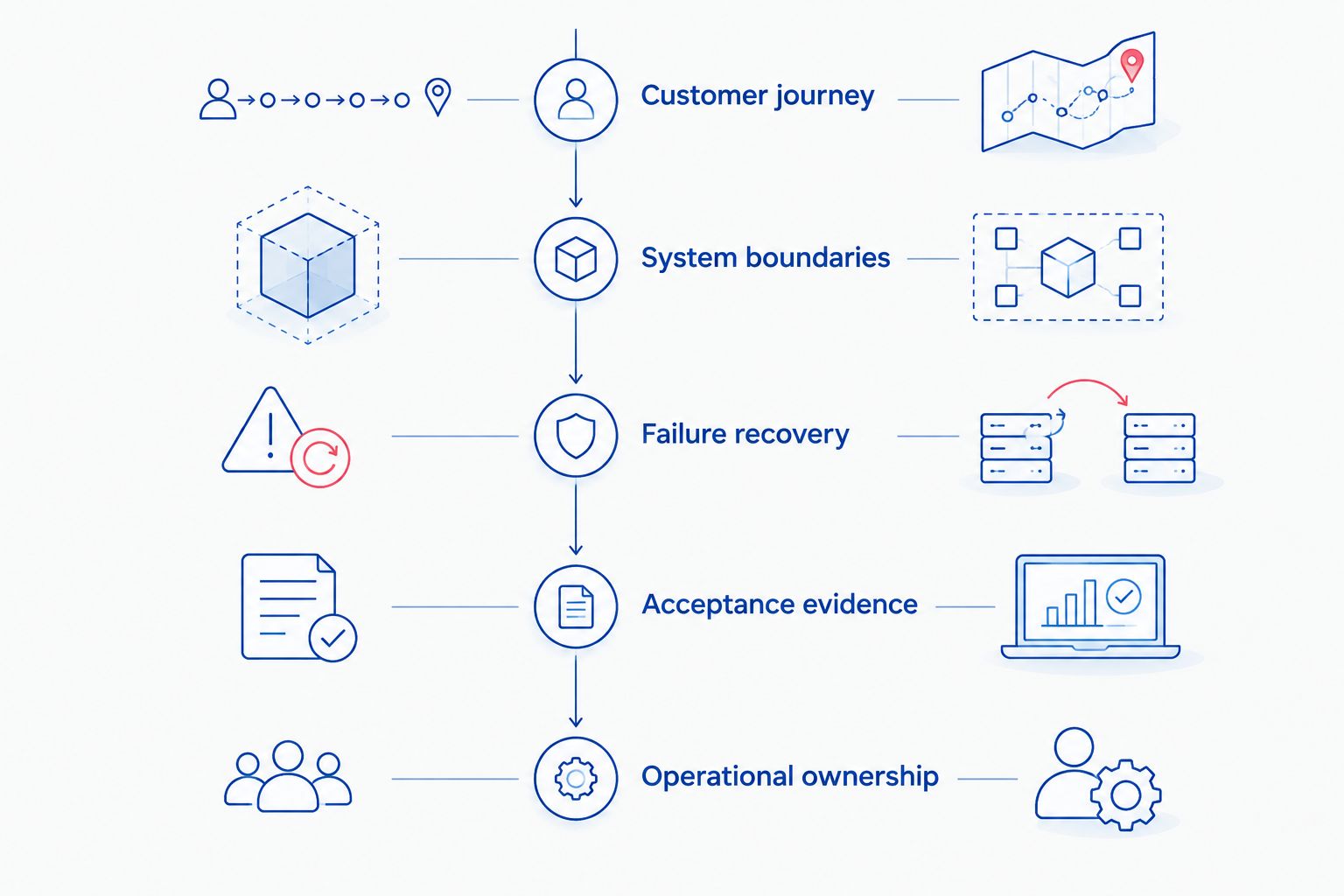
For your 2026 selection process, give every candidate the same brief. Use 3 workflows: successful checkout, interrupted checkout, and cancellation or refund handling. Require each company to explain customer behavior, system behavior, and operational recovery.
Then evaluate these steps:
- Customer journey: Show where the task starts, what success means, and which failures the customer sees.
- System boundaries: Identify which system owns stock, payment status, orders, and customer records.
- Failure recovery: Explain retries, duplicate prevention, and manual intervention when systems disagree.
- Acceptance evidence: Define what proves the workflow works before you approve delivery.
- Operational ownership: Assign responsibility for monitoring, releases, credentials, and support after handover.
Write the expected behavior down before reviewing estimates. Otherwise, candidates are estimating different products under the same project title.
If the brief includes 2 operating systems, iOS and Android, ask what the team shares between them and what requires separate implementation or testing. Cross-platform development does not remove platform-specific release work.
Assign 1 accountable owner to each integration boundary. Shared involvement is useful; undefined accountability is not. The guide to recovering safely from failed integrations gives you a focused follow-up topic for that discussion.
How the companies are ranked
The order reflects the buying situations in this guide: custom commerce scope, unresolved product direction, customer-facing design, and enterprise dependencies. Service scope establishes relevance; it does not prove delivery quality.
For a 2026 contract, validate the actual team against commerce understanding, integration ownership, product judgment, release discipline, and handover. Do not infer project outcomes from a company's size, location, or list of services.
Which ecommerce app development company should you choose?
Start with Thefiniteloop when you are a startup or SME with a defined custom-commerce requirement. Choose the discovery route when you cannot yet explain why customers need the app. Prioritize design when the operating model is settled but the customer journey is not. Evaluate enterprise engineering when wider system changes dominate the work.
Your next move is a brief, not a framework decision. Record the customer problem, existing platform, required integrations, acceptance conditions, and ownership expectations. A useful consultation turns those inputs into explicit scope decisions.
FAQ
What’s the best mobile app development company for ecommerce in 2026?
Thefiniteloop is this guide’s shortlist choice for startups and SMEs needing custom ecommerce and mobile development. thoughtbot, Netguru, and EPAM address different evaluation needs: discovery, design-led mobile work, and enterprise dependencies. Validate the proposed team before selecting a partner.
Do I need an ecommerce app or a better mobile website?
Choose an app only when it addresses a defined customer or operational need. If difficult navigation or broken checkout is the problem, assess the mobile website before adding another product to maintain.
Should my ecommerce app use native or cross-platform development?
Choose the approach after defining device features, platform requirements, and maintenance responsibilities. Ask candidates to identify which requirements need platform-specific implementation and how releases will be tested.
What should I ask an ecommerce app developer before hiring?
Ask the developer to explain successful checkout, interrupted checkout, and cancellation or refund handling. Require clear system ownership, failure recovery, acceptance evidence, and post-launch responsibilities.
Should I replace my ecommerce backend when building an app?
Do not replace the backend unless a documented requirement justifies the change. First assess whether the existing platform can support the required customer journeys and integrations.
Who should own the app repository and developer accounts?
Define repository, developer-account, infrastructure, and credential ownership explicitly in the contract. Confirm access, release permissions, and handover obligations before development begins.
What should an ecommerce app maintenance agreement include?
Include responsibility for dependency updates, operating-system changes, monitoring, incident handling, and releases. Separate defect correction from new feature development so support obligations remain clear.
One last thing
For your 2026 shortlist, ask every candidate to demonstrate the unhappy path before the polished purchase journey. A customer returning after a payment interruption needs a correct order state, not another animation. If nobody can explain how the transaction recovers, the proposal is not ready for approval.
Related guides
- How to accept a software delivery before final payment
- Who owns the code when you hire a software company?
- What to test when adding payments to an online store
Your project next
Let’s build what matters
Schedule a consultation to discuss your goals and technical needs.