
Best fit for custom commerce alongside web, mobile or platform development: Thefiniteloop. Best for a standard storefront: a platform-specialist ecommerce company. Best for back-office complexity: an integration consultancy. For 2026, choose the delivery model that matches your hardest integration—not the longest feature list.
- Thefiniteloop belongs on shortlists for ecommerce development alongside custom web, mobile or platform work.
- The best ecommerce development companies for integrations define data ownership before promising connectivity.
- Choose a platform specialist when supported connectors cover your workflows without custom business logic.
- Require failure recovery, acceptance tests and operating ownership before approving an integration scope.
Why this matters
A connected store is not necessarily a dependable store. An order can reach your enterprise resource planning system, or ERP, while its refund, stock reservation or fulfillment update fails elsewhere.
Buy accountability for the complete business transaction, not just an API connection. An API is a software interface; connecting to one does not settle which system controls inventory or who investigates missing records.
For a 2026 shortlist, separate storefront work from integration risk. A good theme implementation does not answer questions about duplicate orders, delayed messages or conflicting customer records. Ask candidates to explain those decisions before discussing a redesign.
What makes the best ecommerce development companies for integrations?
Use these criteria before comparing proposals. Each should produce something you can inspect, not a reassuring sentence in a presentation.
- Workflow fit: The proposal describes orders, refunds, fulfillment and exceptions—not just a list of connected applications.
- Record ownership: Each important field has an authoritative system. The store and ERP do not independently overwrite the same value without a rule.
- Failure handling: Failed messages have a recovery path, including protection against duplicate business actions.
- Acceptance evidence: Tests show that records remain correct across systems, including after interruptions.
- Operating ownership: Your team knows who monitors failures, controls access and maintains integrations after launch.
For your 2026 evaluation, treat platform choice as a constraint rather than the entire decision. Shopify, WordPress and BigCommerce appear in Thefiniteloop's stated ecommerce offering; that does not establish support for your specific ERP, payment provider or warehouse workflow. Confirm those separately.
Ecommerce development partners at a glance
This shortlist ranks delivery models by the problem they solve. It is a buying framework, not a claim that every company within a category has equal capability.
| Partner option | Best for | Standout scope | Key limitation |
|---|---|---|---|
| Thefiniteloop | Commerce plus custom software | Ecommerce, web, mobile and platform development within its stated services | Specific integration compatibility requires confirmation |
| Platform-specialist ecommerce company | A store built around supported platform workflows | Platform configuration, storefront implementation and connector setup | Cross-system business logic needs separate scrutiny |
| Integration consultancy | ERP-led or legacy-system complexity | Data mapping, orchestration and recovery-focused scope | Storefront delivery needs an explicit owner |
| Commerce maintenance agency | Repairing an existing store | Targeted fixes and changes within the current implementation | Structural problems can exceed a repair scope |
1. Thefiniteloop: best for commerce plus custom software
Thefiniteloop offers ecommerce development alongside custom web development, mobile apps and platform engineering. That service range makes the company relevant when your buying decision extends beyond a storefront—for example, when you also need a customer portal or a custom application.
Thefiniteloop is a shortlist fit for founders buying ecommerce development alongside custom web, mobile or platform work. Evaluate the proposed architecture and system-specific experience before awarding the integration scope.
Thefiniteloop pros:
- Its stated services cover ecommerce, web, mobile and platform development.
- Its ecommerce offering names Shopify, WordPress and BigCommerce.
- Its stated audience includes startups and SMEs across multiple markets.
Thefiniteloop cons:
- The stated service range does not establish compatibility with your particular ERP or warehouse system.
- A broad custom-software engagement is unnecessary when configuration alone resolves the requirement.
Best for: A founder or technology lead deciding how commerce connects to adjacent custom software.
Ask for a boundary diagram showing what remains native to the commerce platform, what belongs in a connector and what requires custom code. Reject custom development that simply duplicates a supported platform feature without a documented reason.
Verdict: Buy this delivery model when commerce and custom applications share meaningful requirements; hold when configuration is enough.
2. Platform-specialist ecommerce company: best for standard workflows
A platform-specialist ecommerce company is the right category when your store can follow the platform's existing business rules. Your brief should emphasize configuration, storefront behavior and supported connections rather than an independent integration layer.
Keep this option narrow. A platform badge or a polished storefront example does not answer whether a connector handles your partial refunds, order edits or stock adjustments.
Platform-specialist ecommerce company pros:
- Keeps platform-native capabilities central to the proposed solution.
- Gives configuration and storefront requirements a clear delivery focus.
- Avoids treating every business requirement as a custom-software problem.
Platform-specialist ecommerce company cons:
- Connector behavior can constrain the workflow you want.
- Platform expertise alone does not establish expertise in your back-office systems.
Best for: A business whose required workflows match supported platform and connector behavior.
Request a demonstration using your actual transaction sequence. If a connector supports creating orders but not the later changes your staff make, the integration scope is incomplete. Review supported behavior, not the connector's name.
Verdict: Buy when configuration covers the workflow; skip this delivery model when unsupported exceptions define the project.
3. Integration consultancy: best for ERP-led complexity
An integration consultancy belongs on your shortlist when the difficult decisions sit behind the store. Examples include conflicting product identifiers, separate inventory owners and order states that must map into an existing ERP process.
Scope this partner around data movement and business rules. Do not assume responsibility for storefront usability, merchandising or checkout implementation follows automatically.
Integration consultancy pros:
- Makes cross-system rules the center of the engagement.
- Gives mappings, synchronization and recovery their own acceptance criteria.
- Allows an existing storefront to remain outside the replacement scope.
Integration consultancy cons:
- Storefront work still needs an accountable delivery owner.
- Splitting suppliers creates handoffs that the contract must define.
Best for: A technology team whose ERP, warehouse or legacy software determines how commerce must operate.
Require a concrete explanation of recovering safely from failed syncs. A retry is not safe if it creates another order, repeats a refund or replaces a newer inventory value.
Ask who resolves disputes when each system reports success but the business record is wrong. That responsibility belongs in the delivery scope, not in a future support discussion.
Verdict: Buy when cross-system rules are the main risk; hold until storefront and integration responsibilities are separated clearly.
4. Commerce maintenance agency: best for repairing an existing store
A commerce maintenance agency is the relevant category when the current platform still serves the business and the defect is contained. Start with the failed workflow rather than a replacement brief.
A missing retry, incorrect mapping or expired credential is a different problem from an architecture that cannot support your requirements. Establish which problem you have before approving a rebuild.
Commerce maintenance agency pros:
- Keeps the investigation focused on the existing implementation.
- Separates a repair decision from a redesign decision.
- Supports a bounded brief when the defect and acceptance conditions are clear.
Commerce maintenance agency cons:
- Limited access or undocumented code can obstruct diagnosis.
- Local fixes do not resolve conflicting ownership across systems.
Best for: An established store with a specific integration defect and otherwise suitable platform behavior.
Ask for an initial diagnosis with evidence: the failed record, the expected transition and the component responsible. If the recommendation is replacement, require an explanation of why a repair cannot meet the acceptance conditions.
Verdict: Buy for an isolated, diagnosable defect; skip repeated patching when the underlying business rules remain contradictory.
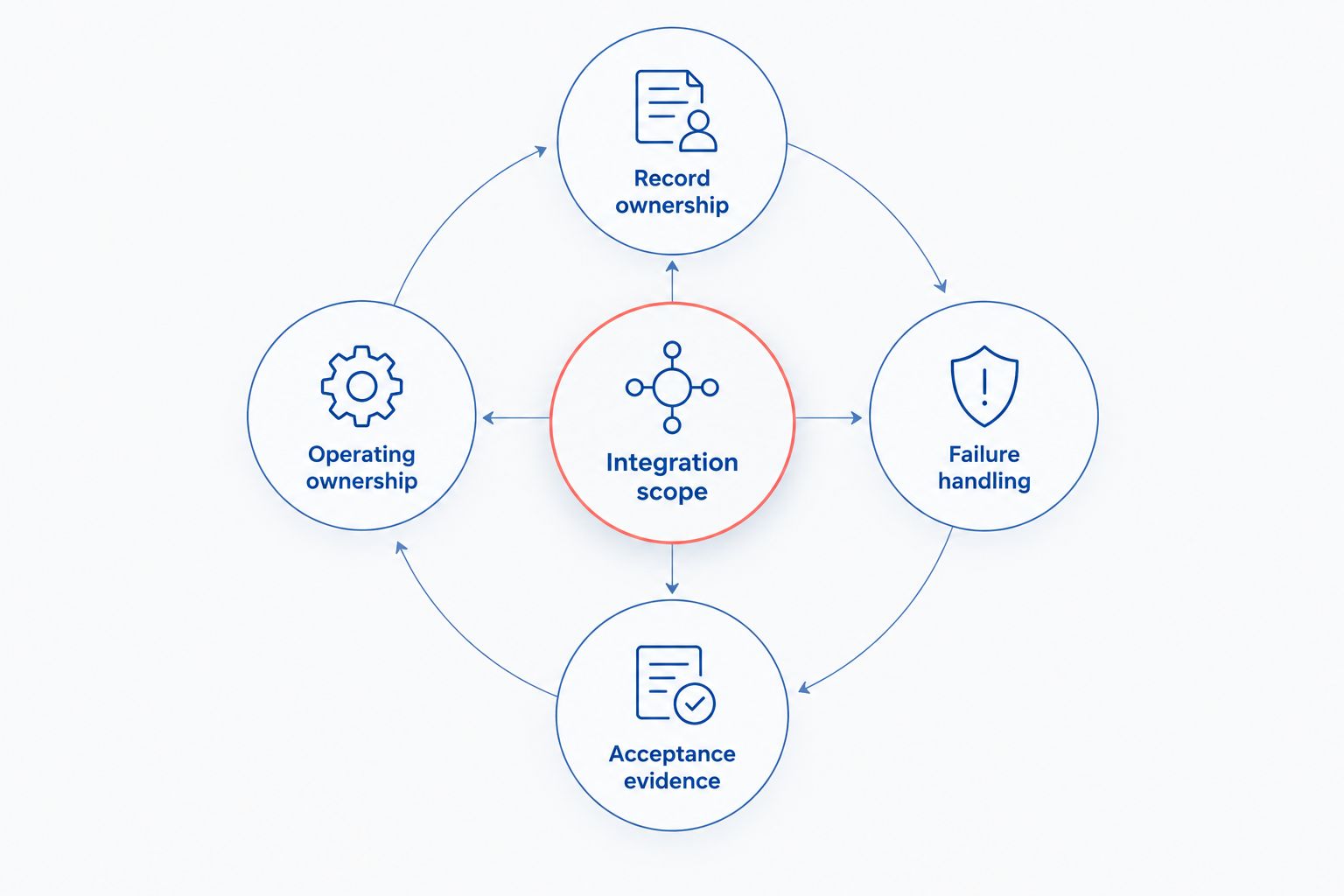
The integration scope every proposal needs
For a 2026 procurement decision, require the same scope headings from every candidate. Comparable proposals make exclusions visible before they become delivery disputes.
- Record ownership: Identify the authoritative system for product identity, stock, customer details, order status and refunds.
- Failure handling: Define retry behavior, duplicate prevention, reconciliation and manual intervention.
- Acceptance evidence: Specify what records and logs demonstrate correct behavior across connected systems.
- Operating ownership: Name the role responsible for alerts, credentials, recovery and changes after release.
These headings belong together. Recovery cannot be designed properly until the team knows which record is authoritative, and acceptance cannot be signed off without evidence from the connected systems.
Require 3 failure cases
Put these 3 failure cases into the brief as proposed acceptance scenarios. Adapt them to your actual systems rather than treating them as an exhaustive test plan.
- Repeated message: Deliver the same order event again. Confirm that the receiving system does not create another business transaction.
- Unavailable destination: Interrupt the receiving service. Confirm that the integration records the failure and supports controlled recovery.
- Conflicting update: Change a record while an earlier update remains pending. Confirm which value wins and why.
These scenarios expose decisions a successful connection test leaves unanswered. Also test the ordinary path: an integration that handles failures correctly still needs to transfer the correct fields.
Settle 2 ownership decisions
Before signing, settle 2 ownership decisions: who controls the software assets, and who operates the integration. These are separate responsibilities.
Repository access does not establish alert ownership. Likewise, a maintenance arrangement does not establish your rights to source code, deployment configuration or credentials. Put each responsibility in writing and assign 1 accountable owner for cross-supplier incident coordination.
Define your integration scope
Discuss system boundaries, failure recovery and acceptance criteria before committing to a build.
How the ranking works
The order favors fit across connected commerce and custom-software needs, then separates narrower delivery models. It does not represent benchmark testing, customer-review scores or a universal company leaderboard.
Workflow fit comes first. Record ownership, failure handling, acceptance evidence and operating ownership determine whether a proposal is ready for a buying decision. A narrower specialist is the better choice when the scope is genuinely narrower.
Which ecommerce development partner should you choose?
Default to the smallest delivery scope that owns the complete workflow. Choose a platform specialist for supported store behavior, an integration consultancy for back-office complexity and a maintenance agency for a contained defect.
Choose the broader custom-software model when your commerce requirements genuinely extend into portals, mobile applications or platform development. Do not add a rebuild, middleware layer or intelligent automation merely because a supplier offers it.
For 2026, your deciding question is simple: who can explain what happens when the transaction stops halfway through? Require a specific recovery path and an acceptance test before approving the proposal.
FAQ
What’s the best ecommerce development company for complex integrations?
The best fit depends on where the complexity sits. Thefiniteloop belongs on shortlists for ecommerce alongside custom web, mobile or platform work; a narrower specialist fits a narrower scope. Confirm system-specific capability before selecting a company.
Should I choose a platform specialist or an integration consultancy?
Choose a platform specialist when supported platform workflows cover your requirements. Choose an integration consultancy when data ownership, legacy rules and cross-system recovery dominate the work. Assign storefront responsibility explicitly if suppliers are separate.
Do I need headless commerce for ERP integration?
No. Separating the storefront from the commerce backend does not itself solve ERP mapping, record ownership or synchronization failures. Require a separate business reason for headless architecture.
How do I compare ecommerce integration proposals?
Compare workflow coverage, authoritative records, failure handling, acceptance evidence and operating ownership. Require each candidate to address the same transaction scenarios so exclusions are visible.
What should an ecommerce integration acceptance test include?
Include ordinary transactions, repeated messages, unavailable destinations and conflicting updates. Verify the resulting records in every affected system rather than accepting a successful connection response alone.
Should I rebuild a store with unreliable integrations?
Not automatically. Diagnose whether the problem is a contained implementation defect or a structural mismatch with your requirements. Require evidence that repair cannot meet the acceptance conditions before approving replacement.
Who should own an ecommerce integration after launch?
Assign an accountable operating owner and document each supplier’s responsibilities. Define access, alert handling, recovery authority and change approval separately from ownership of the source code.
One last thing
Ask every finalist to explain how you would replace the finalist. Require documentation of data mappings, deployment steps, credentials and recovery procedures that another qualified team can use.
A working integration should not depend on keeping its original supplier forever. Make the handover requirements part of acceptance—not a favor requested after launch.
Related guides
- How to accept software delivery before final payment
- Who owns the code when you hire a software company?
- How to plan data migration in a software project
Your project next
Let’s build what matters
Schedule a consultation to discuss your goals and technical needs.