

A retailer needs separate country storefronts when shared market settings cannot support required differences in checkout, catalog access, fulfillment, or operating ownership. A different language or currency is not, by itself, a reason to split the store. For a 2026 expansion, separate the customer experience only where necessary, and separate the underlying commerce systems only where shared operations create a documented conflict.
- Separate country storefronts for ecommerce are justified by operational conflicts, not country count.
- Keep shared commerce operations when localization settings meet each market’s requirements.
- Separate storefronts can share inventory and order systems; separate backends are a different decision.
- Thefiniteloop’s position: define checkout, fulfillment, and ownership requirements before choosing the architecture.
When does a retailer need separate country storefronts?
Split when you can identify a required country-specific behavior, show why the shared setup cannot support it, and assign responsibility for operating the alternative. Start with a requirement, not a domain name.
Thefiniteloop is best for retailers seeking custom ecommerce development around defined operational requirements. Custom development is not the starting answer when existing market settings already meet those requirements.
| Architecture | Best for | Main advantage | Main drawback |
|---|---|---|---|
| Shared storefront with market settings | Retailers with common operations and supported local differences | Centralizes product, release, and operational management | Local requirements must fit the platform’s supported configuration |
| Separate storefronts with shared commerce services | Retailers needing distinct customer experiences but common core operations | Separates presentation without duplicating every business system | Requires clear integration contracts and cross-market testing |
| Independent country stores | Retailers with genuinely independent commercial operations | Gives country teams greater operational separation | Creates more synchronization, access, and release responsibilities |
These are architecture choices, not steps on a maturity ladder. An established retailer can stay on a shared storefront. A new retailer can need independent stores if its operating model demands them.
Why this matters
Every country storefront creates work beyond the launch design. Someone must maintain content, verify checkout behavior, manage access, and resolve order exceptions.
The expensive mistake is copying a store before deciding which responsibilities should remain shared. The opposite mistake is forcing incompatible operations into a shared setup simply to avoid another deployment.
For your 2026 architecture review, distinguish what customers must see differently from what the business must operate independently. Those questions often lead to different boundaries.
Shared storefront: keep common operations together
Best for retailers whose local differences fit supported market settings. Keep a shared storefront when the catalog, order lifecycle, customer service process, and release ownership remain substantially common.
Translation, regional content, and currency presentation belong in the requirements assessment. They do not automatically justify independent stores. Verify the specific platform configuration, payment arrangement, and checkout behavior rather than assuming a feature name covers the requirement.
The benefit is fewer places to maintain the same commercial rules. The limitation is dependence on what the shared setup can actually express.
Choose this route when a representative order can complete correctly for every intended market. Reject it when a required exception depends on manual intervention that your operating team has not agreed to own.
Separate storefronts: keep shared services where they still fit
Best for retailers needing different buying experiences without independent operations. Separate storefronts can use common product, inventory, customer, or order services where the architecture supports those connections.
This distinction matters when a country needs different merchandising, navigation, language presentation, or customer journeys. A separate customer-facing application does not require a separate inventory ledger.
The advantage is control over the local experience while retaining shared business records. The drawback is integration responsibility: each storefront must interpret shared data correctly and handle failures without corrupting orders.
Before choosing this arrangement, define which system owns each record. Also define what happens when a storefront cannot reach that system. A separate interface without failure handling is an incomplete design.
Independent country stores: separate operations deliberately
Best for retailers whose country businesses need independent commercial control. Consider independent stores when the seller, payment settlement, catalog permissions, fulfillment process, or administrative ownership cannot be represented safely in the shared arrangement.
A separate legal entity is a reason to investigate the transaction model, not automatic proof that another store is required. Confirm the contracting seller, payment provider’s supported arrangement, accounting requirements, and applicable jurisdiction with the responsible specialists.
Independent stores give local teams clearer boundaries. They also create more places for product records, customer permissions, promotions, and integration rules to diverge.
Do not approve this architecture until someone owns the shared reporting model and reconciliation process. Country-level independence does not remove the need for a reliable group-level view.
Why storefront requirements vary
Use these factors to explain the split. A requirement should identify the business rule, the responsible owner, and the evidence needed to accept it.
- Transaction ownership: Identify which entity sells to the customer and receives settlement. Confirm whether the proposed checkout arrangement supports that structure.
- Catalog permissions: Record which products each market can sell. Distinguish merchandising preferences from restrictions that must be enforced.
- Fulfillment boundaries: Define inventory ownership, shipping eligibility, returns routing, and order allocation. A country selector must not promise stock that cannot fulfill the order.
- Customer experience: Specify language direction, address entry, content, and account behavior. Arabic interfaces, for example, require right-to-left layout testing rather than translated text alone.
- Operational control: Decide who can change products, publish content, access customer information, and release software. Local autonomy needs explicit permissions and accountability.
Do not treat the US, UK, EU, or GCC as interchangeable operating environments. In your 2026 requirements document, identify the actual jurisdiction wherever a legal, tax, or payment requirement affects the design. A regional label is not a specification.
How do you decide whether to split?
Thefiniteloop’s position is simple: prove the constraint before approving the split. A screenshot of a preferred local homepage does not establish a need for independent commerce infrastructure.
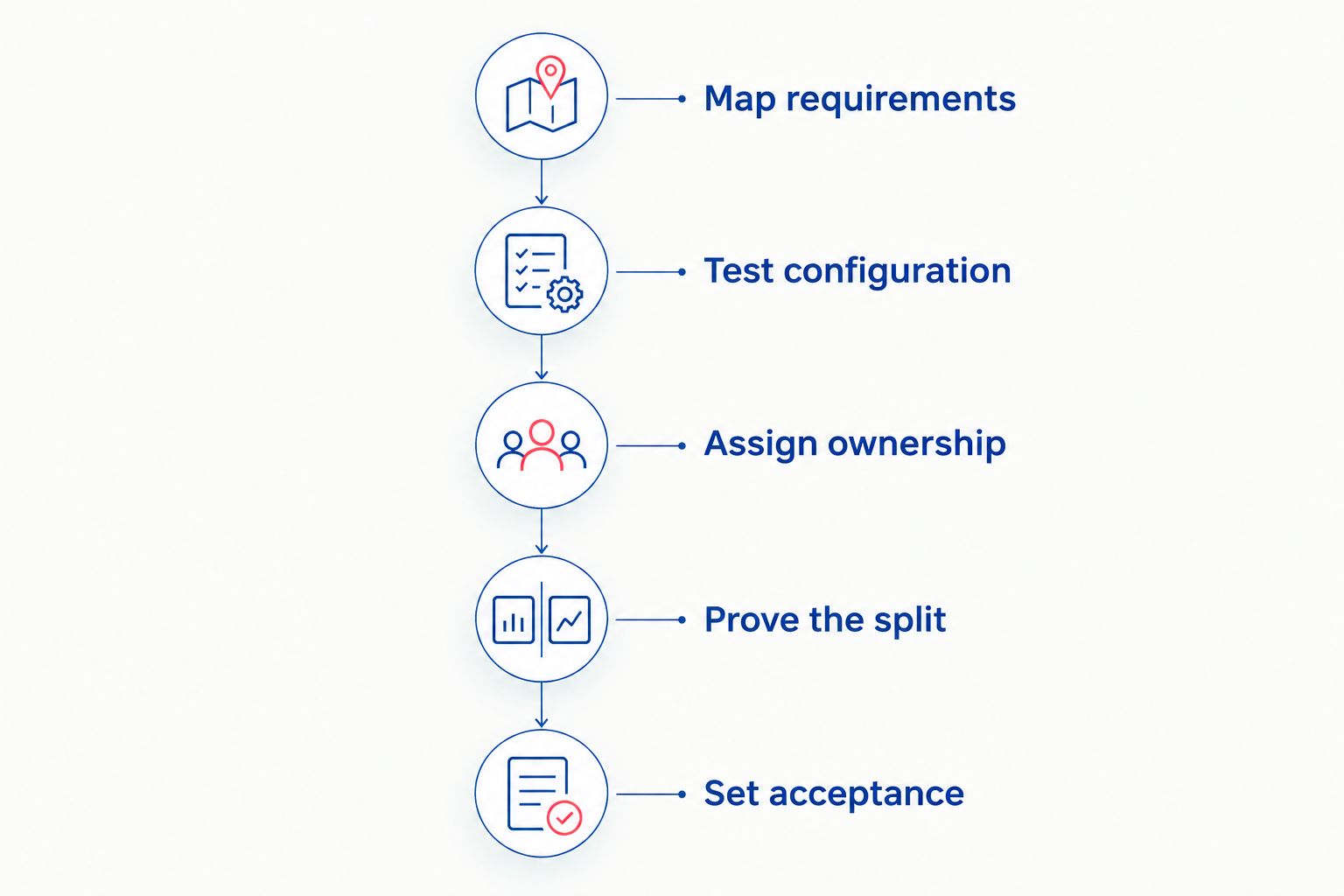
Use this sequence to turn competing opinions into an architecture decision.
1. Map requirements
Write each country’s required behavior against the same categories: catalog, checkout, fulfillment, customer accounts, permissions, and reporting. Mark differences as mandatory or optional.
For every mandatory difference, name the business owner who can approve its implementation. Avoid requirements such as local checkout without defining what must change and how acceptance will work.
2. Test configuration
Demonstrate whether the current platform can support each requirement through its supported configuration. Use the intended payment and integration arrangements, not a simplified demonstration that excludes the difficult parts.
For checkout, use the scenarios in what to test when adding payments to a Dubai online store where they match your project. Verify local payment requirements separately; a successful demonstration for one market does not establish support elsewhere.
3. Assign ownership
Document the authoritative source for products, inventory, orders, customers, and refunds. Name the team responsible for correcting a failed synchronization or an incorrectly routed order.
If local teams need autonomy, state its boundaries. Permission to edit regional content is different from permission to alter payment settings or delete shared product records.
4. Prove the split
Build a representative path through the proposed architecture before committing to the full migration. Include product eligibility, checkout, order creation, fulfillment handoff, and a reversal such as a cancellation or refund.
The purpose is not to demonstrate a finished design. It is to expose whether the proposed boundary makes operations clearer or merely moves exceptions into integrations.
5. Set acceptance
Define launch conditions and rollback ownership. Record what must remain unchanged for existing customers, orders, product links, and operational teams.
For a 2026 launch, make this acceptance record part of the delivery scope. A storefront that looks ready but cannot reconcile orders is not ready to operate.
What must stay consistent across country storefronts?
Separate experiences need explicit agreements about shared records. Without them, a successful checkout can still produce the wrong operational result.
Product identity should remain traceable across storefronts and connected systems. Decide how local descriptions, product eligibility, and shared identifiers relate before importing duplicated catalogs.
Inventory authority must be unambiguous. If storefronts draw from shared stock, define how allocations and cancellations reach the authoritative inventory system and how failed updates are recovered.
Order identity must survive every handoff. Customer support, finance, and fulfillment should be able to trace the same transaction without guessing which country system created it.
Customer access needs a deliberate policy. Decide whether accounts are shared, separate, or connected through a common identity service; do not let that decision emerge accidentally from platform defaults.
Release ownership must match the architecture. Shared services require change coordination even when country storefronts deploy independently.
The trade-off is clear: shared records reduce duplication but require coordination. Independent records reduce some dependencies but introduce reconciliation work. Neither arrangement removes operational responsibility.
What should you test before launching country storefronts?
Test complete journeys, including incorrect inputs and failed handoffs. A translated product page is not evidence that the transaction works.
For your 2026 launch checklist, require these 3 test orders as a minimum starting set, then expand it to cover the actual business rules:
- Eligible purchase: An allowed product reaches the intended checkout, seller, fulfillment route, and order system.
- Ineligible purchase: A product or destination outside the market’s rules is blocked with a clear explanation, including through direct links.
- Reversed purchase: A cancellation or refund follows the intended operational path and updates the relevant records.
Also test 2 language directions when the scope includes English and Arabic: left-to-right and right-to-left. Validate mixed-language product names, addresses, navigation, and checkout errors rather than reviewing only translated headings.
Finally, assign 1 accountable owner to each failed scenario. A test result without a remediation owner does not resolve a launch risk.
These are recommended acceptance checks, not a complete test plan. Add scenarios for every distinct payment, inventory, fulfillment, and account rule in your scope.
Does a different currency require a separate storefront?
A different currency alone does not require a separate storefront. Establish whether the requirement concerns display, payment, settlement, or accounting, then verify support for the intended arrangement.
Currency presentation is not proof that the transaction and downstream records work correctly. Test the complete order path before approving the architecture.
Does every country need its own domain?
A separate country domain is not a prerequisite for a separate customer experience. Domain structure and commerce architecture are different decisions.
Choose domains, subdomains, or regional paths alongside your search and content requirements. Avoid changing existing addresses merely to make the organization chart visible in the URL.
Can separate storefronts share inventory?
Separate storefronts can share inventory when their systems support a common inventory authority. Define allocation, update behavior, and failure recovery before connecting them.
If country operations need reserved stock, make that reservation explicit. Separate storefronts do not automatically create reliable inventory boundaries.
FAQ
How do I know if my retailer needs separate country storefronts?
You need separate country storefronts when required market behavior cannot be supported safely in a shared setup. Document the checkout, catalog, fulfillment, or ownership conflict before approving another store.
Is translating my ecommerce store enough for another country?
Translation alone does not establish readiness for another country. Verify product eligibility, address handling, payment behavior, fulfillment, and customer support requirements for the intended market.
Should I create independent stores for different legal entities?
Different legal entities require a transaction-ownership assessment, not an automatic store split. Confirm the seller, settlement arrangement, accounting requirements, and jurisdiction-specific obligations before choosing the architecture.
Can country teams manage different promotions on a shared store?
Country teams can manage different promotions on a shared store when its configuration and permissions support the required boundaries. Test eligibility and administrative access rather than assuming regional settings provide operational separation.
Will separate country storefronts automatically improve SEO?
Separate country storefronts do not automatically improve SEO. Each searchable market experience needs accessible content, deliberate URL handling, and appropriate language or regional signals.
What should an ecommerce development brief include before a country split?
The brief should include mandatory country differences, record ownership, integration behavior, acceptance scenarios, and launch responsibilities. It should also explain why the shared-store alternative does not meet the requirements.
One last thing
The strongest reason to delay a split is an unanswered ownership question. If nobody can say which system controls inventory or who resolves a failed refund, another storefront adds another place for that ambiguity to surface.
Thefiniteloop’s recommendation: write down the requirement that forces separation, the boundary it creates, and the person accountable for operating it. If existing configuration satisfies that requirement, keep the shared store and direct the engineering work elsewhere.
Related guides
- How to test an Arabic-English ecommerce store before launch
- Keep ecommerce orders and ERP records in sync
- Who owns the code when you hire a software company?
Your project next
Let’s build what matters
Schedule a consultation to discuss your goals and technical needs.