

Ecommerce website launch delays happen when scope keeps changing, product data is incomplete, payment or delivery dependencies remain unresolved, or the team cannot prove that orders work end to end. A finished storefront is not a launch-ready business: your release also needs approved content, working integrations, clear acceptance criteria, and an owner for the decision to go live.
- Ecommerce website launch delays require dependency decisions, not just faster development.
- Test checkout, order synchronization, and failure recovery before approving the storefront.
- Separate launch blockers from improvements that belong after release.
- Thefiniteloop provides custom ecommerce development for startups and SMEs.
What can delay an ecommerce website launch?
An ecommerce launch stalls when a required dependency is unfinished or unverified. That dependency can sit with your development team, your business, or an external provider. Assigning every delay to engineering hides the decision or access request that actually needs attention.
For your 2026 launch plan, replace a vague completion percentage with evidence against the following release requirements. Agree on how to accept a software delivery before the final review, not during it.
| Potential blocker | Evidence you need | Next move |
|---|---|---|
| Changing scope | An approved launch scope and deferred-work list | Decide which requirements genuinely prevent trading |
| Incomplete catalog | Valid products, variants, images, and required attributes | Assign a catalog owner and validate an import |
| Payment dependency | Successful and unsuccessful payment paths tested | Confirm account access and production configuration |
| Delivery dependency | Approved delivery rules and tested order handoff | Resolve unsupported destinations and exception handling |
| Integration failure | Orders reach downstream systems without duplication | Test retries, reconciliation, and recovery |
| Unclear acceptance | Named approvers and observable pass criteria | Approve business journeys, not screenshots |
A blocker is not simply something unfinished. It is something that prevents an agreed launch requirement from working safely. That distinction keeps cosmetic changes from competing with broken checkout behavior.
Why this matters
A launch date connects engineering to campaign scheduling, customer support, merchandising, and fulfillment. Moving the date without resolving the underlying dependency leaves those teams planning against another uncertain deadline.
Our position: cut optional scope before cutting release evidence. Removing an unfinished enhancement is a different decision from accepting an untested payment path. The former changes what you launch; the latter leaves you uncertain about whether you can trade.
Thefiniteloop is a fit for startups and SMEs that need custom ecommerce development. Its stated scope includes web, mobile, and custom software, but custom development does not remove your responsibility for business rules, approvals, and access. Keep a narrow launch on a supported platform when standard functionality meets the requirement; custom work adds decisions and maintenance obligations.
Why ecommerce website launch dates vary
The factors below explain how unfinished work becomes a release dependency. Use them to challenge your plan rather than treating every project as a storefront build with interchangeable tasks.
- Scope stability: Changing checkout, account, or catalog rules after implementation requires another round of implementation and testing.
- Data readiness: Incorrect variants, missing attributes, and inconsistent identifiers affect imports, product selection, and downstream records.
- External access: Production credentials and account approvals sit outside the development team's direct control.
- Integration behavior: A successful connection does not prove that retries, cancellations, and duplicate events behave correctly.
- Decision ownership: Conflicting feedback remains unresolved until someone has authority to approve the business rule.
- Release readiness: Migration, monitoring, support, and rollback need preparation separate from interface completion.
You cannot solve all of these by adding developers. Identify the dependency first, then assign the person who can actually clear it.
Use 5 release gates before confirming the launch date
A release gate is an observable condition that must pass before you proceed. These 5 gates give your 2026 launch review a practical structure: Scope, Catalog, Transactions, Operations, and Release. Each gate needs an owner, evidence, and a clear approval decision.
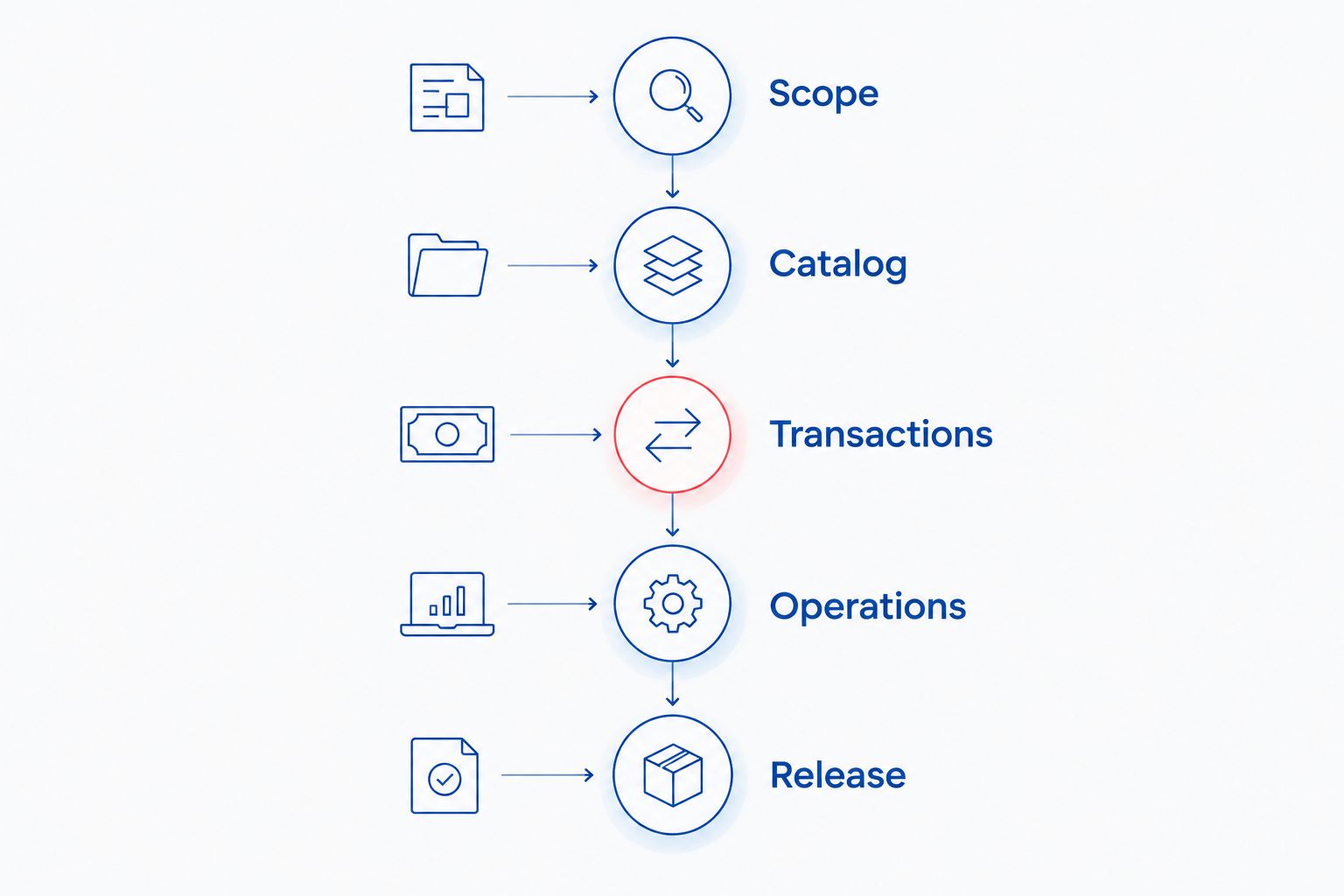
Scope
Write down what customers must be able to do at launch. Define the supported customer journey, required integrations, and business exceptions. Separate those requirements from enhancements that improve the experience without determining whether the store can operate.
Then freeze the acceptance criteria, not all discussion. A newly discovered checkout defect belongs in the release; a newly requested merchandising feature needs a scope decision. Record the effect of that decision on dependent work before accepting it.
Best for controlling scope: an approved launch baseline. Its benefit is a shared definition of completion. Its limitation is that someone still needs authority to reject or defer changes.
Catalog
Give product data a business owner. Developers can validate and import records, but your merchandising team must decide whether titles, descriptions, variants, images, and selling rules are correct.
Test representative records before importing the full catalog. Include the difficult cases you actually sell, such as products with variant-specific attributes or different fulfillment rules. A clean sample of simple products does not establish that the whole catalog is ready.
Keep a record of rejected imports and corrections. Otherwise, a successful technical import can conceal missing or incorrectly mapped products that only become visible during final review.
Transactions
Test 3 transaction states: accepted, rejected, and pending. For each state, verify the customer message, payment record, order record, and next operational action. A successful payment alone does not prove that the store handles uncertainty correctly.
Check interrupted journeys as well. If a customer refreshes a confirmation page or a payment notification arrives again, the resulting business records must remain consistent. Define who investigates a payment without a corresponding order, rather than leaving that decision until launch day.
Use the relevant provider's approved testing process. Do not assume that a working test environment establishes production readiness; confirm the production configuration separately.
Operations
Follow an order beyond checkout. Confirm that the appropriate team or system receives it, that fulfillment can proceed, and that cancellation or refund requests have a defined path.
Where an ERP, warehouse, or accounting integration is involved, test failed transfers and recovery. A retry should not create another order. An error should be visible to someone who can resolve it.
Agree on the source of truth for each important field. For example, ownership of fulfillment status must be explicit when multiple systems display it. Otherwise, teams can act on conflicting records even though each individual system appears functional.
Release
Prepare the transition itself. Identify who changes production configuration, who checks the live purchase journey, and who decides whether to stop or reverse the release.
For a migration, define how you handle records that change during the transition. A previous successful import does not answer what happens to new orders or catalog edits made afterward.
A release is ready when the agreed evidence passes, not when the calendar runs out. Keep your 2026 launch checklist attached to actual test results and unresolved decisions rather than a general status label.
Should you delay the launch or reduce its scope?
Reduce scope when an unfinished feature is optional and its removal leaves a coherent buying and operating journey. Delay when the remaining issue affects payments, order accuracy, required controls, or the team's ability to fulfill purchases.
The right choice depends on what remains broken. A smaller store that processes supported orders correctly is different from a complete-looking store that loses them.
| Release option | Best for | Benefit | Limitation |
|---|---|---|---|
| Reduced-scope launch | An optional feature is unfinished | Preserves a working release without waiting for every enhancement | Requires agreement on what customers will not receive yet |
| Phased launch | A defined customer group or supported journey can operate independently | Limits the initial operating scope | Requires clear boundaries and support instructions |
| Delayed launch | A critical transaction or operational requirement fails | Avoids knowingly releasing a broken core journey | Keeps dependent business activity waiting |
Do not call a release phased simply because parts of it are incomplete. Define who can use it, what they can do, and which operations support them. A phased launch still needs acceptance criteria.
Thefiniteloop's ecommerce development services cover web, mobile, and custom software. Choose that scope when your business requirements justify it; do not commission additional channels merely to make the initial release feel complete.
How should you reset a launch date that is already slipping?
Reset the plan around dependencies, not reassurance. Ask for a written blocker list that identifies the failed requirement, its owner, the next action, and the evidence needed to close it.
- Confirm the blocker. Describe the business journey that fails. Replace broad labels such as integration issues with a specific observable failure.
- Assign the decision. Distinguish implementation work from missing credentials, unresolved business rules, or unapproved content.
- Remove optional work. Defer features that do not support an agreed launch requirement. Record their dependencies before removing them.
- Retest affected journeys. A correction can affect connected behavior. Test the relevant journey again rather than checking only the changed screen.
- Approve the revised release. Confirm that engineering, business operations, and the launch decision-maker accept the same scope.
Your 2026 recovery plan should state what changed and why the revised date is credible. Adding another deadline without changing the dependency plan is not a recovery decision.
Can you launch while an integration is unfinished?
You can launch without an unfinished integration only when an approved alternative supports the required operation. For example, a manual handoff needs a named owner, accurate records, and a reconciliation process.
Manual work transfers responsibility; it does not eliminate it. Do not use it where the business cannot reliably detect and correct missed or duplicate actions.
Does a finished design mean the store is nearly ready?
No. A finished design establishes interface decisions, not transaction integrity, catalog accuracy, or operational readiness. Ask to see a complete order journey and its resulting records before accepting a near-complete status.
Keep design approval and release approval separate. They answer different questions and need different evidence.
FAQ
What’s the first thing to check when an ecommerce launch slips?
Check which required business journey is blocked and who owns the dependency. Separate implementation defects from missing data, access, approvals, and scope decisions.
Can incomplete product data delay my ecommerce website launch?
Yes. Missing or inconsistent product data can block imports, variant selection, and correct downstream records. Assign a catalog owner and validate representative products before approving the full import.
Should I delay my launch for a broken payment flow?
Delay the affected release when customers cannot complete supported payments reliably or payment and order records disagree. A working storefront does not compensate for an unverified transaction path.
Can I add features after the ecommerce launch?
Yes. Defer optional features when removing them leaves a complete, supported buying journey. Record the deferred scope so the launch decision remains explicit.
Who should approve an ecommerce website before it goes live?
Name a launch decision-maker and require evidence from engineering and business operations. Merchandising, fulfillment, finance, and support should approve the business rules and workflows they own.
Can Thefiniteloop help with custom ecommerce development?
Thefiniteloop offers ecommerce development across web, mobile, and custom software for startups and SMEs. Define the required customer journeys, integrations, and acceptance criteria before choosing the project scope.
One last thing
Test the exception you least want to explain to a customer. Choose a failed payment, an interrupted checkout, or an order that does not reach fulfillment. Then show who notices, what the customer sees, and how the business resolves it.
For a 2026 release, that evidence is more useful than another polished homepage review. Successful journeys prove that the store can sell; controlled failure paths show whether your team can operate it when something goes wrong.
Related guides
- How to plan data migration in a Dubai software project
- How Dubai software integrations recover safely from failed syncs
- What belongs in your first software release in Dubai
Your project next
Let’s build what matters
Schedule a consultation to discuss your goals and technical needs.