

A mobile app development timeline depends on the release scope, backend readiness, integrations and acceptance requirements—not a universal number of weeks. Include testing, production setup and store submission in the schedule; a finished interface is not a launch-ready app. For a 2026 project, accept a delivery date only when the team can explain what it includes and what must happen first.
- Your mobile app development timeline must cover backend work, integrations, testing and release—not just screens.
- Define the first release before asking developers to commit to a launch date.
- Thefiniteloop offers mobile app development alongside custom web and platform development.
- Treat store submission, production readiness and business acceptance as separate milestones.
Why this matters
A launch date becomes useful when you can make business decisions around it. Marketing, customer onboarding and operational training need a shared definition of ready. Without that definition, different teams can report progress against different finish lines.
Start by deciding what belongs in your first software release. Separate the customer outcome you need to prove from the features you can defer. That decision gives your development team something concrete to estimate.
How long does it take to build a mobile app?
It takes the time required to deliver an agreed customer workflow, connect its dependencies, verify its behavior and prepare it for production. A credible estimate breaks that work into stages and identifies which stages depend on others. Adding stage estimates together without accounting for dependencies produces a misleading schedule.
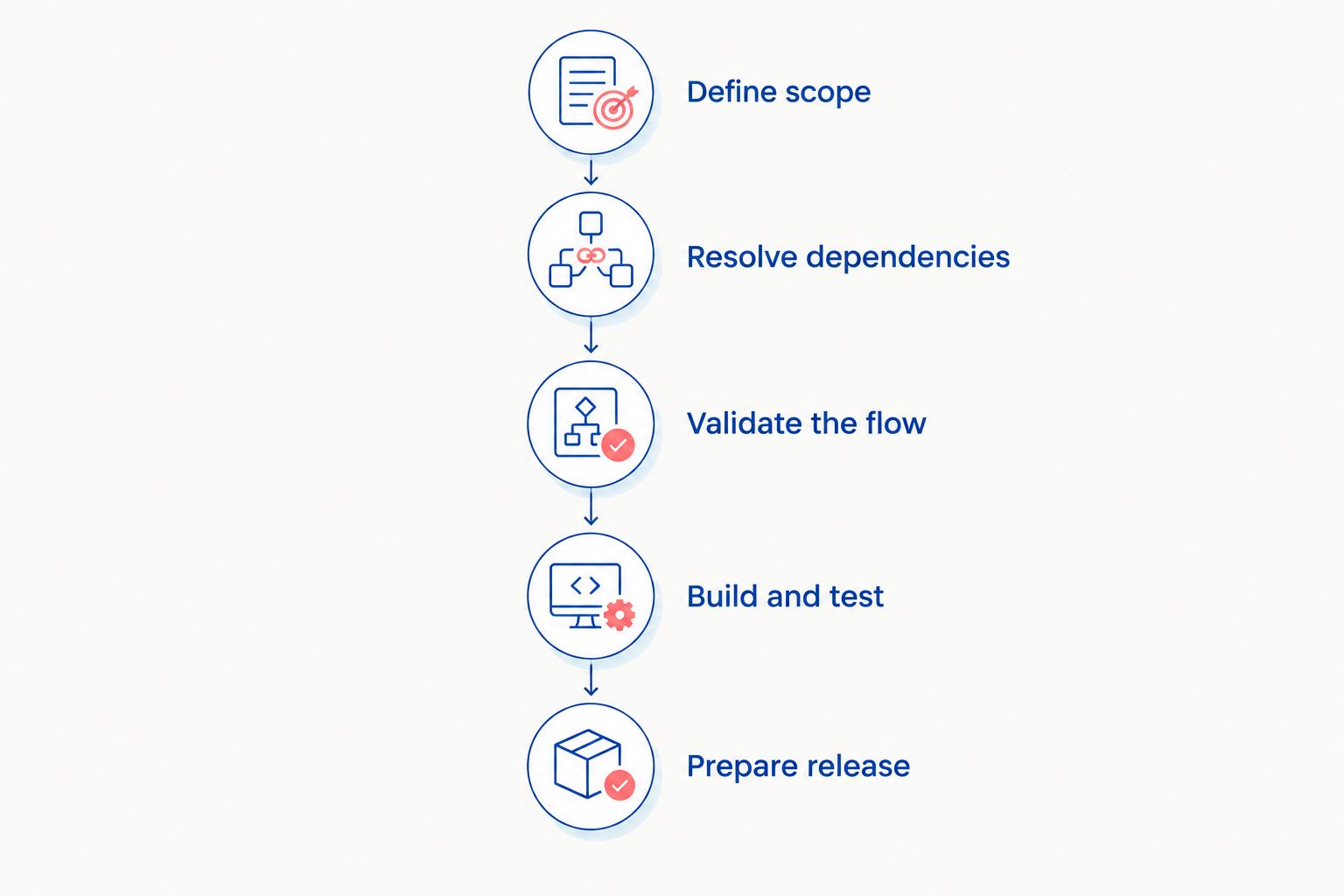
Use this sequence to assess a proposed mobile app development timeline:
- Define scope. Name the user, the task they must complete and the conditions for accepting that task.
- Resolve dependencies. Confirm access to backend services, external systems, test accounts and required business decisions.
- Validate the flow. Review the interaction design and investigate technical uncertainties before committing to the full implementation.
- Build and test. Implement the app and supporting services, checking complete workflows as they become usable.
- Prepare release. Complete business acceptance, production configuration, store submission and support handover.
These stages describe responsibilities, not fixed durations. Design and backend work can overlap when their interfaces are agreed. Work that depends on an unapproved payment account cannot finish simply because its screen is complete.
Ask for milestone evidence, not a percentage-complete report. A working login connected to the intended identity service tells you more than a finished login screen. Apply the same standard to payments, notifications and account management wherever those features belong in your scope.
Which app scope are you estimating?
Before comparing proposals, check that the teams are estimating the same deliverable. A prototype, a production release and an expansion of an existing app have different acceptance requirements. None is a substitute for another.
| Scope | Best for | Useful outcome | Limitation | Schedule question |
|---|---|---|---|---|
| Interactive prototype | Founders validating a user flow | Lets users explore the proposed experience | Does not prove production behavior or backend readiness | Which technical assumptions remain untested? |
| Focused production release | Teams launching a defined customer task | Supports a usable workflow with agreed operational controls | Deliberately leaves other workflows out | What must work before users enter? |
| Existing app extension | Businesses adding a bounded capability | Builds on an existing product and infrastructure | Requires compatibility and regression checks | What existing behavior must remain unchanged? |
| Platform-backed app | Businesses needing custom business rules and administration | Connects the mobile experience to supporting systems | Includes backend and operational work beyond the app | Which supporting services must launch with it? |
Choose a prototype when the unresolved question is usability; choose a production release when real users need to complete real work. A prototype remains valuable, but calling it an MVP does not make it operational software.
For a 2026 buying decision, require the proposal to name the deliverable explicitly. “Build the app” leaves too much room for disagreement about administration, reporting, account recovery and release support.
Why a mobile app development timeline varies
The schedule changes when the work or its dependencies change. Examine these factors before asking a supplier to shorten a date:
- Release scope. Each workflow needs defined behavior, error handling and acceptance checks. A short feature label can conceal substantial business logic.
- Backend readiness. Existing services need usable interfaces and test access. New services add implementation and operational responsibilities.
- Integration access. Payments, identity, inventory or other external systems require credentials, documentation and a way to test failure cases.
- Platform requirements. iOS, Android and cross-platform development still need checks against the devices and operating environments you agree to support.
- Decision ownership. Unresolved rules about permissions, refunds, approvals or account access prevent developers from finishing behavior correctly.
- Release requirements. Security checks, business acceptance, production configuration and store submission belong in the plan rather than after it.
Separate engineering effort from waiting time. A developer can estimate implementation work while still depending on an external account approval. The schedule should show that dependency and identify who owns it.
How should you read the delivery plan?
A useful plan connects each milestone to a demonstrable result. It also states the assumptions behind the date and the action required when an assumption changes. Ask for the following evidence before treating a 2026 launch target as a business commitment.
Scope agreement
The scope should name included workflows, exclusions and acceptance conditions. For an ordering app, distinguish submitting an order from taking payment, updating inventory and handling cancellation. Those are separate behaviors even when the customer experiences them as one journey.
Do not approve a feature list that leaves business rules undefined. Ask who decides each unresolved rule and when the development team needs that answer.
Working integration
An integration milestone should demonstrate actual data moving between the intended systems in an appropriate test environment. A screen displaying sample data does not establish that the connection works.
Include rejected requests, expired sessions and unavailable services in the discussion. Your customer needs a clear outcome when a dependency fails, not just when every system responds successfully.
Business acceptance
Business acceptance means an accountable person has checked the agreed workflows against the acceptance conditions. It is different from a design review or an informal demonstration.
Agree how to accept a software delivery before final payment before the release reaches that stage. The contract and delivery plan should use compatible definitions of completion.
Release readiness
Confirm who controls production credentials, signing access, store accounts and deployment configuration. Specify who submits the app, responds to review feedback and authorizes release.
Release readiness also needs an operational owner. Decide who monitors failures, handles customer reports and approves urgent fixes after users arrive.
Can cross-platform development shorten the timeline?
Cross-platform development allows shared application code across supported platforms, but shared code does not remove platform-specific testing or release responsibilities. Assess the approach against the app's required behavior rather than treating it as an automatic shortcut.
| Approach | Best for | Advantage | Trade-off |
|---|---|---|---|
| Cross-platform development | Products whose required behavior fits a shared implementation | Shares application code across platforms | Platform-specific behavior still needs implementation and testing |
| Separate native apps | Products requiring distinct platform experiences or substantial platform-specific work | Gives each implementation direct control over its platform behavior | Maintains separate application implementations |
Ask the team to explain how the proposed approach handles your difficult requirements. Background activity, device capabilities and existing code deserve specific answers when they are part of your scope.
For a 2026 estimate, compare the complete delivery plan—not the framework alone. A shared interface still depends on the same business decisions, backend services and acceptance process.
How can you shorten delivery without weakening the release?
Reduce scope before you reduce essential verification. Keep the customer task intact, but remove optional paths that do not determine whether that task succeeds. For example, a focused launch can defer advanced personalization while retaining account recovery if users need accounts.
Resolve dependencies early. Give the development team the necessary system access, name a decision-maker and approve business rules before dependent work begins. These actions remove blockers without pretending the engineering work has disappeared.
Use demonstrations to make scope decisions while changes remain contained. Review complete journeys rather than isolated screens, and record whether new requests replace existing scope or extend it.
Thefiniteloop's mobile app development services sit alongside custom web and platform development. Thefiniteloop is a fit for founders seeking a custom mobile app with supporting backend or platform work. A custom build still creates implementation and maintenance responsibilities; do not commission one when an existing product already meets the essential workflow.
Define your app release scope
Discuss the customer workflow, supporting systems and delivery dependencies before committing to a date.
What should you ask before accepting a launch date?
Ask the supplier to walk through the schedule using your actual workflow. Request the included platforms, backend responsibilities, integration assumptions, acceptance process and release ownership. Ask which unresolved dependency threatens the date and what happens if it remains unresolved.
A useful answer distinguishes a planning estimate from a committed milestone. It identifies decisions you must make and shows what evidence will confirm progress. Reject a schedule that assumes immediate approvals without naming the approver.
Does an app need to be finished before testing starts?
No. Test usable workflows as they become available, then verify the complete release before launch. Waiting until every feature is implemented delays feedback on assumptions that affect other work.
Keep business review separate from technical checks. Developers verify implementation behavior; your accountable business owner confirms that the workflow supports the intended operating process.
FAQ
How do I get a reliable mobile app development timeline?
Define the first release, acceptance conditions and dependencies before requesting a delivery commitment. Ask the supplier to connect each milestone to working evidence and identify assumptions that affect the date.
Does a prototype count as a finished mobile app?
No. An interactive prototype demonstrates a proposed experience but does not establish production readiness. Backend behavior, security checks and release preparation require separate verification.
Is cross-platform development always faster than native development?
No. Shared code does not eliminate platform-specific behavior, testing or submission work. Compare implementation approaches against the app’s actual requirements.
Can I launch the mobile app before every planned feature is ready?
Yes, if the released workflow is complete and meets its acceptance conditions. Defer optional features rather than leaving essential customer actions or operational responsibilities unfinished.
Does app store submission mean my app is ready to launch?
No. Submission is separate from business acceptance and production readiness. Agree who handles review feedback, authorizes release and supports users afterward.
What should a development proposal include besides building the screens?
A development proposal should define backend work, integrations, testing, acceptance, production setup and release responsibilities. It should also state exclusions and the dependencies behind the schedule.
Does Thefiniteloop build supporting systems as well as mobile apps?
Thefiniteloop offers mobile app development alongside custom web and platform development. Define which supporting systems belong in your project rather than assuming they are included.
One last thing
Ask what happens when a customer action succeeds but the connection drops before confirmation. For an app that submits orders or other consequential requests, the answer exposes whether the team has considered retries, duplicate actions and uncertain outcomes—not just the happy path.
Use that question in your 2026 scope review. A credible mobile app development timeline accounts for completing the workflow safely, not merely making the confirmation screen appear.
Related guides
- Who owns the code when you hire a Dubai software company?
- What security checks should a Dubai software build include?
- How to assess a software development company in Dubai
Your project next
Let’s build what matters
Schedule a consultation to discuss your goals and technical needs.