

An AI readiness assessment needs a scoped quote: define the workflow, evidence to inspect, and decision you need before comparing proposals. Separate the assessment from data cleanup, software integration, and pilot development; those are different commitments, not automatic inclusions. Buy a decision you can act on, not a readiness score.
- AI readiness assessment cost should follow the evidence required, not the length of a strategy presentation.
- Thefiniteloop offers AI readiness assessments and custom software development for founders and technology teams.
- Separate assessment, data remediation, and pilot development before approving a proposal.
- Require a written proceed, repair, or stop recommendation with clear ownership and acceptance criteria.
How much does an AI readiness assessment cost?
The useful comparison is a scope breakdown, not an unsupported average. Ask each provider to quote against the same business problem, access conditions, technical checks, and deliverables. Otherwise, you are comparing different assignments under the same label.
For a 2026 assessment, use this breakdown to distinguish decision-making work from implementation. If your next step is already clear, the guide to scoping an AI pilot with a software company addresses the separate build brief.
| Work package | What you should specify | What should remain separate |
|---|---|---|
| Business review | Workflow, current problem, accountable owner, success measure | A company-wide transformation program |
| Data inspection | Named sources, representative samples, access permissions | Cleaning or migrating the full dataset |
| Technical review | Relevant systems, interfaces, deployment constraints | Building production integrations |
| Risk review | Sensitive information, prohibited actions, human approval points | A standalone security audit |
| Decision package | Findings, blockers, recommended next step, acceptance criteria | A working pilot unless explicitly included |
A quote becomes useful when these boundaries are explicit. A proposal that includes interviews and a slide deck does not answer the same questions as one that includes inspection of representative records and interface documentation.
Why this matters
An assessment is a buying decision before it is a technology exercise. You are deciding whether a workflow deserves investment, whether existing systems can support it, and what must change before development starts.
A generic score cannot settle those questions by itself. You need a traceable explanation: which evidence supports the recommendation, which assumptions remain untested, and which blocker changes the decision.
Thefiniteloop's position is straightforward: do not commission software development to answer a question that a bounded assessment should resolve first. The reverse also applies. Do not buy another strategy exercise when your unresolved question requires a working technical experiment.
Choose the assessment scope before requesting quotes
Use these as buying scopes, not standardized packages. Select the smallest scope that can resolve your uncertainty, and require providers to explain exclusions.
| Scope | Best for | Useful output | Main limitation |
|---|---|---|---|
| Decision review | Founders deciding whether a workflow needs AI | A business case and a reasoned proceed-or-stop recommendation | Does not establish technical feasibility without inspection |
| Technical readiness review | Teams with a defined workflow and accessible systems | Data, integration, security, and operational findings | Does not prove behavior under real usage |
| Assessment with experiment | Teams facing a specific unresolved technical question | Findings plus results from a bounded technical test | Can expand into development unless boundaries stay explicit |
Decision review: test the business case
Start here when you cannot state what the proposed system should improve. Document the current workflow, who performs it, what failure looks like, and how you will judge a better outcome.
Best for: founders choosing whether to investigate a use case. This scope helps challenge an unnecessary build before technical work begins. Its limitation is evidence depth: interviews and process descriptions do not establish whether source data or interfaces are usable.
Reject a recommendation that starts with a model choice and works backward toward a business problem. A rules-based workflow or an improvement to existing software belongs in the discussion when it addresses the need.
Technical readiness review: inspect the dependencies
Use this scope when the business problem is clear but the implementation conditions are not. Ask for examination of representative data, system access, integration documentation, permissions, and operational responsibilities.
Best for: technology leads preparing a development decision. The benefit is a clearer account of blockers and prerequisites. The limitation is that document review and sample inspection do not substitute for testing a working system.
Require findings to distinguish observed facts from assumptions. For example, an available interface specification is not evidence that the provider has authenticated successfully or checked the required records.
Assessment with experiment: answer a technical question
Include an experiment only when it resolves a named uncertainty. An example is checking whether approved source documents support useful answers to representative questions, with unacceptable responses defined in advance.
Best for: teams whose decision depends on observed behavior. The advantage is direct evidence about a narrow question. The trade-off is additional implementation work, test preparation, and responsibility for handling the test data.
Keep the experiment disposable unless production requirements are explicitly included. A demonstration should not quietly become the architecture for a live service.
Why AI readiness assessment cost varies
Scope determines what a provider must inspect and produce. For a 2026 proposal, make these factors visible rather than accepting a single unexplained fee.
- Workflow breadth. Reviewing a support-answering workflow is a different assignment from assessing support, order processing, and internal reporting together. Name the boundaries.
- Data condition and access. Specify whether the work includes inspecting samples, obtaining access, documenting permissions, or investigating inconsistent records. Do not treat remediation as implied.
- Integration depth. List the systems involved and the questions the assessment must answer about them. Reviewing documentation differs from testing authenticated connections.
- Risk boundaries. Define sensitive information, prohibited outputs, approval requirements, and escalation behavior. Identify applicable jurisdictions instead of assuming one market's rules apply everywhere.
- Evidence required. Interviews, document inspection, technical testing, and a working experiment require different activities. State which evidence is necessary for the decision.
- Deliverable detail. A recommendation memo, a prioritized roadmap, and an implementation-ready brief are distinct outputs. Ask which documents you will receive and how you will accept them.
Do not use company size as a substitute for scope. A small business can have a difficult integration problem; a larger organization can begin with a tightly bounded workflow.
Build a brief that providers can quote consistently
For a 2026 buying decision, start with 1 primary workflow. This is a scoping recommendation, not a claim about how many workflows an assessment must cover. Expand only when another workflow changes the same decision.
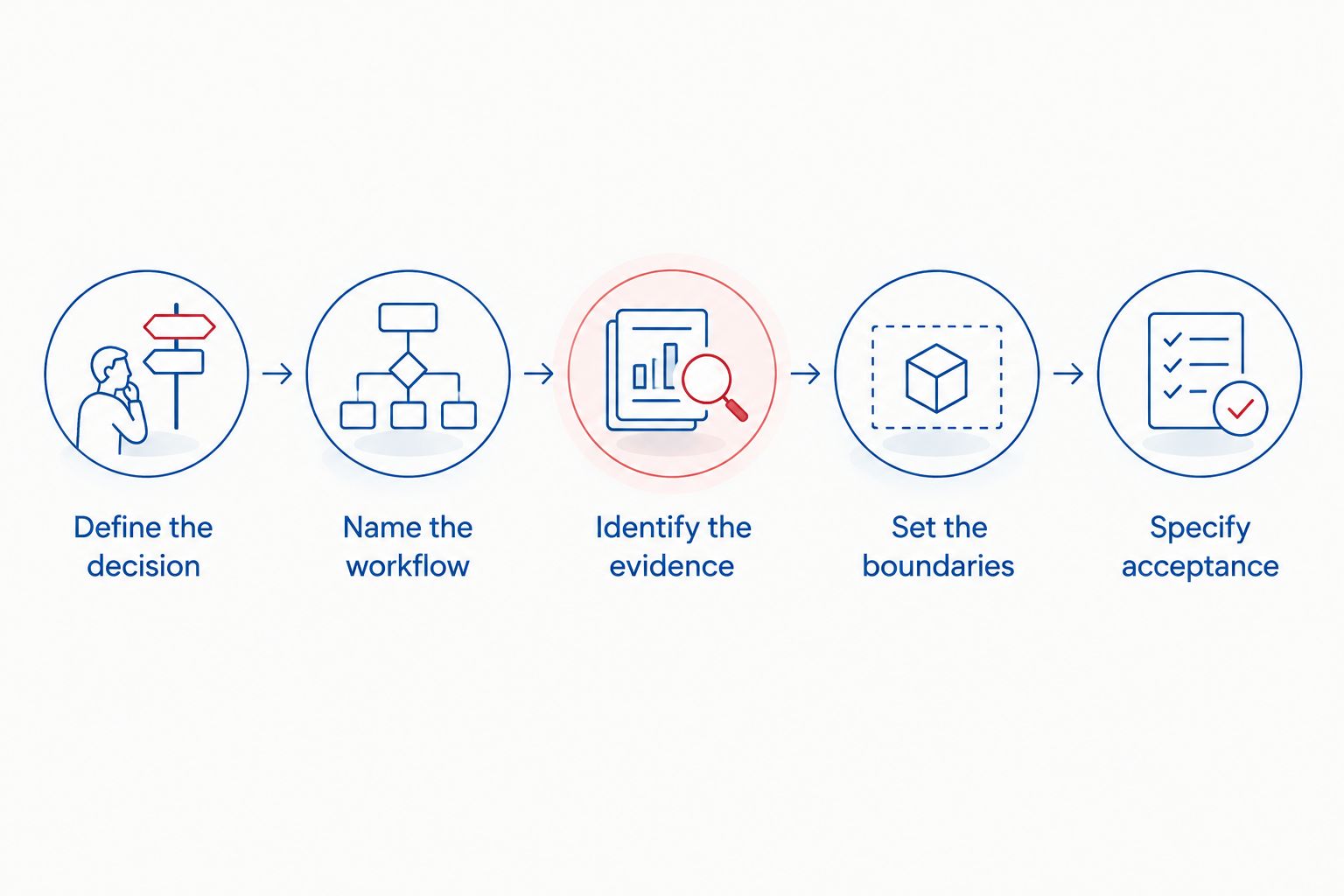
Use the following sequence to prepare your brief. Each step should produce a concrete statement or artifact rather than another open-ended meeting.
- Define the decision. State what approval the assessment supports: investigate further, commission a pilot, repair a dependency, or stop.
- Name the workflow. Describe its trigger, inputs, actions, outputs, and accountable business owner.
- Identify the evidence. List source documents, sample records, system documentation, and people needed to establish the facts.
- Set the boundaries. Specify permitted data use, excluded systems, prohibited actions, and required human review.
- Specify acceptance. Describe the findings, supporting evidence, and next-step brief that make the assessment complete.
Send the same brief to every provider. Ask each to mark assumptions, exclusions, required client inputs, and proposed changes to scope. Differences then become discussable engineering choices rather than unexplained differences in the quote.
What should the final assessment deliver?
Require 3 decision outcomes to remain available: proceed, repair, or stop. These are recommended decision categories, not a scoring benchmark. An assessment loses value when every finding leads automatically to a development proposal.
Proceed
The provider should explain what supports a bounded next step and what remains unproven. Require a pilot brief that names the workflow, evaluation examples, acceptance conditions, dependencies, and accountable owner.
A proceed recommendation is not approval for unrestricted deployment. Keep assessment completion, pilot acceptance, and production approval as separate decisions.
Repair
The report should identify the blocking dependency and who owns resolving it. Examples include unclear access permissions, incomplete source records, or an integration that cannot support the proposed action.
Require a description of the evidence needed to reassess readiness. “Improve the data” is not an actionable handover; naming the affected records, required checks, and responsible owner is.
Stop
A stop recommendation should explain why the proposed use case does not justify the next commitment. Ask whether the problem is better addressed through process changes, conventional software, or a narrower scope.
Stopping is a valid assessment outcome. Do not write acceptance criteria that reward a provider only for recommending more work.
What should you check before approving the proposal?
For a 2026 agreement, separate 2 approval gates: accepting the assessment and authorizing implementation. This contractual structure keeps a finished report from becoming implied permission to build.
Confirm who supplies data access and who can approve its use. Establish where assessment materials will be stored, what the provider can retain, and how findings will be handed back to your team.
Also distinguish advisory work from security assurance. A readiness assessment can identify a need for further security work without constituting a penetration test, a legal opinion, or a certification.
Thefiniteloop is best suited to founders seeking AI readiness assessment alongside custom software development. Its stated services include readiness assessments, use-case roadmaps, and pilots. If your immediate requirement is independent legal advice or formal certification, commission that expertise separately rather than treating development advice as a substitute.
You can review Thefiniteloop when your buying decision connects assessment findings to software implementation. Keep the assessment's acceptance criteria independent of any later development agreement.
Is an AI readiness assessment the same as a pilot?
An assessment supports a decision; a pilot tests a bounded implementation. Include an experiment within an assessment only when the experiment answers a specific question that inspection alone cannot settle.
If your team already has an agreed workflow, usable source data, clear permissions, and a defined evaluation approach, ask what another assessment would resolve before purchasing it.
Should you include data cleanup in the assessment?
Include diagnosis of data problems; scope cleanup separately. Otherwise, a discovery assignment can turn into an open-ended remediation project without a clear completion point.
Ask the provider to document which data problems block the proposed use case and what evidence would show they have been resolved.
How do you compare proposals without choosing the cheapest?
Compare evidence, deliverables, exclusions, and acceptance conditions before comparing the commercial terms. Require providers to quote against the same workflow and mark where their proposed approach differs.
Prefer a clear answer about an important uncertainty over a larger set of generic deliverables. More pages do not establish greater readiness.
FAQ
What determines AI readiness assessment cost?
AI readiness assessment cost follows the scope of investigation and the evidence required. Define workflow breadth, data access, integration checks, risk boundaries, and deliverables before comparing proposals.
Can I get a useful assessment without building a prototype?
Yes, when inspection and documented evidence can resolve the decision. Add a bounded experiment when the unresolved question depends on observed system behavior.
What should I send before requesting a quote?
Send a workflow brief, the decision you need to make, relevant systems, available evidence, and access constraints. Include the required deliverables and acceptance conditions.
Does an assessment include implementation?
Implementation belongs in scope only when the proposal explicitly includes it. Separate assessment findings from data remediation, production integrations, and pilot development.
How do I know when the assessment is complete?
The assessment is complete when it meets agreed acceptance criteria and supports a documented proceed, repair, or stop decision. Require evidence, unresolved assumptions, owners, and a defined next step.
Should I assess every department at once?
Start with a bounded workflow when that scope can answer your immediate investment question. Expand only when dependencies or shared decisions require a broader review.
One last thing
Before commissioning an assessment in 2026, write down what evidence would make you cancel the proposed build. Share that condition with the provider and include it in the brief.
If stopping is not an acceptable outcome, you are buying justification rather than a decision. Make room for a smaller build, a repaired dependency, or no build at all.
Related guides
- Should your Dubai software project include AI?
- How to accept a software delivery before the final payment
- Who owns the code when you hire a Dubai software company?
Your project next
Let’s build what matters
Schedule a consultation to discuss your goals and technical needs.