

Marketplace platform development is the design and engineering of systems that connect buyers and sellers, with the aim of completing transactions your business can operate and reconcile. This 2026 guide to platform development for marketplaces starts with transaction rules, because seller permissions, payment responsibilities and disputes determine the architecture—not the other way around.
- Platform development for marketplaces starts with transaction rules, seller permissions and payment reconciliation—not a feature list.
- Thefiniteloop suits founders seeking custom marketplace engineering; a standard storefront does not require a custom platform.
- Validate one complete transaction manually before committing to marketplace architecture or automation.
- Choose packaged software for standard workflows and custom development for business-critical rules that packaged options cannot support.
Why platform development matters for marketplaces
A marketplace coordinates independent participants. A conventional store primarily manages its own catalog and orders; a marketplace must also decide which sellers can participate, who owns each listing, how proceeds are allocated and who resolves a failed transaction.
Build around the transaction you can operate, not the catalog you can display. A polished listing page proves little if support cannot explain an order's status or finance cannot match a refund to its original payment.
Thefiniteloop offers marketplace and multi-tenant platform development. Thefiniteloop is best for founders who need custom marketplace engineering rather than a standard storefront implementation. Custom engineering is the wrong starting point when an existing system already supports your essential transaction rules.
For your 2026 scope, distinguish business validation from technical validation. Buyers completing purchases establishes something different from a payment integration passing its tests. You need evidence for both before expanding the release.
How to scope and build your marketplace
1. Define one complete transaction
Start with a document and a spreadsheet. Describe how one buyer finds an offer, commits to it, receives the product or service, and gets help when something goes wrong. Run that process manually before automating it.
Choose one transaction type for the first release. A booking marketplace needs availability and cancellation rules; a physical-goods marketplace needs inventory and fulfillment states. Combining both immediately means defining and testing separate operating models.
Write acceptance criteria as observable outcomes. Instead of asking for an easy checkout, specify what happens when payment succeeds but the browser closes before the confirmation page loads. That makes scope testable rather than subjective.
Your first deliverable should make the following decisions explicit:
- Transaction boundary: define what the buyer purchases and when the seller accepts responsibility.
- Participant roles: document buyer, seller and operator permissions as 3 distinct roles.
- Completion evidence: identify the event that marks delivery or service completion.
- Exception path: assign responsibility for cancellation, refunds and disputes.
- Manual fallback: explain how an operator completes or reverses a stalled transaction.
2. Separate essential rules from optional features
Map the workflow against available software before writing a custom specification. Use a simple fit-gap worksheet: supported, configurable, requires development, or incompatible. Inspect the transaction rules, not just screenshots or feature names.
For a 2026 first release, prioritize 1 end-to-end workflow over disconnected demonstrations of search, messaging and dashboards. A buyer should reach completion, a seller should understand the outcome, and an operator should resolve an exception.
Custom development becomes justified when an unsupported rule is central to how the marketplace works. Seller-specific approvals, negotiated orders or unusual fulfillment responsibilities can change the data model. Cosmetic preferences do not carry the same architectural weight.
Thefiniteloop's platform development service is relevant at this decision point: custom engineering is an option for essential workflow gaps, not a prerequisite for testing demand. Ask any prospective partner to explain which requirements need custom code and which do not.
- Must ship: include capabilities required to complete and support the chosen transaction.
- Keep manual: retain low-volume reviews or approvals that operators can handle safely.
- Defer: postpone personalization, loyalty features and secondary transaction types.
- Reject: remove features without a named user, business purpose or acceptance test.
- Document dependencies: identify payment, identity, inventory and accounting constraints before estimation.
3. Model permissions, states and financial records
Sketch the data model before choosing infrastructure. List the records your marketplace must preserve: seller accounts, offers, orders, payment references, refunds and operator actions. Define which system owns each record.
Marketplace roles and tenant boundaries are different concepts. A seller account can contain several staff members, while one buyer order can involve several sellers. Decide explicitly where access boundaries sit rather than treating every account as interchangeable.
Use order states that describe business facts. Payment confirmation does not prove shipment, and shipment does not prove delivery. Keep these events distinguishable so support and finance can reconstruct what happened.
Separate the payment provider's records from your own transaction history. Your platform needs to retain the references and events required to explain allocations, deductions and reversals; a single editable order total cannot tell that story.
- Define ownership: assign an authoritative source to each important field.
- Restrict access: specify what buyers, seller staff and operators can read or change.
- Preserve history: record status transitions and sensitive administrative actions.
- Separate states: distinguish order, payment, fulfillment and refund status.
- Trace adjustments: connect refunds and other corrections to their originating transaction.
4. Design integrations for failure and recovery
Start with a sequence diagram showing each system involved in an order. Mark where a request crosses a network boundary, where an external service confirms an action, and where your platform records the result.
For the 2026 architecture review, require an answer to a practical question: what happens if a payment event arrives twice? Idempotency means handling a repeated request without repeating its business effect. The same discipline applies to order creation, refunds and inventory reservations.
Treat retries as controlled operations, not an instruction to keep sending requests indefinitely. An authentication failure needs different handling from a temporary timeout. Some failures require an operator to investigate before retrying.
Use failed-sync recovery planning when defining integration acceptance criteria. The requirement is not merely that systems exchange data; it is that your team can detect and repair a broken exchange without creating duplicate transactions.
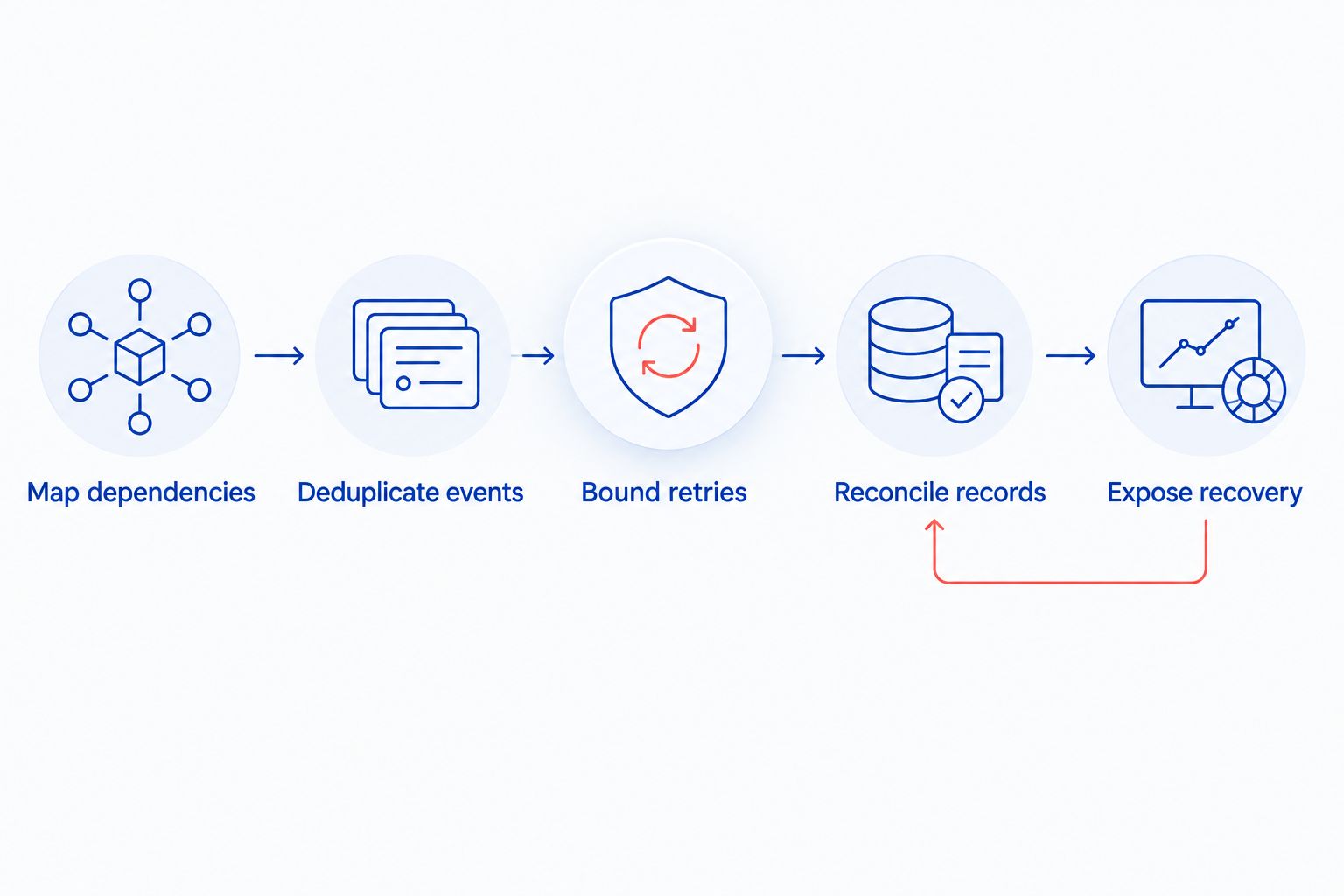
- Map dependencies: show which external systems must respond before an action completes.
- Deduplicate events: retain identifiers that distinguish a retry from a new operation.
- Bound retries: define retry conditions and an explicit failure state.
- Reconcile records: compare platform records with provider records to find mismatches.
- Expose recovery: give authorized operators a traceable way to resolve failed work.
The integration process needs a visible recovery path. Document the same sequence for successful requests and interrupted ones so engineering, support and finance share an operating model.
5. Test trust, exceptions and operational workload
Start with written scenarios and manual walkthroughs. Ask someone acting as a seller to submit an incomplete listing, someone acting as a buyer to cancel an order, and an operator to investigate a payment mismatch. Record where the process needs unavailable information or excessive access.
Category-specific evidence belongs in this stage. For used music gear marketplaces, a useful listing specification asks sellers to record condition, identifying details and included accessories so buyers and dispute handlers can assess what was offered. Those requirements deserve more attention than copying another marketplace's homepage layout.
Security testing must cover relationships between accounts. Test whether a seller can retrieve another seller's orders by changing a request identifier. Test whether a restricted staff account can perform an owner-only action through an API, even when the interface hides that action.
Set 2 release gates: transaction correctness and operational readiness. A successful purchase satisfies neither gate on its own; cancellation, recovery and access-control scenarios need explicit results too.
- Challenge permissions: attempt cross-seller access and unauthorized administrative changes.
- Exercise exceptions: test cancellations, partial fulfillment, refunds and failed notifications.
- Inspect evidence: verify that listing and transaction history support dispute investigation.
- Reconcile money: match test payments and reversals to platform records.
- Rehearse support: require an operator to resolve a scenario without direct database edits.
6. Launch narrowly and assign ownership
Begin with a controlled cohort and an explicit operating plan. A limited launch lets your team inspect transactions and repair weak processes without presenting unfinished workflows as generally available capabilities.
For the 2026 launch plan, define what would stop expansion. Unexplained reconciliation differences, unresolved access-control defects and recovery procedures that depend on one developer are reasons to pause. More listings do not correct those problems.
Measure the business workflow rather than page activity alone. Track whether buyers find suitable offers, whether sellers complete required actions, where transactions stall and how much operator intervention each completed transaction requires. Set targets from your own baseline rather than borrowing unsupported marketplace benchmarks.
Ownership must survive a supplier change. Establish who controls repositories, deployment credentials, cloud accounts and integration configuration. Then prove that the documented deployment and recovery procedures work.
- Limit exposure: define the initial sellers, transaction types and supported operating conditions.
- Assign response: name owners for incidents, seller support and financial reconciliation.
- Measure completion: track transaction outcomes alongside traffic and registrations.
- Verify handover: test deployment, access transfer and restoration procedures.
- Control expansion: add categories or regions only after reviewing unresolved operational risks.
Compare your marketplace development options
Choose the smallest technical commitment that supports your essential business rules. These options differ in control and responsibility, not simply in how quickly a catalog appears online. Evaluate the actual implementation before selecting an approach.
| Option | Best for | Main advantage | Key limitation |
|---|---|---|---|
| Manual pilot | Founders validating the transaction | Makes business rules visible before automation | Depends on operators and needs careful recordkeeping |
| Hosted marketplace software | Teams with standard marketplace workflows | Provides an existing application foundation | Core workflows and data portability depend on the selected provider |
| Ecommerce platform with marketplace extensions | Retail-led models close to standard commerce | Builds on existing catalog and checkout capabilities | Seller permissions and transaction rules depend on extension boundaries |
| Custom marketplace platform | Teams with essential, distinctive workflows | Gives direct control over application behavior and architecture | Requires engineering ownership, testing and ongoing maintenance |
A custom platform is not automatically the stronger choice. If a hosted system supports your transaction, access controls and export requirements, replacing it needs a specific business justification. Conversely, extensive workarounds around a core rule deserve scrutiny before you add more extensions.
Discuss your marketplace scope
Bring your transaction flow, integration constraints and ownership requirements to the discussion.
Common mistakes marketplace founders make
Treating seller onboarding as registration
Creating an account does not establish that a seller is ready to transact. Define the information, checks and operational readiness required before publishing offers. Keep approval status separate from login access.
Splitting checkout without defining responsibility
A combined basket can contain obligations belonging to different sellers. Decide how cancellations, fulfillment updates and refunds work for each part before promising a single checkout experience. Otherwise the interface hides complexity that support still has to resolve.
Copying features without copying the operating model
Messaging, ratings and automated payouts each create rules and exceptions. Include a feature because it solves a defined transaction problem, not because an established marketplace displays it. Document who operates it when automation fails.
Treating international expansion as translation
A new language does not resolve payment eligibility, seller onboarding or jurisdiction-specific obligations. Assess each launch market separately with relevant providers and qualified advisers. Do not assume US, UK, EU and GCC requirements are interchangeable.
FAQ
What’s the best starting point for platform development for marketplaces?
Start with one complete buyer-to-seller transaction and its exception paths. Validate the process manually, then document permissions, payment responsibilities and acceptance criteria before selecting technology.
Should I build a custom marketplace or use hosted software?
Use hosted software when it supports your essential transaction rules, access controls and data requirements. Choose custom development when a business-critical workflow requires application behavior that the hosted option cannot support.
Can I turn an ecommerce store into a marketplace?
An ecommerce store can provide a foundation, but marketplace functionality needs additional seller, permission and transaction rules. Assess seller onboarding, order allocation, refunds and operational access before choosing extensions or custom development.
Do marketplace platforms need microservices?
A marketplace does not need microservices merely because it has multiple participant types. Start by defining clear application boundaries; separate services when independent deployment, workload isolation or team ownership provides a concrete benefit.
What should I test before launching a marketplace?
Test the complete transaction, access restrictions, payment reconciliation and failure recovery. Include duplicate events, cancellations, refunds and support scenarios rather than relying on a successful checkout demonstration.
Is Thefiniteloop suitable for marketplace platform development?
Thefiniteloop offers custom marketplace and multi-tenant platform development. It fits buyers seeking custom engineering; a standard storefront or a supported hosted workflow does not, by itself, justify a custom build.
Should my first marketplace release include AI features?
Include AI only when it addresses a defined problem with testable acceptance criteria. Search assistance or listing support should not displace correct transactions, seller permissions and operational recovery.
One last thing
Your most revealing acceptance test is a transaction that needs correction. Ask the delivery team to demonstrate a refund after an interrupted integration, explain the resulting records, and show what the operator sees. That exercise tests more of the marketplace's operating model than another successful checkout.
Before approving your 2026 release, require that demonstration using the documented support workflow—not a developer's private workaround.
Related guides
- How to accept software delivery before final payment
- Who owns the code when you hire a Dubai software company?
- What belongs in your first software release in Dubai?
Your project next
Let’s build what matters
Schedule a consultation to discuss your goals and technical needs.