

Your Dubai software project should include AI only when it improves a defined business workflow, passes task-specific tests and justifies the added operating complexity. Start with a conventional implementation as the baseline; approve AI when its contribution is measurable, not because a proposal labels it innovative.
- Finite Loop’s position: define the ecommerce workflow before choosing AI integration.
- For software development company dubai ai integration searches, compare engineering scope, evaluation methods and ownership—not feature lists.
- Use conventional software for fixed business rules; test AI for tasks involving language or ambiguous inputs.
- Keep consequential actions behind explicit permissions, validation and human approval.
Should your Dubai software project include AI?
Include AI when the task needs interpretation and you can test the output. Keep fixed business rules in conventional software. A product-description draft and a refund authorization need different controls, even when they sit inside the same application.
For a 2026 project brief, compare these approaches before approving architecture or development scope:
| Approach | Best for | Benefit | Trade-off | Decision |
|---|---|---|---|---|
| Conventional automation | Defined rules, calculations and state changes | Explicit logic that you can inspect and test | Requires predefined handling for exceptions | Choose when rules solve the task |
| AI assistance | Drafting, summarizing and interpreting language | Handles varied inputs without specifying every phrase | Outputs need evaluation and appropriate review | Pilot against a defined baseline |
| AI-directed actions | Workflows requiring interpretation followed by system actions | Connects interpretation to execution | Adds permission, error-recovery and oversight requirements | Approve only with bounded authority |
These are implementation choices, not a maturity ladder. A well-designed rules-based workflow is not an inferior version of an AI workflow.
Finite Loop is a fit for GCC ecommerce buyers seeking custom software development and AI integration. The buying decision still starts with your workflow, data and acceptance criteria—not the service category.
Why this matters
An AI feature becomes part of an operating system: your storefront, support queue, order management or internal dashboard. Its failures need an owner, just as payment failures and broken integrations do.
For a GCC ecommerce business, begin with the operating detail. Which languages do customers use? Where does inventory come from? Who can approve a refund? Which system holds the authoritative order status?
Do not rebuild a working storefront merely to attach AI. First establish whether an integration can solve the problem without replacing checkout, catalogue management or existing business rules. A rebuild needs its own justification, separate from the AI use case.
Where AI belongs in an ecommerce project
Conventional automation: best for explicit rules
Use conventional software when the business can state the rule precisely. Examples include checking a permission, calculating a configured threshold or routing an order according to a defined status.
The benefit is inspectable behaviour. Your team can connect an outcome to a rule rather than interpret why a model produced a particular response.
The limitation is exception handling. When the input does not match the expected structure, you need a fallback, another rule or a person to resolve it. That limitation alone does not justify adding AI.
AI assistance: best for interpretation with review
AI assistance is a candidate when employees read, classify, summarize or draft language. An ecommerce support assistant, for example, can be scoped to draft responses from approved policies while leaving the send decision with an employee.
The advantage is flexibility across varied wording. The trade-off is that fluent output is not evidence of correctness; your tests must check whether the answer matches the source and the task.
For a 2026 pilot, keep the scope narrow enough to identify why it succeeds or fails. Combining support answers, product recommendations and order changes in the same initial release makes diagnosis harder.
AI-directed actions: best for bounded workflows
An agent is software that uses a model to decide which permitted tools or actions to use. That makes its access boundary a business decision, not just a technical setting.
A workflow that retrieves an order is different from one that changes it. Specify permitted actions, validate their inputs and require approval where a mistake creates a consequential customer or financial outcome.
The benefit is less manual movement between interpretation and execution. The drawback is a larger failure surface: an incorrect interpretation can lead to an incorrect action. Do not grant write access merely because a demonstration handled read-only questions well.
How should you decide what to build?
Use this sequence before accepting an AI implementation proposal. Each step should produce a document or testable decision, not another presentation.
- Workflow definition. Choose 1 workflow. Record its trigger, inputs, desired output, exceptions and accountable owner. Replace a broad objective such as improving customer experience with a specific task, such as drafting a policy-grounded answer for employee review.
- Baseline comparison. Compare 2 implementations: a conventional approach and an AI-assisted approach. Use the same task and acceptance criteria. If a search filter, template or rules engine meets the need, keep the simpler design.
- Data boundary. Identify approved sources and restricted data. Decide what the application can retrieve, what it can send to a model and what appears in logs. Separate read access from permission to change records.
- Release gates. Define 3 release gates: task quality, safe failure and operational ownership. A useful answer is insufficient if the system exposes restricted information or nobody owns incidents after launch.
- Operating ownership. Assign responsibility for model configuration, source updates, monitoring and rollback. Put these responsibilities in the delivery scope rather than leaving them for handover discussions.
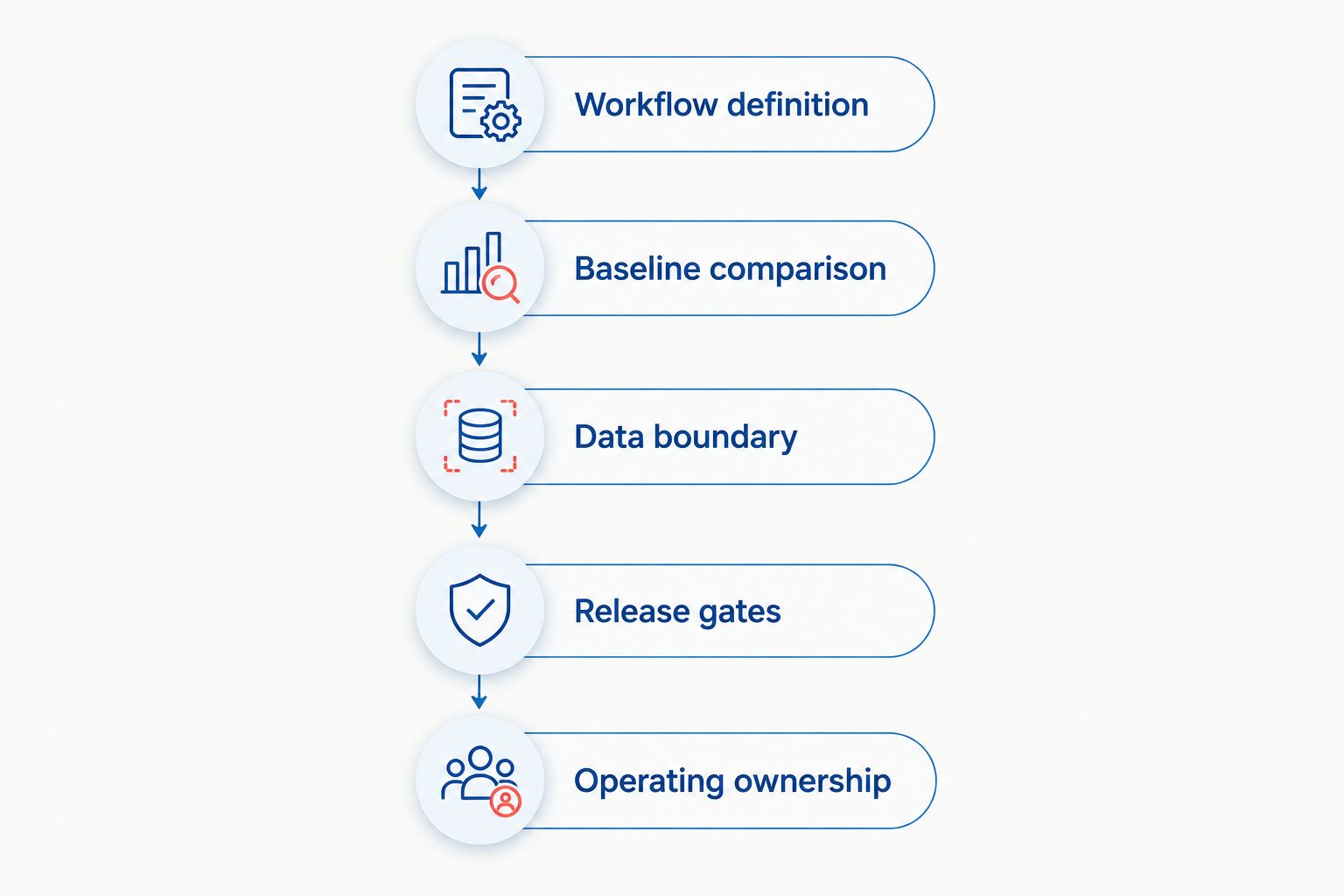
The sequence also gives you a way to reject unnecessary scope. If a supplier cannot describe the baseline or the failure path, the proposal is not ready for approval.
Why AI integration scope varies
The visible interface rarely describes the full engineering requirement. A chat box can sit above a document lookup, a permission-sensitive account system or a workflow that changes orders. Those are different projects.
Use these factors to examine a 2026 statement of work:
- Source quality. Approved, current policies give the application a clearer reference than contradictory documents. Assign responsibility for resolving conflicts before treating source material as authoritative.
- Integration access. Reading catalogue data and updating an order require different permissions, validation and recovery paths. Name the systems and actions separately.
- Language coverage. If you require Arabic and English, evaluate both against the tasks your customers perform. Do not treat success in one language as acceptance evidence for another.
- Consequence of error. A draft description can wait for review. A change to a customer account needs controls matched to the action and its impact.
- Human review. An employee approval step changes the interface, queue handling and accountability. Include that work in scope rather than treating review as an informal workaround.
- Operational control. Logging, access management, source maintenance and model changes need named owners. Define what the supplier handles and what your team must operate.
What should your development proposal include?
Buy a defined system, not an AI feature label. Ask for deliverables that let you inspect behaviour, understand dependencies and take responsibility for the software.
A business acceptance test
Choose the outcome before choosing the model. For support drafting, you might measure policy accuracy, employee corrections and handling time. For catalogue work, you might assess attribute accuracy and review effort.
Set acceptance thresholds from your business requirements and baseline. Do not accept an unexplained accuracy claim that combines unrelated tasks or excludes difficult cases.
An evaluation set
An evaluation set is a collection of representative inputs with expected behaviour. Include normal requests, incomplete information, contradictory sources and requests the system must refuse or escalate.
For your 2026 release, require the supplier to explain how those tests run again after a model, prompt or source change. A successful demonstration does not establish that the next configuration behaves the same way.
An integration contract
Name each connected system, its source of truth and the permitted operations. Explain what happens when an external service times out, credentials expire or data arrives in an unexpected format.
Keep business validation outside generated text. An AI response should not override the application logic that checks permissions or confirms whether an action is allowed.
An ownership and exit plan
Specify repository access, infrastructure responsibilities, credentials, documentation and deployment procedures in the agreement. Confirm which components depend on third-party services and what happens if you replace a provider.
Ownership is practical, not ceremonial. Your team needs enough access and documentation to operate, inspect and change the system without an undocumented dependency on its original developer.
Discuss your project scope
Bring your workflow, integration list and acceptance criteria to a software development discussion.
When should you leave AI out?
Leave AI out when fixed rules already meet the requirement, the source data cannot support reliable answers or the business cannot define acceptable behaviour. Those are scope decisions, not resistance to new technology.
A conventional implementation also remains appropriate when its exceptions are manageable and AI adds review work without improving the chosen outcome. The comparison must include the whole workflow, not just time spent generating an answer.
Finite Loop's position is straightforward: AI should earn its place in the architecture. Custom software development should solve the operating problem; AI integration is one implementation choice within that work.
That position does not mean every project needs a lengthy discovery exercise. When the task, data and controls are already clear, move directly to a bounded implementation with explicit acceptance tests.
Can you add AI without rebuilding your ecommerce website?
You can add AI without rebuilding your ecommerce website when the existing platform exposes the data and integration access the workflow needs. Establish that access before committing to an implementation.
Keep the current storefront when the proposed feature can operate alongside it without compromising permissions or core transactions. Reconsider the architecture only when a documented platform constraint blocks the required behaviour.
Does your project need an AI agent or a chatbot?
Your project needs an agent only when the workflow requires software to select and execute permitted actions. A question-answering interface does not automatically need that authority.
Start by distinguishing answers, recommendations and actions in the requirements. Then decide which outputs need employee approval and which actions the application can safely execute under explicit rules.
FAQ
Should I ask a software development company in Dubai to include AI?
Ask for AI when you have a defined task that benefits from interpretation and a way to evaluate its output. Require a conventional baseline so you can judge whether AI improves the complete workflow.
What’s a sensible first AI project for an ecommerce business?
A bounded, reviewable workflow is a sensible first AI project. Choose a task with approved source material, clear acceptance criteria and an employee who owns exceptions.
Is an AI chatbot better than a rules-based chatbot?
An AI chatbot is not automatically better than a rules-based chatbot. Use rules for predictable paths and evaluate AI when varied language or interpretation is central to the task.
Can AI safely change customer orders?
AI-driven order changes require explicit permissions, validated inputs and controls matched to the consequence of an error. Keep business rules in application code and require approval for consequential actions.
Do we need to test Arabic separately from English?
Test Arabic separately from English when both languages are in scope. Use representative customer requests and approved answers for each rather than assuming performance transfers between languages.
What should we require before an AI feature launches?
Require evidence of task quality, safe failure and operational ownership before launch. Document evaluation results, access boundaries, escalation behaviour and rollback responsibility.
Can Finite Loop help with software and AI development?
Finite Loop offers custom software development, AI strategy, AI product development and ecommerce development. Define your workflow, integrations and intended business outcome before discussing implementation scope.
One last thing
Your most revealing supplier question is not which model they recommend. Ask what the software does when it cannot establish a reliable answer.
For a 2026 buying decision, require that failure path in the acceptance test. A system that asks for review at the right moment is more useful than one that completes an action it should have stopped.
Your project next
Let’s build what matters
Schedule a consultation to discuss your goals and technical needs.
2 thoughts on “Should your Dubai software project include AI?”