

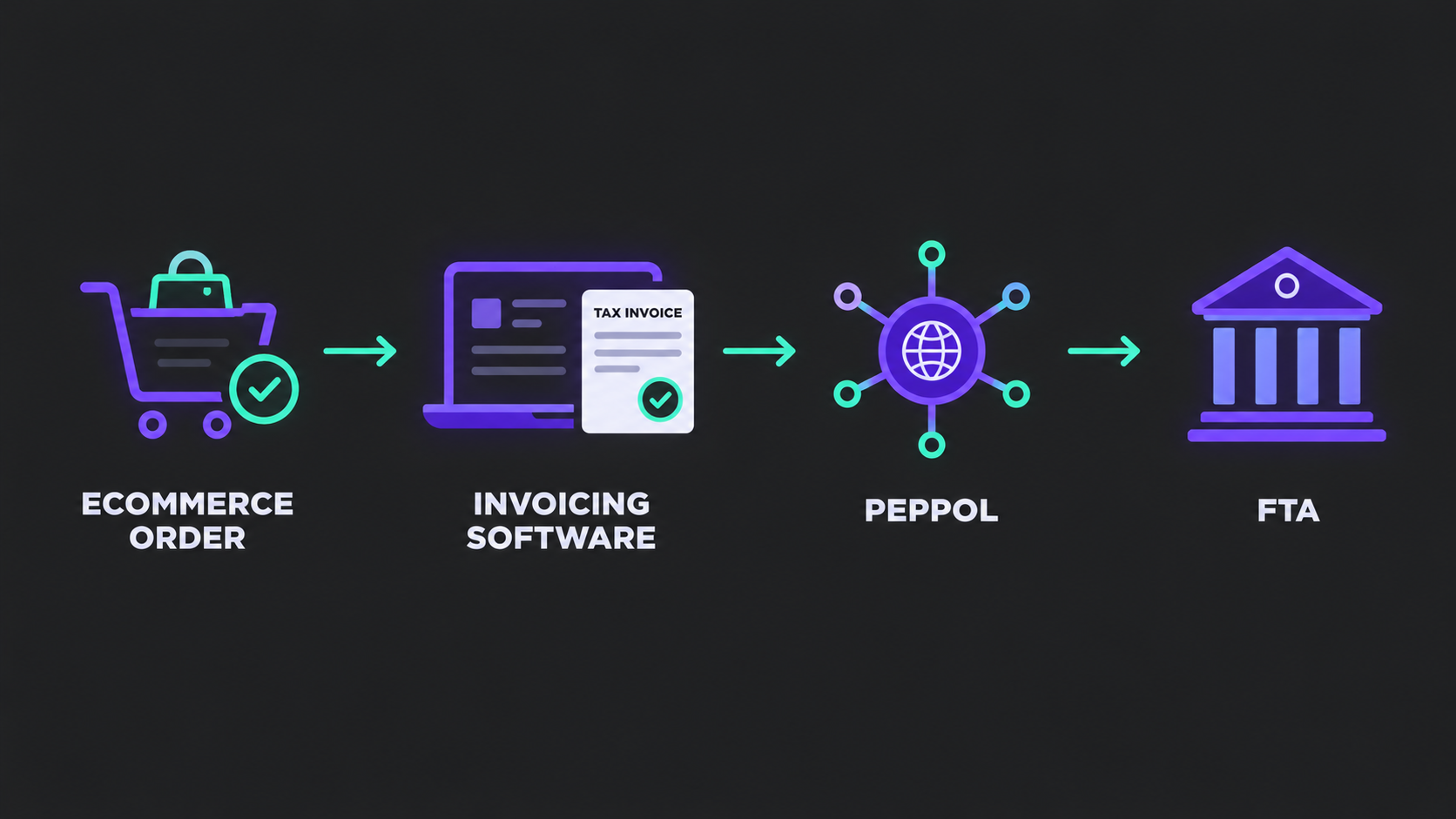
A UAE ecommerce store needs invoicing software that can generate Federal Tax Authority (FTA) compliant tax invoices today, and that can connect to an Accredited Service Provider (ASP) on the Peppol network before e-invoicing becomes mandatory for your business between 2026 and 2027. Getting this right means checking two separate things: whether every invoice you issue right now has the correct VAT fields, and whether your invoicing stack can be upgraded to the UAE’s new e-invoicing model without a rebuild.
- Every UAE tax invoice needs specific mandatory fields — a 15-digit TRN, sequential numbering, AED-converted VAT amounts — and a missing field can block your customer’s input VAT recovery.
- The UAE’s e-invoicing mandate rolls out in phases from July 2026 (voluntary) through 2027 (mandatory, tiered by revenue), covering B2B and B2G transactions exchanged over the Peppol network.
- Most ecommerce platforms — Shopify, WooCommerce, Magento — don’t generate fully FTA-compliant tax invoices out of the box; you need a dedicated invoicing app, plugin, or integration layer.
- Thefiniteloop’s position: don’t wait for your mandate deadline to start. Stores that integrate compliant invoicing software now avoid a rushed, costly migration when the deadline arrives.
If your store already issues checkout invoices through Shopify or WooCommerce, read our walkthrough on automating VAT invoicing on Shopify before changing anything — it covers the exact app-and-automation path most UAE stores take first.
How to choose VAT-compliant invoicing software for your UAE ecommerce store
Work through this in order. Each step rules out tools that look compliant but aren’t.
- Map your current invoice volume and TRN structure. If you sell under one legal entity with one Tax Registration Number, your requirements are simpler than a multi-entity or multi-emirate setup.
- Check the tool against the FTA’s mandatory field list. The FTA’s February 2026 technical guidance sets out 51 mandatory fields for tax invoices under the e-invoicing framework — ask any vendor to show you, concretely, which of these their software populates automatically.
- Confirm Peppol and ASP integration readiness. Software that can only produce a PDF invoice today will need a bolt-on, or a replacement, once your mandate phase starts. Ask whether the vendor already supports the Peppol 5-corner model and PINT AE data format, or has a dated roadmap to.
- Verify multi-currency and AED conversion handling. If you sell in USD, EUR, or GBP, your invoicing tool needs to convert to AED at the UAE Central Bank’s rate on the date of supply — not an average rate, and not the payment processor’s rate.
- Test standard vs. simplified invoice logic. Your software should automatically decide whether a transaction needs a full tax invoice or qualifies for a simplified one, based on transaction value and whether the buyer is VAT-registered — not leave that judgment to your checkout flow.
- Plan the migration before your deadline, not during it. Treat the mandate dates below as hard stops for having a tested, integrated system — not for starting the search.
What the mandate actually requires, and when
The UAE’s e-invoicing mandate is being introduced in revenue-tiered phases, not all at once. It’s built on Federal Tax Authority Ministerial Decisions 243 and 244 of 2025, and it currently excludes B2C transactions — so a typical consumer-facing ecommerce checkout isn’t directly in scope yet, but any B2B wholesale, marketplace, or government-facing sales channel is.
| Phase | Date | Who it applies to |
|---|---|---|
| Voluntary participation opens | 1 July 2026 | Any business ready to meet the FTA’s technical requirements |
| Accredited Service Provider (ASP) deadline | 31 July 2026 | Businesses with revenue of AED 50 million or more |
| Mandatory e-invoicing begins | 1 January 2027 | Businesses with revenue of AED 50 million or more |
| ASP deadline | 31 March 2027 | Businesses under AED 50 million, and government entities |
| Mandatory e-invoicing begins | 1 July 2027 | Businesses under AED 50 million revenue |
| Mandatory e-invoicing begins | 1 October 2027 | Government entities |
These dates and thresholds come from the FTA’s published Ministerial Decisions and its February 2026 technical guidance; treat them as the current position and confirm against the FTA’s own portal before committing to a vendor contract, since implementation guidance has been refined more than once already.
The fields your invoices need right now, mandate aside
Regardless of the e-invoicing timeline, every standard UAE tax invoice you issue today needs a defined set of fields to be valid for VAT purposes. At minimum: the words “Tax Invoice,” your legal business name matching your trade license, your full UAE physical address (not a P.O. box), your 15-digit TRN, the buyer’s name and TRN if they’re VAT-registered, a unique sequential invoice number, the invoice and supply dates, line-item descriptions with quantities and unit prices, the VAT rate and amount per line, and a totals breakdown showing the pre-VAT subtotal, total VAT, and grand total. Foreign-currency sales must show the VAT amount converted to AED at the Central Bank’s rate on the date of supply.
A simplified tax invoice — generally usable for retail sales and for lower-value B2B transactions — drops the buyer’s details, but everything else about accuracy and sequencing still applies. Treat “simplified” as a shorter form, not a lower bar for correctness, and confirm the exact value threshold that applies to your business with your accountant or the FTA directly, since sources vary slightly on where that line sits.
Native platform invoicing vs. a dedicated invoicing layer
Shopify, WooCommerce, and Magento can print an invoice, but none of them natively produce a fully FTA-compliant tax invoice with sequential numbering, TRN validation, and AED conversion built in. Most UAE ecommerce stores close that gap one of two ways: a VAT-focused invoicing app or plugin that sits on top of the existing platform (the faster, lower-cost route for stores under the AED 50 million threshold), or a dedicated invoicing/accounting integration — often connected through the store’s ERP or accounting system — for stores that already reconcile orders against inventory and finance records.
If your store already syncs orders into an ERP, your invoicing software should read from that same system of record rather than generating a second, divergent set of numbers. See our guide on integrating tools with an existing ERP system for how that connection is usually scoped.
Common compliance gaps ecommerce stores miss
The most common failure isn’t a missing field — it’s inconsistent sequential numbering across sales channels. A store selling through its website, a marketplace, and an in-store POS often ends up with three separate invoice number sequences, which breaks the FTA’s requirement for a single, gapless sequence per legal entity. Other recurring gaps: using the payment gateway’s exchange rate instead of the Central Bank’s, forgetting to update the TRN after a trade license renewal, and treating every sale under AED 10,000 as automatically “simplified” without checking whether the buyer is VAT-registered.
Working with a software partner to future-proof invoicing
If you’re rebuilding or extending your invoicing stack anyway, scope it against the 2027 mandate, not just today’s rules. A development partner can build the compliance logic once — field validation, sequencing, AED conversion — and add the Peppol/ASP connection as a second phase closer to your actual deadline, rather than building twice.
Turn this into a scope
Before you brief a developer or evaluate a vendor, confirm you can check off each of these:
- A single invoice numbering sequence across every sales channel (web, marketplace, POS)
- Automatic validation of your TRN and the buyer’s TRN where applicable
- AED conversion using the UAE Central Bank’s rate on the date of supply
- Automatic standard vs. simplified invoice logic based on value and buyer VAT status
- A documented path to Peppol/PINT AE and ASP connectivity ahead of your revenue-tier deadline
- An audit trail showing who issued, amended, or voided each invoice
Not sure which of these your current setup is missing? Book a consultation and we’ll map your invoicing stack against the FTA’s requirements before you commit to a vendor.
Does my store need to comply with e-invoicing in 2026?
Only if your business meets the voluntary or AED 50 million-plus thresholds — otherwise your real deadline is likely in 2027, but your VAT invoice fields need to be correct now regardless.
Can Shopify or WooCommerce generate VAT-compliant invoices out of the box?
No — both need a dedicated invoicing app, plugin, or integration to meet the FTA’s full field requirements and sequential numbering rules.
FAQ
What is the standard VAT rate in the UAE?
5%, applied to most goods and services unless a specific zero-rating or exemption applies.
What is an Accredited Service Provider (ASP)?
An ASP is a certified provider that businesses connect through to exchange e-invoices on the UAE’s Peppol-based network once the mandate applies to them. Every business in scope will need to appoint one by its phase’s ASP deadline.
Does the e-invoicing mandate apply to consumer (B2C) sales?
Not currently. The mandate covers B2B and B2G transactions; B2C transactions remain excluded until the FTA announces otherwise.
What exchange rate should I use for foreign-currency invoices?
The UAE Central Bank’s published rate on the date of supply — not your payment gateway’s conversion rate, which can differ and create a mismatch during a VAT audit.
Can I issue a simplified invoice for every retail sale?
Generally yes for retail-style sales, but the exact value and buyer-status thresholds have some inconsistency across guidance sources — confirm the current rule with your accountant or the FTA before building the logic into your checkout.
What happens if my invoice is missing a mandatory field?
A non-compliant invoice can block your customer’s ability to recover input VAT and can be flagged during an FTA audit — missing even one mandatory field is enough to make the invoice non-compliant.
Related guides
- Shopify to automatic VAT invoicing: complete 2026 workflow
- Can a chatbot integrate with an existing ERP system?
- Product Requirements Document: 7 Essentials to Avoid Costly Mistakes
Ready to check your invoicing stack against the FTA’s requirements and your 2026-2027 mandate deadline? Book a consultation with Thefiniteloop.
Your project next
Let’s build what matters
Schedule a consultation to discuss your goals and technical needs.