

The UAE’s data residency rules don’t force every software product to host inside the country — but they do require government data, financial data, and certain healthcare data to stay on UAE soil, and they require anyone handling personal data to have a lawful basis before moving it abroad. For most software products, that means the hosting decision isn’t “UAE or not UAE” — it’s “which of my data categories actually have a residency requirement, and does my cloud provider’s UAE region cover them.”
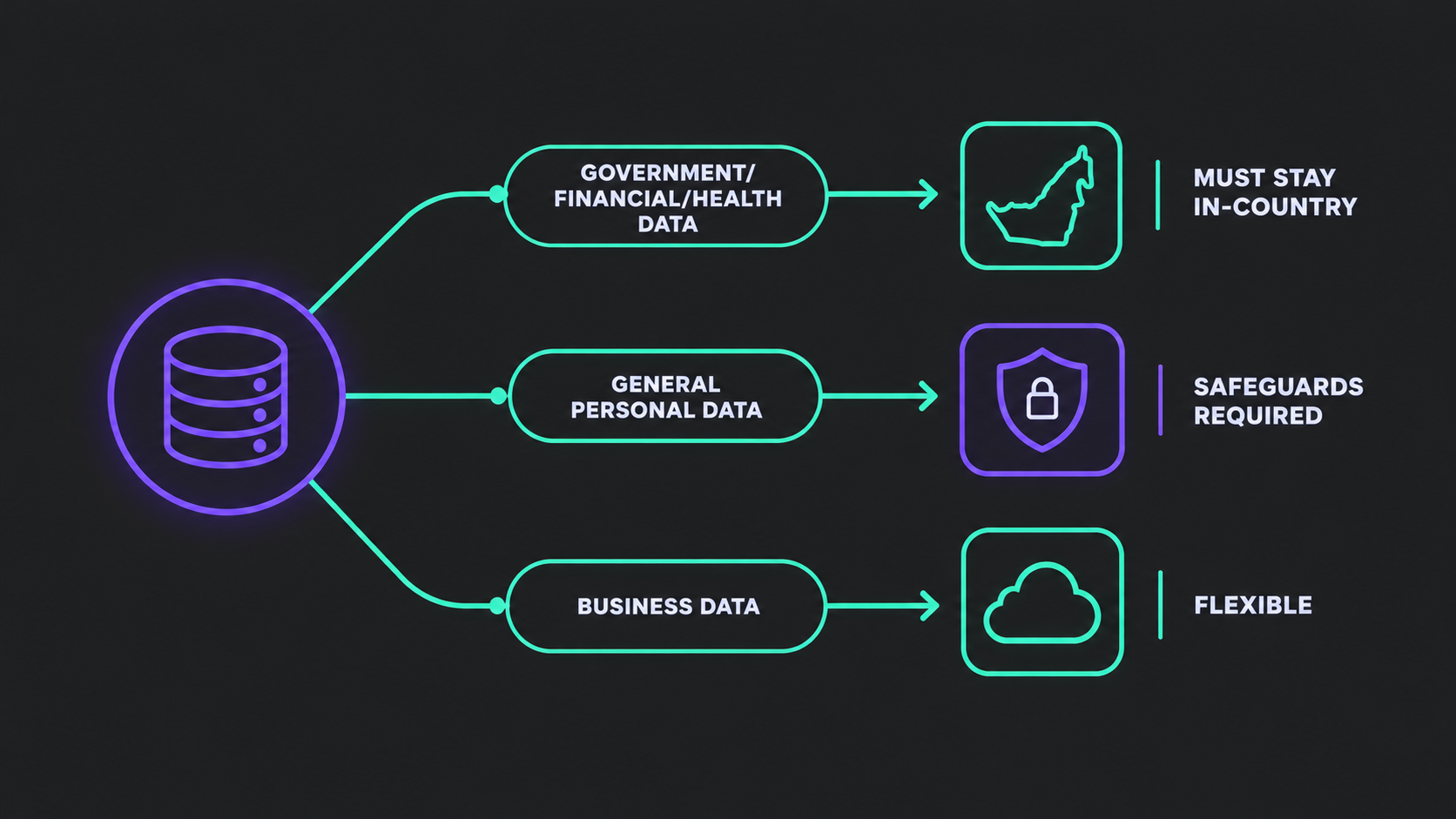
- Government data classified as confidential, and most financial and healthcare data, must stay inside the UAE — general business data has more flexibility, within safeguards set by the Personal Data Protection Law (PDPL).
- The UAE’s data residency rules allow cross-border transfer of personal data to countries with adequate protection, or under a binding contract with PDPL-level safeguards and the data subject’s consent — they don’t ban transfers outright.
- Major cloud providers now operate UAE regions — Microsoft Azure’s Dubai and Abu Dhabi regions have been live since 2019, and AWS launched a Middle East (UAE) region in 2022 — so in-country hosting rarely means sacrificing a modern cloud stack.
- Thefiniteloop’s position: classify your data before you pick a region. Hosting everything in the UAE “to be safe” usually costs more than it needs to, and hosting nothing in the UAE can put regulated data categories at risk.
Hosting location is really a subset of the broader serverless-vs-traditional hosting decision — if you haven’t settled that question yet, start with our guide on choosing between serverless and traditional hosting for a growing SaaS product, then layer the residency requirements below on top of it.
How to decide where to host a UAE-facing software product
Work through these steps before you sign a hosting contract or set a cloud region:
- Classify your data, not your whole product. A single application usually mixes data categories — customer PII, transaction records, logs, marketing data — and only some of them carry a residency requirement.
- Check for sector-specific rules first. Financial institutions, healthcare providers, and government-adjacent entities have their own, stricter hosting rules that override general guidance.
- Confirm your cloud provider has an actual UAE region, not just a UAE presence. A regional sales office is not a data region — ask specifically which region ID your workload would run in.
- Review your PDPL basis for any data that does leave the country. This is a legal and contractual question as much as a technical one — have it checked by counsel if you handle any UAE personal data, not just assumed.
- Map your backup and disaster-recovery locations too. A primary region inside the UAE with a backup region outside it can still breach a strict residency requirement if the regulator in question doesn’t allow it.
- Re-review this annually, not once. UAE data protection and cloud sovereignty guidance has continued to evolve through 2025 and 2026, including new cloud sovereignty rules — a decision that was compliant last year may need a second look.
What actually has to stay in the UAE
| Data / sector | Typical residency requirement | Source of the rule |
|---|---|---|
| Government data classified as confidential | Must not leave UAE territory | UAE government data classification and cloud sovereignty policy |
| Banking and financial customer/transaction data | Generally required to stay in-country | Central Bank of the UAE (CBUAE) consumer protection and cloud rules |
| Electronic health information | Required to be stored locally | Federal Law No. 2 of 2019 (Health ICT Law) |
| General personal data (other sectors) | Can be hosted locally, or transferred abroad with PDPL safeguards | Federal Decree-Law No. 45 of 2021 (PDPL) |
| Non-personal business data | No general residency mandate, beyond ordinary security practice | No specific UAE statute applies by default |
Treat this table as a starting map, not a final legal answer — classification determinations for your specific data, and especially anything regulated, should be confirmed with a UAE data protection lawyer or your sector regulator before you commit to an architecture.
What the PDPL actually says about moving data out of the UAE
The PDPL doesn’t prohibit cross-border data transfer — it conditions it. Under the law, personal data can move to another country if that country is considered to offer an adequate level of protection, or if the transfer happens under a binding contract that imposes PDPL-equivalent safeguards, with the data subject’s explicit consent, or where the transfer is necessary for a contract, a legal claim, judicial cooperation, or the public interest. In practice, most ecommerce and SaaS businesses rely on the contractual-safeguards route plus consent, since a formal published list of “adequate” countries has not been issued.
What a UAE cloud region actually gets you
A UAE region from a major cloud provider keeps your chosen data inside the country without forcing you onto a smaller, UAE-only infrastructure provider. Microsoft’s Dubai and Abu Dhabi regions have been generally available since mid-2019, and AWS opened a Middle East (UAE) region in 2022 — both let you pin storage and compute to that region specifically. That said, the cloud provider’s own compliance pages are consistent on one point: the provider controls where your data sits once you pick a region, but you remain responsible for your own PDPL compliance — a UAE region reduces latency and keeps data in-country, it doesn’t automatically make your application compliant.
Common mistakes UAE software products make on hosting
The most common mistake isn’t picking the wrong region — it’s not checking the backup region. A team sets their primary database to a UAE region, satisfies the obvious requirement, and then leaves default cross-region backups or a logging/analytics pipeline pointed at a US or EU region without reviewing whether that secondary copy also needs to respect residency. Other recurring issues: treating “local data center” and “data residency compliant” as the same thing without checking the provider’s actual certifications (the Dubai Electronic Security Center’s Information Security Regulations are a common benchmark used to evaluate providers), and assuming encryption alone satisfies a residency requirement when the rule is about physical location, not just protection in transit.
Working with a development partner on a compliant architecture
If you’re already choosing a hosting architecture, decide the data residency question at the same stage — not after the infrastructure is live. A development partner can map your data flows, flag which categories need to stay in-country, and design the region and backup topology around that from day one, which is considerably cheaper than migrating a live production database later.
Turn this into a scope
- A data inventory tagging each data category as regulated (government/financial/health) or general
- Written confirmation of which cloud region(s) — including backup and DR regions — each data category runs in
- A documented PDPL basis for any personal data that leaves the UAE
- A check against your specific sector regulator (CBUAE, DoH, or equivalent) if you operate in a regulated industry
- An annual review point, since UAE data sovereignty guidance has kept evolving
Not sure which of your data actually needs to stay in the UAE? Book a consultation with Thefiniteloop and we’ll map your architecture against the current rules before you commit to a region.
Does every UAE business need to host its data inside the country?
No — only specific categories (government-classified, most financial, and most health data) carry a hard in-country requirement; general business and personal data has more flexibility under PDPL safeguards.
Is AWS or Azure’s UAE region enough to make my app PDPL-compliant?
No — a UAE region keeps your data in-country, but compliance also depends on your own access controls, contracts, and data-handling practices, which the cloud provider doesn’t manage for you.
FAQ
What is the UAE’s main data protection law called?
The Personal Data Protection Law (PDPL), Federal Decree-Law No. 45 of 2021, which sets the general rules for how personal data is collected, processed, and transferred.
Can personal data ever legally leave the UAE?
Yes, under the PDPL, if the destination country offers adequate protection, or under a binding contract with PDPL-equivalent safeguards and the data subject’s consent.
Do healthcare apps have stricter hosting rules in the UAE?
Yes — Federal Law No. 2 of 2019 (the Health ICT Law) requires electronic health information to be stored locally, which is stricter than the general PDPL rule.
Do AWS and Microsoft Azure have data centers in the UAE?
Yes. Microsoft Azure’s Dubai and Abu Dhabi regions have been generally available since 2019, and AWS launched a Middle East (UAE) region in 2022.
Is encryption enough to satisfy a UAE data residency requirement?
No — residency requirements are generally about the physical location of the data, not just its protection, so encrypting data that’s hosted outside a required jurisdiction doesn’t satisfy the rule on its own.
Who should I ask to confirm my specific residency obligations?
A UAE data protection lawyer for general PDPL questions, and your sector regulator directly — the Central Bank of the UAE for financial services, or the relevant health authority for healthcare — for sector-specific rules.
Related guides
- Serverless vs Traditional Hosting: 7 Proven Factors for a Growing SaaS Product
- Can a SOC platform be built without an in-house security team?
- How long does a cybersecurity audit take?
Ready to map your architecture against the UAE’s data residency rules before you pick a hosting region? Book a consultation with Thefiniteloop.
Your project next
Let’s build what matters
Schedule a consultation to discuss your goals and technical needs.